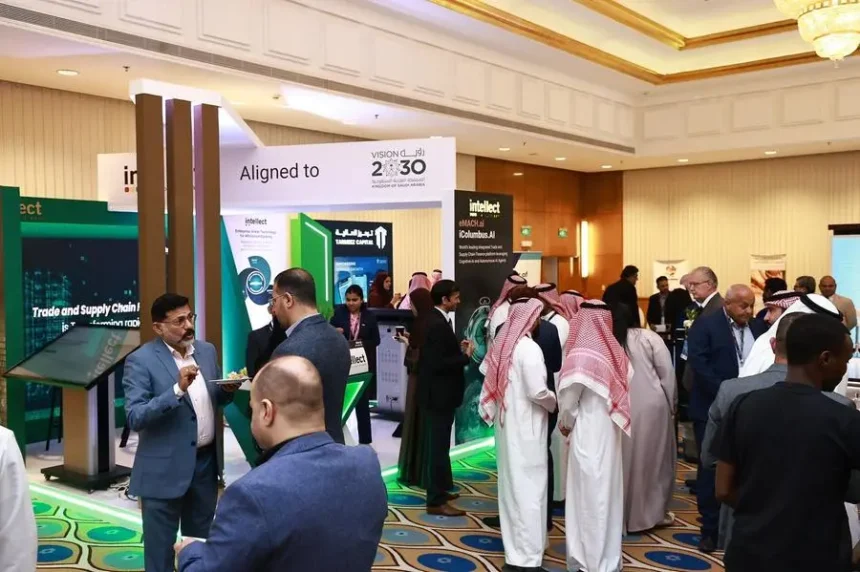
The 13th Annual Saudi Trade Finance Summit in Riyadh has brought global trade-finance stakeholders together for a focused two-day agenda on how Saudi Arabia can ascend as a global trade-finance and supply-chain hub. The summit underscores the kingdom’s ambition to convert policy reform and infrastructure investment into strategic financial leadership.
Summit convenes trade-finance ecosystem in Riyadh
The summit opened in Riyadh with more than 400 senior decision makers from banks, export agencies, corporates and fintech firms attending. The theme this year centred on digitalisation, sustainable trade finance, SME inclusion and cross-border supply-chain risk. Saudi organisers positioned the event as a flagship platform in line with the country’s broader diversification strategy.
Sessions addressed how trade-finance instruments—such as supply-chain finance, export credit, digital onboarding and blockchain‐enabled workflows—fit into Saudi Arabia’s economic goals. For participants it offered networking across GCC, Asia and Europe, reflecting the kingdom’s aspiration to sit at the crossroads of major trade flows.
Saudi Arabia’s strategic logic for trade-finance leadership
Saudi Arabia’s incentive for elevating its trade-finance ecosystem is rooted in multiple structural priorities. First it aims to reduce oil-dependence by expanding non-oil trade, manufacturing and supply-chain services. Robust trade-finance infrastructure supports exporters and importers in this shift.
Second, the kingdom is building out logistics corridors, ports, warehousing and digital platforms that can handle global flows—from Asia to Europe and Africa. By offering sophisticated trade-finance tools and institutional frameworks, Saudi Arabia hopes to attract global firms’ regional operations and anchor supply-chain finance activity.
Third, aligning trade-finance growth with its national vision gives it a competitive edge: access, regulatory clarity, evolving legal frameworks and a pro-investor posture signal that the kingdom is open for business at financial‐services depth.
Key development areas: digitalisation, SME access and sustainability
One major focus discussed at the summit was digital transformation of trade finance. Topics included blockchain applications for letters of credit, automated credit scoring for SMEs, and digital platforms that integrate logistics, financing and payments.
Another key area was SME access to trade finance. Saudi Arabia is seeking to bridge the finance gap for smaller exporters and traders by offering tools that reduce cost, time and paperwork. Attendees noted that regional SMEs often struggle with global trade due to lack of credit history or platform integration.
Sustainability in trade finance emerged as a third pillar. The summit emphasised green trade corridors, carbon-aware supply chains and financing tools that reward low-emission logistics. By linking trade-finance frameworks with environmental goals, Saudi Arabia is positioning itself at the intersection of finance, commerce and sustainability.
Challenges and roadblocks on the road to a hub
Notwithstanding the positive direction, several challenges remain for Saudi Arabia’s trade-finance ambitions. One is the relative infancy of regional capital-markets and trade-finance liquidity compared with established hubs like Singapore or London. Building depth in institutional investor participation will take time.
Another challenge is regulatory harmonisation: cross-border trade finance often requires consistency across jurisdictions, currencies, legal frameworks and risk protocols. Saudi Arabia must deepen links and equivalencies with major partner countries to unlock large volume flows.
Operational complexity also presents hurdles. Upgrading legacy systems, training institutions, onboarding global banks and integrating fintech modules will require sustained investment and execution discipline. Until these pieces scale, the new trade-finance hub thesis will remain aspirational rather than fully realised.
What to watch next for hub realisation
Market watchers should keep an eye on several indicators: first, the volume of trade-finance transactions routed through Saudi banks and platforms. A rising share would signal uptake of the kingdom’s value proposition.
Second, development of regional partnerships and currency-clearing arrangements. For instance, if Saudi Arabia deploys platforms that permit direct trade-settlement with Asia, Africa or Europe without dominant dollar-intermediation, that will represent structural change.
Third, innovation deployment metrics: number of SMEs onboarded, number of digital letters of credit issued, volume of sustainability-linked trade-finance deals. These will show whether the summit discourse is translating into measurable flows.
Finally, equity and debt markets supporting trade-finance instruments in Saudi Arabia will be meaningful: growth in export credit agencies, securitisation of trade receivables and participation of international financial institutions.
Takeaways
- The Saudi Trade Finance Summit is a focal point of Riyadh’s push to develop itself as a global trade-finance and supply-chain hub.
- Saudi Arabia is combining infrastructure, regulatory reform and digital tools to capture global trade-finance flows.
- Execution risks remain significant—building scale, legal alignment and global participation will take time.
- The real test will lie in measurable transaction growth, SME inclusion and platform maturity rather than ambitions alone.
FAQs
Q: Why is Saudi Arabia focused on trade finance now?
A: Because diversifying its economy requires boosting non-oil trade, enabling exporters and strengthening logistics and finance linkages. Trade finance is central to global supply chains.
Q: What makes Saudi Arabia competitive in trade finance?
A: Its investment in logistics infrastructure, regulatory reforms, vision to attract global firms and strategic geographic location bridging Asia, Africa and Europe.
Q: Can Saudi Arabia displace established hubs like Singapore or Dubai?
A: Not immediately. It has structural advantages but still needs to build market depth, institutional frameworks and global ecosystem to rival entrenched hubs.
Q: What should companies watch if they want to engage in Saudi trade-finance opportunities?
A: They should monitor digital platform roll-outs, new regulatory frameworks for trade finance, SME programmes, currency-clearing solutions and bilateral trade-finance agreements emerging from Saudi Arabia.