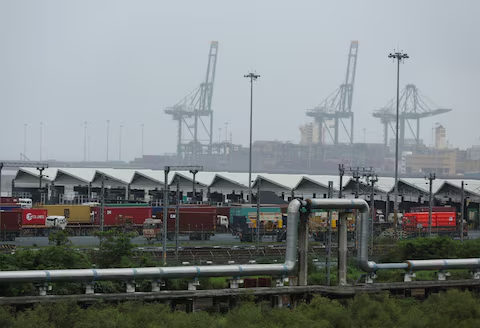
India’s exporters are facing heightened risk as the new US tariffs — reaching up to roughly 50 % on certain Indian goods — threaten export volumes and growth. The main keyword new US tariffs puts pressure on labour-intensive and export-oriented sectors, forcing supply chains to adapt quickly.
Why the US tariff shock matters for India’s growth
The imposition of steep tariffs on Indian exports to the United States has triggered warnings that India’s growth rate could decelerate into 2026. Although India remains one of the world’s fastest-growing major economies, forecasts by multilateral agencies suggest that external demands will pose headwinds. India’s fiscal year growth might still be robust, but the drag from tariffs on items such as textiles, gems & jewellery, leather, and marine products is real. Exporters’ margins are squeezed, and many are rethinking market strategy.
Which sectors are most exposed to the tariff impact
Labour-intensive sectors are at the frontline of this shock. Textiles and apparel, gems & jewellery, leather goods and shrimp/seafood exports are particularly vulnerable because a large portion of their exports traditionally went to the US market and they operate on thin margins. A 50 % tariff essentially raises cost of Indian exports relative to competitors from Vietnam, Bangladesh or Indonesia, which means either reduced volumes or compressed margins. Meanwhile, sectors such as electronics, pharmaceuticals and services, with more diversified markets or higher value-addition, are less immediately exposed.
How supply chains and exporters are adapting to the new tariff reality
Exporters are responding in several ways. First, redirecting exports to alternate geographies such as Southeast Asia, Middle East, Africa and Latin America in order to reduce dependence on the US market. Second, shifting product mix towards higher value-added items that are less tariff-sensitive. Third, improving cost competitiveness through localisation of inputs and tighter supply-chain controls. Fourth, entering trade agreements or utilising regional trade-blocks to mitigate tariff impact. However, this adaptation takes time and upfront investment, and the lead-time may expose companies to short-term stress in 2025-26.
Implications for India’s macro outlook and export strategy
While domestic consumption and services-sector growth provide a cushion, the export sector drag cannot be ignored. If export volumes decline or margin erosion persists, it will weigh on manufacturing growth, employment in export hubs and overall trade surplus. For policy makers the message is clear: they must support export-oriented sectors with credit, risk mitigation, logistics and market access interventions. At the same time India will need to accelerate structural changes — supply-chain diversification, input localisation, higher value-addition and export-market expansion — to strengthen resilience. Investors will monitor export growth rates, margin trends in vulnerable sectors and sign of recovery into non-US markets.
Takeaways
- Export shock looming: Steep US tariffs up to 50 % on Indian exports raise immediate risk for labour-intensive sectors and export volumes.
- Sectoral vulnerability: Textile, gems & jewellery, leather and marine exports are most exposed; higher value or service exports less so.
- Supply-chain shift required: Exporters must pivot markets, upgrade products and localise inputs to maintain competitiveness.
- Growth resilience dependent on adaptation: India’s growth may hold, but sustained momentum depends on how quickly export-oriented firms and policy makers adapt to the tariff shock.
FAQs
Q: What is the scale of the US tariff impact on Indian exports?
A: The tariffs affect a large share of exports to the US market, with some goods facing up to 50 % duty, significantly raising cost for Indian exporters and reducing competitiveness against other Asian exporters.
Q: Which sectors are most at risk from these new tariffs?
A: Labour-intensive export sectors such as textiles/apparel, gems & jewellery, leather goods and certain marine products are most at risk due to high dependence on the US market and low margins.
Q: How are exporters adapting to this challenge?
A: They are diversifying into alternate markets outside the US, moving up the value chain, localising input sourcing, improving cost structures and forming new trade alliances to offset tariff disadvantages.
Q: Does this mean India’s overall growth will collapse?
A: No. India’s growth remains supported by strong domestic consumption, services sector strength and infrastructure spending. However, growth might moderate somewhat if the export drag persists and adaptation lags.