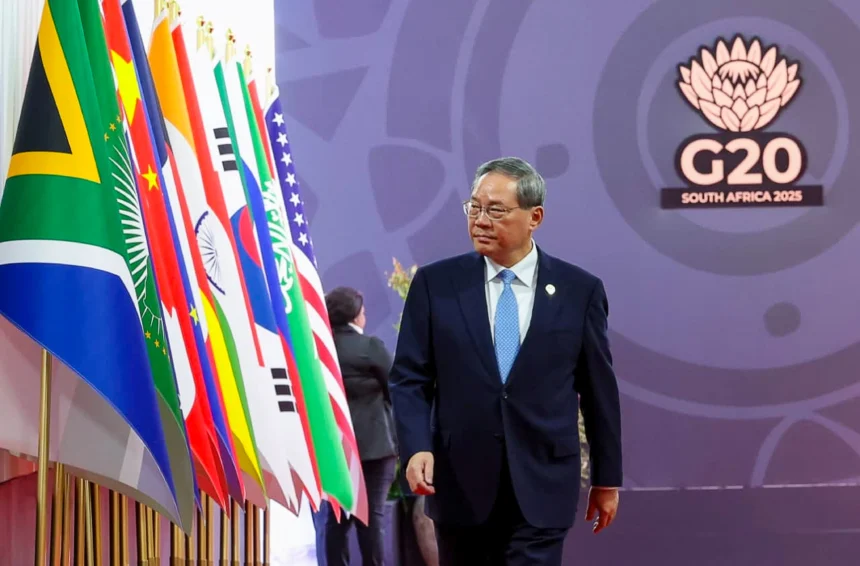
The Post 2025 G20 Johannesburg Summit placed the Global South agenda at the center of global economic debate after both China’s Xi and the United States skipped top level participation, pushing emerging economies to take a more assertive leadership role.
Global South fills leadership vacuum at Johannesburg
The absence of top table representation from the world’s two largest economies reshaped the tone of the summit. With neither Washington nor Beijing leading discussions, emerging economies gained the political space to push priorities long overshadowed by great power competition. African nations, South Asia, Southeast Asia and Latin America used the opportunity to advance agendas on development financing, climate transition support, debt restructuring and inclusive digital growth. The shift made the Johannesburg summit one of the most distinctive G20 meetings in recent years, not for its geopolitical theatrics but for the policy influence of countries that rarely dominate global forums.
For many developing economies, the summit was a rare moment to shape outcomes without the gravitational pull of US China rivalry. Delegations emphasised that global governance cannot rely solely on the strategic interests of the two largest powers, especially when global supply chains, climate exposure and financial stability increasingly depend on multi regional cooperation.
Why the Global South agenda surged this year
Several structural factors explain why the Global South agenda resonated so strongly. First, rising debt vulnerabilities across developing economies have created urgent demands for new financing models, expanded multilateral lending and cheaper infrastructure capital. Second, climate transition pressure is intensifying. Many developing nations face severe climate risk but lack the funds, technology or market access to transition effectively. Third, supply chain realignment continues to shift the balance of global manufacturing, bringing new opportunities for African and South Asian economies.
In Johannesburg, leaders pressed for accelerated reforms within multilateral banks, calling for simplified lending rules, faster disbursements and greater representation for emerging markets. They also urged more predictable climate financing that moves beyond pledges and toward enforceable commitments. By placing these issues front and center, the Global South signalled that structural inequities in the global system can no longer be sidelined.
Impact of US and China absence on summit dynamics
The absence of top level leadership from both the US and China changed the energy of the summit floor. While both countries sent delegation level representation, their non participation at the highest level reduced direct geopolitical friction. This allowed discussions to proceed with fewer confrontational moments and more policy oriented exchanges.
However, it also left gaps. Without the US pushing financial commitments or China advancing Belt and Road aligned proposals, several negotiations stalled. Some proposals lacked the diplomatic weight typically needed to produce binding commitments. At the same time, the absence highlighted the need for stronger structural independence for the G20, ensuring that its relevance does not depend solely on whether major powers attend at the highest level.
Africa’s presidency and regional priorities
South Africa’s G20 presidency brought strong regional focus to African development challenges. African nations emphasised the need for large scale investment in energy, health, logistics and digital infrastructure. Calls for expanding Africa’s role in global decision making grew louder, especially after the African Union’s permanent membership secured last year. The summit also showcased Africa’s ambition to reposition itself as an investment destination rather than a donor dependent region.
The agenda stressed youth employment, industrialisation and regional value chain development. Several African representatives pushed for a global mechanism to stabilise commodity exposed economies during periods of price volatility. By anchoring the agenda to concrete regional priorities, the African bloc used the summit to increase its negotiating influence.
How emerging markets aligned on key issues
Emerging economies found common ground across several fronts. India, Brazil, Indonesia, South Africa and Saudi Arabia cooperated on proposals for sustainable financing, digital inclusion and trade diversification. Their alignment demonstrated that multi regional coalitions within the G20 can shape outcomes even when major powers step back.
Digital public infrastructure, cross border payment frameworks and climate resilience financing became areas where the Global South showcased leadership. Many countries also advocated for supply chain partnerships that distribute manufacturing more evenly across regions, reducing vulnerability to single country dependencies.
What the summit means for global governance
The Johannesburg summit underscored that global governance is entering a new phase where emerging economies are increasingly unwilling to be peripheral participants. The narrative is shifting toward multipolar economic cooperation, with countries seeking more balanced representation and practical reforms.
At the same time, the absence of major power leaders reflects growing fragmentation in global diplomacy. The challenge ahead will be ensuring that the G20 remains credible and actionable despite diverging priorities among its members. For now, the clear outcome is that the Global South has demonstrated its capacity to shape global dialogue when given space and collective alignment.
Takeaways
The Global South dominated the G20 narrative after US and Chinese leaders skipped top table participation.
Emerging markets pushed hard for reforms in development financing, climate support and supply chain diversification.
Africa leveraged its presidency to elevate regional priorities and governance representation.
The summit highlighted a shift toward multipolar cooperation amid great power absenteeism.
FAQs
Why did the Global South agenda gain prominence this year?
Because the absence of top level US and Chinese participation opened policy space for emerging economies and amplified shared priorities around financing, climate and development.
Did the absence of major powers weaken the summit?
It reduced geopolitical friction but also limited binding commitments. However, it strengthened collective action among emerging economies.
Which issues saw the strongest alignment among Global South nations?
Development financing reform, climate transition support, digital infrastructure and supply chain diversification.
How does this shift affect future G20 meetings?
It signals rising influence of emerging economies and highlights the need for G20 structures that are not overly dependent on participation of major power leaders.