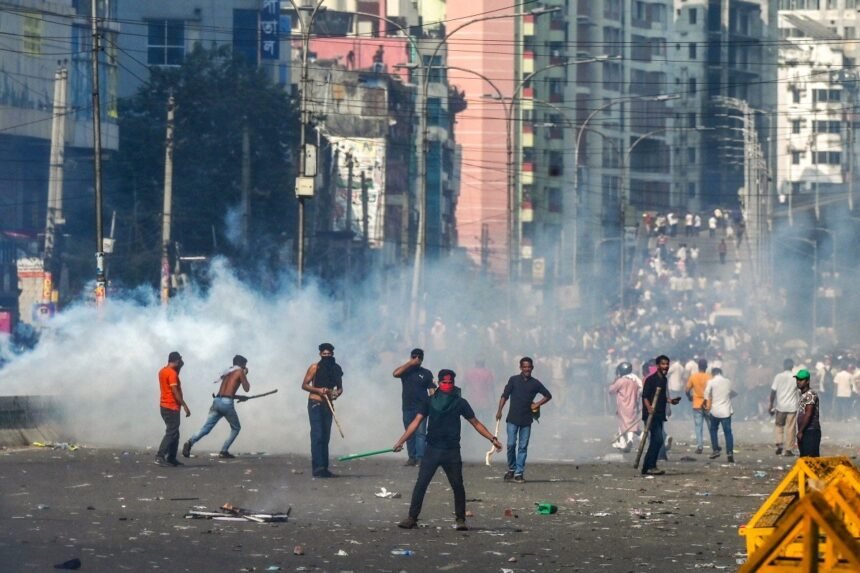
Bangladesh unrest ripple effects on regional supply chains and investor sentiment are becoming increasingly visible as political instability disrupts manufacturing output, logistics flows, and cross border trade confidence. The situation is now influencing sourcing strategies, currency stability, and near term investment decisions across South Asia.
This topic is time sensitive. It reflects ongoing political and economic developments. The tone below follows a news reporting style with regional market analysis.
Bangladesh unrest ripple effects are no longer confined within national borders. As protests, shutdowns, and security concerns persist, their impact is spreading across interconnected supply chains that serve global apparel brands, regional manufacturers, and logistics networks. Investors and corporate buyers are reassessing exposure as uncertainty replaces predictability.
Supply Chain Disruptions Hit Manufacturing and Exports
Bangladesh plays a critical role in regional and global supply chains, particularly in textiles and apparel manufacturing. Political unrest has disrupted factory operations, workforce availability, and inland transportation, leading to delayed shipments and production slowdowns.
Export oriented manufacturers face challenges meeting delivery schedules as port congestion and intermittent transport shutdowns affect cargo movement. Even short disruptions have cascading effects because global buyers operate on tight inventory cycles. Missed timelines increase penalty risks and erode supplier reliability scores.
Neighboring countries integrated into the same sourcing networks are also affected. Yarn suppliers, accessory manufacturers, and logistics providers across South Asia feel the strain as demand fluctuates unpredictably. This interconnectedness explains why unrest in one country can quickly influence regional trade flows.
Apparel and Retail Buyers Reassess Sourcing Risk
Global apparel brands are closely monitoring developments in Bangladesh due to its status as a major production hub. While buyers are not exiting en masse, many are activating contingency plans.
Short term responses include shifting incremental orders to alternative suppliers in India, Vietnam, and other Southeast Asian markets. These adjustments increase costs but reduce delivery risk. Long term contracts are being reviewed with greater emphasis on political stability and operational resilience.
This recalibration does not imply an immediate loss of Bangladesh’s manufacturing relevance. However, it highlights how quickly sourcing decisions can change when stability is questioned. The unrest has reinforced the importance of diversification rather than over concentration.
Logistics and Trade Routes Face Volatility
Beyond factories, logistics networks are under pressure. Road and rail disruptions affect inland cargo movement, while ports face periodic slowdowns due to labor and security constraints.
Freight forwarders report schedule uncertainty and higher insurance costs. Shipping lines factor in additional buffers, increasing transit times. These frictions raise landed costs for exporters and importers alike.
Regional trade corridors feel secondary effects. Cross border trucking, feeder vessel schedules, and transshipment timelines are adjusted to accommodate delays. For time sensitive goods, reliability matters as much as cost, and unrest undermines both.
Investor Sentiment Turns Cautious
Investor sentiment toward Bangladesh and the broader region has softened as unrest persists. Equity markets typically react quickly to political instability, and risk premiums rise when visibility declines.
Foreign investors are reassessing near term exposure, particularly in sectors sensitive to exports and domestic consumption. Currency volatility adds another layer of concern, as capital outflows and reduced export earnings pressure exchange rates.
While long term fundamentals remain intact, short term uncertainty affects valuation multiples and investment flows. Investors prioritize stability, policy continuity, and enforceability of contracts when allocating capital. Unrest weakens confidence on all three fronts.
Spillover Effects on Regional Economies
The ripple effects extend to neighboring economies. Countries that compete with Bangladesh for manufacturing orders may see short term gains, but capacity constraints limit how much demand can be absorbed quickly.
At the same time, regional suppliers dependent on Bangladesh’s production ecosystem face revenue volatility. This includes raw material producers, logistics firms, and service providers.
Financial markets across South Asia track these developments closely. Regional risk perception often moves together, even when fundamentals differ. As a result, unrest in one economy can influence broader investor sentiment across emerging markets.
Policy and Business Responses Take Shape
Governments and businesses are responding cautiously. Trade bodies are engaging with stakeholders to maintain export continuity. Companies are strengthening communication with buyers to manage expectations and protect relationships.
Multinationals are accelerating supply chain risk assessments. This includes mapping dependencies, evaluating alternate routes, and building inventory buffers where feasible. These adjustments increase costs but enhance resilience.
Policy responses will be critical. Clear communication, restoration of stability, and protection of economic activity can help limit long term damage. Markets respond not only to events but to how quickly and credibly they are addressed.
What to Watch Going Forward
The duration and intensity of unrest will determine its economic impact. Short disruptions may result in temporary adjustments, while prolonged instability could accelerate structural shifts in sourcing and investment.
Investors will watch signals around governance, security, and economic management. Supply chain managers will track production normalization and logistics reliability. Currency movements and export data will offer early indicators of stress or recovery.
For the region, the episode reinforces a broader lesson. Stability is a competitive advantage in global trade.
Takeaways
- Political unrest in Bangladesh is disrupting manufacturing and export supply chains
- Global buyers are reassessing sourcing risk and activating contingency plans
- Investor sentiment has turned cautious due to uncertainty and currency pressure
- Ripple effects are influencing regional trade and market perception
FAQs
Which sectors are most affected by the unrest?
Textiles, apparel manufacturing, logistics, and export dependent industries face the greatest impact.
Are global buyers leaving Bangladesh permanently?
No. Most are diversifying risk rather than exiting, but future order allocation may change.
How does unrest affect investor confidence?
Political instability raises risk premiums, pressures currencies, and delays investment decisions.
Can regional competitors absorb diverted demand quickly?
Only partially. Capacity, labor, and infrastructure constraints limit rapid substitution.