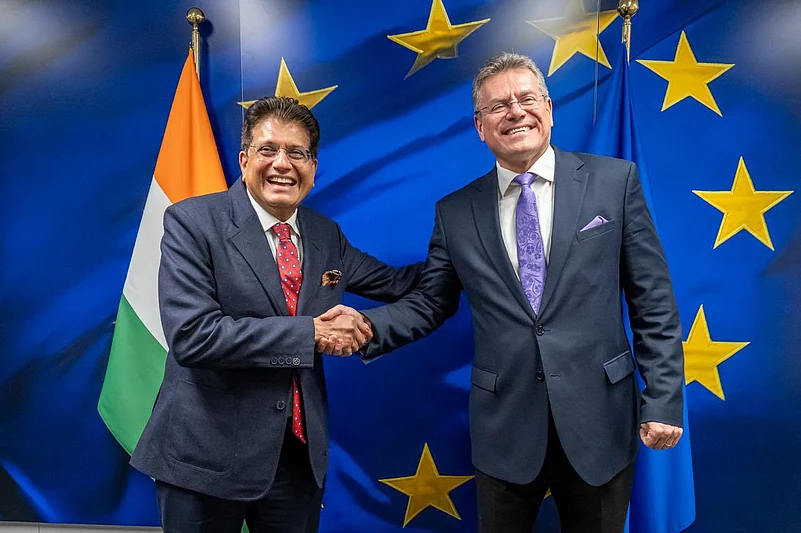
India EU trade deal discussions have reached a decisive stage after the Indian trade secretary said negotiations are close to conclusion, setting the stage for final political alignment ahead of an upcoming bilateral summit. Markets, exporters, and policymakers are now watching tariff outcomes, market access terms, and timing signals closely.
The statement has shifted the conversation from whether a deal will happen to what shape it will take and when it will be announced. With years of negotiations behind it, the agreement is now being framed as a strategic economic and geopolitical move rather than a routine trade pact.
Why the India EU trade deal is suddenly moving fast
The India EU trade deal has been under negotiation for years, marked by repeated pauses over tariffs, standards, and regulatory alignment. The recent assertion that talks are close signals that major political trade-offs have likely been agreed in principle.
Several factors are driving this momentum. Global supply chains are being restructured, Europe is actively diversifying away from overdependence on China, and India is positioning itself as a reliable manufacturing and services partner. Both sides see strategic value in locking in predictable trade rules at a time of global uncertainty.
From India’s side, concluding the deal now strengthens its credibility as a serious trade negotiator after recent agreements with other major economies. For the EU, it secures access to one of the world’s fastest-growing large markets.
Tariff future and the hard compromises involved
Tariffs remain one of the most sensitive elements of the India EU trade deal. European negotiators have consistently pushed for lower duties on automobiles, wines, spirits, and high-end consumer goods. India, historically cautious on tariff reductions in these categories, has focused on protecting domestic manufacturing and revenue stability.
What appears to be emerging is a phased tariff reduction framework rather than immediate cuts. This allows India to signal openness while managing domestic political and industry concerns. In return, Indian exporters are seeking greater certainty and lower barriers for textiles, pharmaceuticals, chemicals, and engineering goods.
The tariff future under this deal is less about headline cuts and more about predictability. Businesses on both sides value stable tariff schedules over sudden policy shifts.
Market access priorities on both sides
Market access is the economic core of the agreement. Indian IT and professional services firms are looking for smoother entry into EU markets, including recognition of qualifications and clearer rules on short-term mobility. These issues have become more important as services exports form a growing share of India’s trade profile.
The EU, meanwhile, is focused on regulatory transparency and level playing field provisions. This includes rules on state support, public procurement access, and intellectual property protection. For European companies, access is not just about tariffs but about confidence in operating conditions.
If finalised, the agreement could materially change how Indian and European firms plan long-term investments, especially in manufacturing, digital services, and clean technology.
Political timing ahead of the summit matters
The timing of the statement that the deal is close is not accidental. With a high-level summit approaching, both sides are under pressure to show tangible progress. Trade agreements often need political endorsement at the highest level to clear final hurdles.
For India, announcing momentum before the summit reinforces its image as a proactive economic partner. For the EU, it demonstrates engagement with emerging markets at a time when internal economic growth is under strain.
Political timing also helps manage domestic narratives. Leaders can frame the deal as a strategic win rather than a concession-driven compromise, which is crucial for public acceptance.
What businesses and markets are reading into this
Markets are interpreting the India EU trade deal developments as medium-term positive rather than an immediate catalyst. Export-oriented sectors such as pharmaceuticals, textiles, and auto components are expected to track headlines closely, while logistics and port operators are watching for volume implications.
Businesses are cautious but preparing scenarios. Many exporters are already evaluating compliance requirements and certification standards that could come into play once the deal is signed. Importers are assessing how tariff changes might affect pricing and sourcing strategies.
The key signal for markets will be clarity on implementation timelines. A deal that is close but delayed loses momentum. One that moves swiftly into ratification gains credibility.
Risks and unresolved pressure points
Despite the optimism, risks remain. Environmental and labour standards have been sticking points, particularly from the European side. India has traditionally resisted binding commitments that could constrain domestic policy flexibility.
Another challenge is ratification. Even after negotiators agree, the deal must pass political and legal scrutiny within the EU’s complex institutional structure. This can slow timelines and introduce uncertainty.
These factors mean that while the deal is close, execution will matter as much as announcement.
What comes next after the close signal
The next phase is likely to involve final text alignment, legal scrubbing, and coordinated messaging. If political backing is confirmed at the summit, the deal could move rapidly toward formal signing.
For India, the agreement would mark a significant step in its trade strategy shift from protection to partnership. For the EU, it opens deeper engagement with a market that is becoming central to global growth.
Takeaways
- India EU trade deal talks have entered a decisive final phase
- Tariffs and market access are moving toward phased, balanced outcomes
- Political timing ahead of the summit is driving urgency
- Businesses are preparing for medium-term structural changes
FAQs
What does it mean when officials say the trade deal is close?
It usually indicates that major political and economic disagreements have been narrowed and only final technical and approval steps remain.
Which sectors could benefit most from the India EU trade deal?
Indian exporters in pharmaceuticals, textiles, engineering, and services could benefit, while EU firms gain broader access to India’s consumer and industrial markets.
Will tariffs be eliminated immediately?
Most tariff changes are expected to be phased over time rather than removed at once.
Is the deal guaranteed to be signed soon?
While momentum is strong, final political approval and ratification processes still need to be completed.