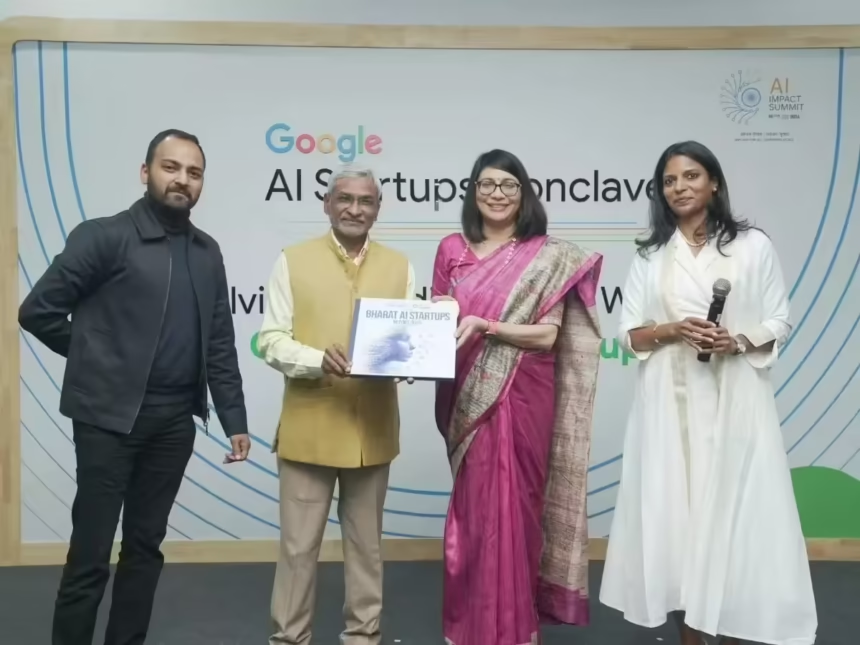
Google launches Market Access Program for Indian AI startups, marking a strategic intervention aimed at helping domestic AI companies reach global customers faster. The initiative is expected to reshape how Indian startups scale internationally by reducing go to market friction and improving enterprise access.
What the Market Access Program is designed to do
Google’s Market Access Program targets a long standing gap in the Indian AI ecosystem. While India produces strong AI talent and competitive products, many startups struggle to convert innovation into global revenue. The new program focuses on commercialisation rather than incubation.
The structure centres on helping selected AI startups integrate with Google’s enterprise ecosystem, cloud marketplace channels, and partner networks. Instead of funding or grants, the emphasis is on distribution, credibility, and customer access. For early and growth stage AI firms, this can significantly shorten sales cycles that typically take years to build independently.
The move signals Google’s recognition that India is no longer just a development hub but a source of deployable AI solutions for global enterprises.
Why Google is betting on Indian AI startups now
Timing is critical to understanding why Google launches the Market Access Program for Indian AI startups at this stage. Global demand for applied AI solutions is accelerating across sectors such as healthcare, finance, retail, cybersecurity, and enterprise automation.
Indian startups are well positioned in applied and cost efficient AI use cases, particularly those built for scale and real world deployment. However, global buyers often hesitate due to concerns around reliability, integration, and long term support. Google’s involvement helps bridge that trust gap.
From Google’s perspective, enabling Indian AI startups also strengthens demand for its cloud infrastructure and enterprise tools. It is a mutually reinforcing strategy rather than a purely philanthropic one.
How the program could change startup go to market strategies
Traditionally, Indian AI startups follow a fragmented expansion path. They first prove traction locally, then attempt overseas entry through small pilots or channel partners. This process is slow, expensive, and uncertain.
The Market Access Program alters this equation. Startups can potentially tap into Google’s existing enterprise relationships, marketplace visibility, and solution partner ecosystem. This shifts focus from cold outbound selling to co selling and platform led discovery.
As a result, startups may prioritise enterprise readiness earlier. This includes compliance, security certifications, product documentation, and integration standards. The ecosystem could see a shift from experimentation driven AI products to enterprise grade solutions built with global buyers in mind.
Implications for the Indian AI ecosystem
The broader Indian AI ecosystem is likely to feel second order effects. Startups selected for the program may gain a visibility and credibility advantage, making fundraising and hiring easier. This could raise the bar for peers and push the ecosystem toward stronger execution discipline.
Venture capital interest may also tilt toward startups with clear enterprise monetisation paths rather than purely technical differentiation. Market access and distribution will increasingly be valued alongside model performance.
At the same time, there is a risk of concentration. If access programs favour a limited set of startups, others may struggle to compete for attention. This could widen gaps within the ecosystem unless similar initiatives emerge from other global platforms.
Competitive dynamics and global positioning
Google launches Market Access Program for Indian AI startups at a time when global competition for AI leadership is intensifying. Cloud providers, enterprise software firms, and governments are all racing to secure AI capabilities.
For Indian startups, alignment with a global platform can be a strategic advantage but also a dependency risk. While Google provides reach, startups will need to ensure they retain product independence and multi platform flexibility.
From a global standpoint, the program positions India as a supplier of AI solutions, not just talent. This strengthens India’s narrative as a builder of enterprise technology rather than a backend services provider.
What founders should prepare for
Participation in such a program comes with expectations. Startups will need to demonstrate product maturity, reliable customer support, and scalability. Enterprise buyers demand uptime guarantees, data protection assurances, and long term roadmaps.
Founders should also prepare for longer sales cycles and complex stakeholder management, even with platform support. Market access does not eliminate the need for strong sales and customer success teams.
Strategically, startups should view the program as an accelerator, not a crutch. The real value lies in learning how global enterprise sales work and building repeatable go to market playbooks.
Longer term impact on policy and talent
Over time, initiatives like this could influence policy and talent flows. As Indian AI startups generate global revenue, pressure will increase for clearer cross border data, taxation, and compliance frameworks.
Talent preferences may also shift toward startups with international exposure rather than purely domestic scale. This could further professionalise the ecosystem and align it with global standards.
The success of Google’s program will likely determine whether similar models are adopted by other global technology firms.
Takeaways
- Google is focusing on market access, not funding, for Indian AI startups
- The program aims to shorten global enterprise sales cycles
- Indian AI startups may shift toward enterprise ready product strategies
- Ecosystem credibility and global positioning could improve
FAQs
What is Google’s Market Access Program for Indian AI startups?
It is an initiative designed to help Indian AI startups reach global customers through Google’s enterprise ecosystem and channels.
Does the program provide funding to startups?
No. The focus is on distribution, partnerships, and customer access rather than direct financial support.
Which startups are most likely to benefit?
AI startups with enterprise ready products, clear use cases, and scalability potential.
Will this change how Indian AI startups build products?
Yes. Greater emphasis is likely on compliance, integration, and enterprise grade deployment.