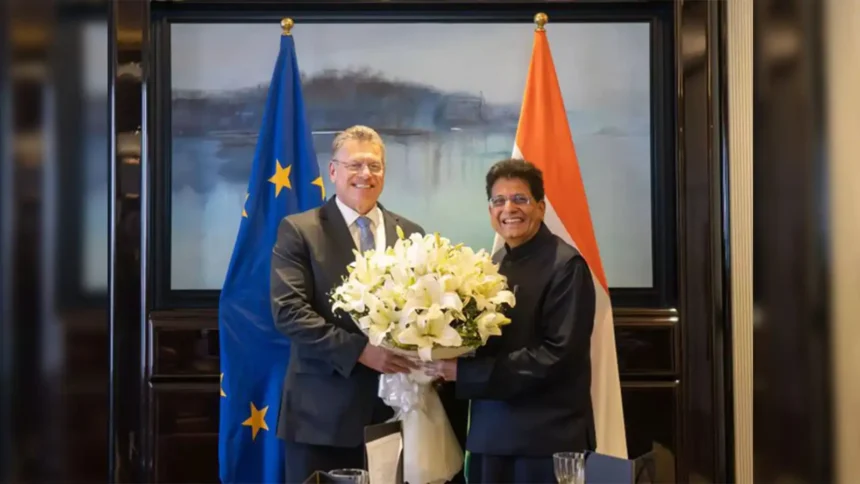
India EU FTA moves toward legal ratification as traders and businesses track potential tariff shifts across key sectors. The development is time sensitive trade and policy news, with markets assessing near-term sector impact rather than long-term diplomatic symbolism.
India EU FTA is entering a decisive phase as both sides move closer to legal ratification after prolonged negotiations. The agreement, once ratified, would reshape tariff structures, market access rules, and compliance frameworks between India and the European Union. Traders are already positioning around sectors expected to see early gains or pressure, reflecting anticipation rather than confirmed outcomes.
Where the India EU FTA stands right now
India EU FTA negotiations have cleared several political and technical hurdles, pushing the agreement toward legal ratification. At this stage, the focus has shifted from headline commitments to legal text finalization, compliance timelines, and sector specific carve-outs.
Ratification does not mean immediate tariff elimination. Instead, it sets a phased roadmap for reductions, quota adjustments, and rule alignment. This nuance matters for markets. Traders are not reacting to a single date but to the sequence of changes that could roll out over multiple years.
The move toward ratification signals intent and reduces uncertainty. For businesses, this is often enough to trigger early investment and sourcing decisions, even before the agreement fully takes effect.
Tariff shifts traders are watching closely
Tariff realignment is the core reason traders are tracking the India EU FTA so closely. Sectors with historically high duties face the biggest repricing risk. These include automobiles, auto components, chemicals, pharmaceuticals, textiles, apparel, and select agricultural goods.
For Indian exporters, lower EU tariffs could improve competitiveness in value added manufacturing and processed goods. For European exporters, reduced Indian tariffs could open pricing room in premium automobiles, machinery, and high-end consumer products.
Traders are focusing on relative winners rather than absolute gains. A marginal tariff cut in a high volume sector can have more impact than deeper cuts in niche categories. This is driving selective positioning rather than broad market moves.
Sector level implications for Indian businesses
From an Indian perspective, the India EU FTA presents both opportunity and adjustment pressure. Export oriented sectors such as pharmaceuticals, specialty chemicals, engineering goods, and textiles stand to gain from improved access and predictable trade rules.
However, domestic producers in sensitive sectors may face increased competition. Automobiles, wines and spirits, dairy, and luxury goods are often flagged as areas where European imports could intensify price competition over time.
This dual impact explains why Indian industry bodies have pushed for phased tariff reductions and safeguard clauses. Ratification suggests these concerns have been addressed to a workable degree, though execution will determine real outcomes.
What European firms stand to gain
European companies view the India EU FTA as a gateway to a large and growing consumer market. Reduced tariffs, clearer investment rules, and improved dispute resolution mechanisms lower entry barriers for EU firms.
Sectors such as green technology, renewable energy equipment, advanced manufacturing, and high-end consumer goods are expected to benefit. European firms are also keen on services access, including finance, logistics, and professional services, where regulatory clarity matters as much as tariffs.
For markets, this means increased competitive pressure on Indian incumbents in select segments, balanced by greater collaboration and joint ventures in others.
Market behavior ahead of formal ratification
Equity and commodity markets rarely wait for formal ratification. Anticipation drives early moves. Stocks linked to export heavy sectors often see speculative interest as trade deals approach legal closure.
However, experienced traders remain cautious. Past trade agreements have shown that implementation timelines and non-tariff barriers can dilute headline benefits. As a result, positioning around the India EU FTA is tactical rather than euphoric.
Currency markets are also watching. Improved trade flows over time could support the rupee, but near-term effects are limited without immediate changes in trade volumes.
Strategic implications beyond tariffs
Beyond tariffs, the India EU FTA carries strategic weight. It signals India’s intent to deepen economic ties with developed markets amid a fragmented global trade environment. For the EU, it diversifies supply chains and reduces overreliance on single geographies.
This strategic layer matters for long-term investors but is secondary for traders focused on near-term price action. Still, ratification strengthens policy credibility, which indirectly supports capital flows and investment sentiment.
In that sense, the agreement is as much about signaling stability as it is about duty reductions.
Takeaways
India EU FTA is moving closer to legal ratification, reducing policy uncertainty
Traders are focusing on tariff shifts in autos, chemicals, pharma, and textiles
Sector impact will be phased, not immediate
Market positioning remains selective rather than broad based
FAQs
Does ratification mean tariffs drop immediately
No, tariff reductions are typically phased over several years.
Which sectors benefit the most
Export oriented manufacturing and chemicals are among the key beneficiaries.
Will Indian consumers see cheaper European goods
Over time, yes, but the impact will be gradual rather than instant.
Is this a major market moving event
It influences sector sentiment but does not trigger across-the-board market moves.