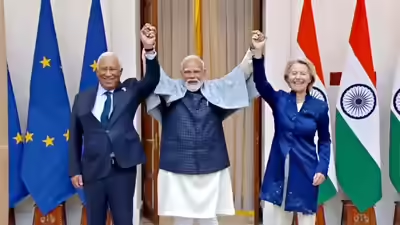
India EU free trade deal, often described as the mother of all deals, has entered a critical phase as attention shifts from negotiation headlines to ratification roadblocks and sector level outcomes. While the agreement promises wide ranging gains for goods and services, implementation risks remain significant.
The India EU free trade deal is time sensitive and news driven. Negotiations have concluded, but the real challenge now lies in ratification across multiple jurisdictions and translating legal text into commercial reality. Markets, exporters, and service providers are watching closely as timelines, political approvals, and sector readiness come into focus.
Why the India EU free trade deal matters now
The India EU free trade deal is one of the most ambitious trade agreements India has pursued, covering goods, services, investment protection, and regulatory cooperation. The European Union is among India’s largest trading partners, while India represents a high growth market for European exporters facing saturation at home.
This deal arrives at a moment when global trade is fragmenting. Supply chains are being restructured, and companies are actively diversifying away from overconcentration. For India, the agreement offers preferential access to a high value market. For the EU, it provides a strategic foothold in a fast growing economy with rising consumption and digital adoption.
However, scale cuts both ways. The broader the deal, the more complex the ratification process becomes.
Ratification roadblocks across Europe and India
Ratification is the first major hurdle. On the EU side, trade agreements of this scale often require approval not just at the EU level but also by national parliaments in member states, especially if the deal includes investment protection or regulatory clauses. Political sensitivities around labor standards, environment norms, and market access for agriculture could slow progress.
In India, domestic industry concerns also shape ratification dynamics. Certain manufacturing segments worry about import competition from European firms with advanced technology and scale. Agriculture and dairy remain politically sensitive sectors, even with safeguards built into the agreement. Any perception of uneven benefits could trigger calls for renegotiation or delays in approval.
These ratification risks mean the deal may not come into force as quickly as headline announcements suggest.
Goods trade winners and pressure points
On the goods side, the India EU free trade deal creates clear winners but also exposes pressure points. Indian exporters in textiles, apparel, leather goods, chemicals, engineering products, and select electronics stand to benefit from tariff reductions and simplified access to European markets.
For European exporters, automobiles, machinery, high end consumer goods, and specialty chemicals gain improved access to India. This raises competitiveness concerns for Indian manufacturers who may face pricing pressure and technology gaps. While phased tariff reductions offer adjustment time, not all firms will adapt at the same pace.
The net outcome depends on how effectively Indian companies upgrade quality, compliance, and scale to meet European standards.
Services sector implications are more nuanced
Services form a critical pillar of the India EU free trade deal, but gains here are less straightforward. India seeks greater mobility for professionals, recognition of qualifications, and access for IT and business services. The EU, meanwhile, prioritizes data protection, regulatory alignment, and market access for financial and professional services firms.
Progress in services often depends on implementation rather than treaty language. Visa regimes, local licensing rules, and data regulations can dilute headline commitments. Indian IT and consulting firms could see incremental benefits, but expectations of dramatic market opening may be overstated.
For startups and digital firms, regulatory convergence could improve predictability but also raise compliance costs.
Investment flows and supply chain realignment
One of the longer term impacts of the India EU free trade deal lies in investment flows. European companies looking to de risk supply chains may increase manufacturing and sourcing from India, particularly in sectors like clean energy equipment, automotive components, and industrial machinery.
This could support India’s manufacturing ambitions if paired with infrastructure readiness and policy stability. However, investment decisions depend on factors beyond trade agreements, including logistics efficiency, contract enforcement, and state level execution. The deal opens the door, but it does not guarantee capital inflows.
Supply chain realignment will likely be gradual, favoring firms that already operate across both regions.
What businesses should prepare for now
For businesses, the focus should shift from deal optimism to operational readiness. Exporters need to assess compliance requirements, rules of origin, and certification standards well before implementation. Services firms should evaluate regulatory exposure and data obligations under the agreement.
Companies that prepare early can capture first mover advantage once the deal comes into force. Those that wait for full clarity risk losing competitiveness. The India EU free trade deal rewards preparedness more than size.
The realistic timeline and outlook
Despite political momentum, the India EU free trade deal is unlikely to be operational immediately. Ratification could stretch over multiple quarters, if not longer. Sector specific provisions may be phased in, with varying timelines for goods and services.
The deal’s success will ultimately be judged not by its length or ambition, but by trade flows, investment decisions, and firm level outcomes over the next decade. It is a strategic agreement with long term potential, but near term friction should be expected.
Takeaways
- India EU free trade deal faces complex ratification hurdles
- Goods exporters see clearer gains than services firms
- Investment impact will depend on execution, not treaty text
- Businesses must prepare early to capture benefits
FAQs
Why is the India EU free trade deal called the mother of all deals?
Because of its scale, covering goods, services, investment, and regulatory cooperation.
What is the biggest risk to implementation?
Delayed ratification across EU member states and domestic political resistance.
Which sectors benefit the most initially?
Textiles, engineering goods, chemicals, and select manufacturing exporters.
Will services firms see immediate gains?
Services benefits are likely to be gradual and depend heavily on implementation.