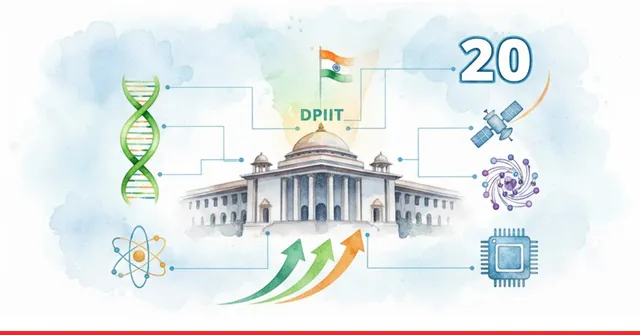
India startups reshaped as the government doubles the deep tech startup recognition period to 20 years, a move that could significantly impact tax benefits, regulatory flexibility, and venture capital interest across high innovation sectors.
The policy change is time sensitive and reflects India’s push to strengthen its deep technology ecosystem. By extending recognition beyond the earlier 10 year window, authorities are signaling long term support for research intensive startups that require longer gestation cycles.
What The 20 Year Deep Tech Recognition Means
Under India’s startup framework, recognized startups are eligible for a range of incentives including tax benefits, easier compliance norms, and access to government schemes. Traditionally, this recognition was limited to entities incorporated within a specified number of years.
By extending deep tech startup recognition to 20 years, the government acknowledges that sectors such as artificial intelligence, semiconductor design, space technology, biotechnology, robotics, and advanced materials often require extended development timelines.
Unlike consumer internet startups, deep tech ventures may spend years in research and prototyping before generating commercial revenue. The longer recognition window provides operational breathing room and policy continuity.
Impact On Tax Benefits And Compliance
Startup recognition in India is linked to several tax provisions, including eligibility for profit linked deductions under specific sections of the Income Tax Act, subject to conditions. It also influences exemptions related to angel tax provisions and capital gains reinvestment in eligible startups.
With the deep tech recognition period extended to 20 years, qualifying companies can potentially access tax benefits and compliance relaxations for a longer duration, provided they meet turnover and innovation criteria set by authorities.
This can improve capital efficiency. Reduced compliance burdens and clarity around tax treatment lower friction for founders and early stage investors. However, eligibility will still depend on adherence to defined turnover thresholds and innovation benchmarks.
Boost To Venture Capital And Long Term Funding
The extension is likely to influence venture capital interest in India’s deep tech space. VC funds often evaluate regulatory risk and policy stability before allocating capital to research heavy sectors.
Longer recognition reduces uncertainty around compliance and tax exposure during the scale up phase. This is particularly relevant for sectors like climate tech, defense technology, and advanced manufacturing where commercialization timelines can exceed a decade.
Foreign investors looking at India as a technology manufacturing hub may view this as a positive signal. Policy alignment with long term innovation cycles enhances the attractiveness of capital intensive ventures that previously faced structural disadvantages.
Alignment With India’s Innovation Strategy
India has been positioning itself as a global innovation and manufacturing hub through initiatives aimed at electronics manufacturing, semiconductor production, digital public infrastructure, and space commercialization.
Deep tech startups play a strategic role in these ambitions. By extending recognition to 20 years, the government is aligning regulatory frameworks with national priorities in technology self reliance and intellectual property creation.
Research driven enterprises often collaborate with academic institutions, government laboratories, and public sector undertakings. The extended window provides continuity in such partnerships and improves eligibility for grants and public procurement opportunities.
Sector Specific Implications For AI And Space Startups
Artificial intelligence startups developing core models, chip design firms, and space technology companies often face long regulatory and certification cycles. Revenue realization can be delayed due to testing, compliance approvals, and infrastructure development.
A 20 year recognition period allows these startups to mature without losing formal startup status prematurely. This can influence investor confidence, particularly in hardware heavy segments where capital expenditure is significant.
India’s private space ecosystem, which has expanded following regulatory reforms allowing non government participation, could benefit from this continuity. Similarly, biotechnology ventures engaged in clinical research and trials gain extended policy support.
Challenges And Execution Considerations
While the extension is positive, execution clarity remains critical. Authorities must define what qualifies as deep tech, how innovation will be assessed, and what documentation startups must provide to retain recognition.
Overly broad definitions may dilute the intent, while narrow definitions could exclude genuine innovators. Transparent evaluation frameworks and periodic review mechanisms will be important to maintain credibility.
Additionally, tax benefits are subject to regulatory approval and compliance checks. Startups must maintain proper documentation, governance standards, and reporting discipline to fully leverage extended recognition.
Broader Economic Implications
The move signals a shift from short cycle digital entrepreneurship toward long horizon technology building. Deep tech innovation has multiplier effects across manufacturing, defense, healthcare, and clean energy sectors.
By supporting longer development timelines, India aims to create intellectual property within its borders and reduce reliance on imported core technologies. This could strengthen export competitiveness and improve the country’s position in global value chains.
The reshaping of India startups through extended recognition is therefore not just administrative. It reflects a strategic recalibration toward sustainable and research driven growth.
Takeaways
Deep tech startup recognition in India has been extended to 20 years
Longer recognition supports tax benefits and compliance flexibility
Venture capital interest may increase in research intensive sectors
Policy aligns with India’s broader innovation and manufacturing strategy
FAQs
What qualifies as a deep tech startup in India?
Deep tech startups typically focus on advanced scientific or engineering innovation such as AI, semiconductors, biotechnology, robotics, or space technology.
How does extended recognition affect tax benefits?
Recognized startups may access certain tax incentives and compliance relaxations for a longer period, subject to meeting eligibility conditions.
Will this automatically increase funding for startups?
It does not guarantee funding, but improved policy stability and tax clarity can enhance investor confidence in long term projects.
Does the 20 year period apply to all startups?
No. The extended window is specifically designed for deep tech startups that meet defined innovation and regulatory criteria.