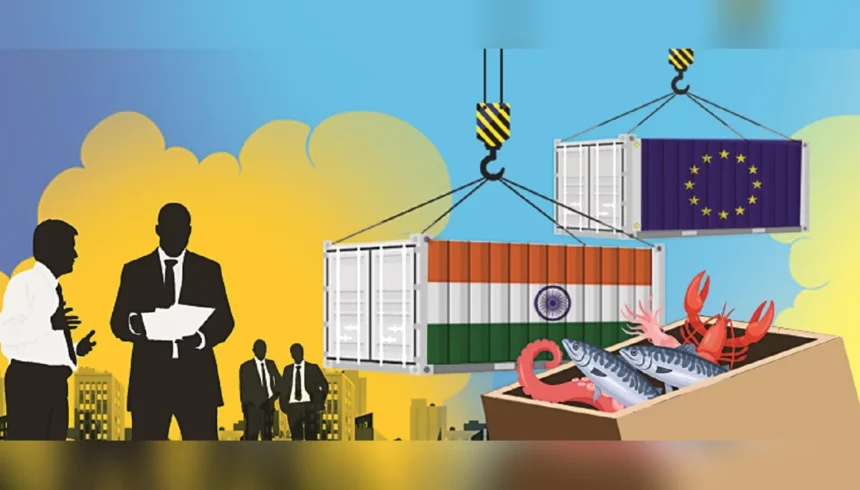
India EU trade deal negotiations have entered a decisive stage as parliamentary ratification hurdles loom on both sides, with policymakers calling it the mother of all deals. Pending approvals could significantly influence bilateral trade flows and cross border investment patterns.
The development is time sensitive and policy driven. After years of negotiations, legal text finalization and political sign offs now determine whether the agreement transitions from negotiation to implementation. Markets and multinational companies are closely watching the ratification timeline.
Scope Of The India EU Trade Deal
The India EU trade deal aims to create a comprehensive free trade framework covering goods, services, investment protection, intellectual property, public procurement, and sustainable development commitments. The European Union is one of India’s largest trading partners, and both sides seek to reduce tariff and non tariff barriers.
For India, greater access to European markets could benefit sectors such as pharmaceuticals, textiles, engineering goods, information technology services, and renewable energy components. For the EU, improved access to India’s large consumer market is a major incentive, particularly in automobiles, machinery, luxury goods, and financial services.
However, the breadth of the agreement also means more scrutiny during ratification. National parliaments, legal committees, and sectoral stakeholders examine clauses before formal approval.
Parliament Ratification And Political Scrutiny
Trade agreements of this scale require ratification through established legislative procedures. In the EU, depending on the structure of the agreement, approval may involve the European Parliament and potentially individual member states. In India, parliamentary oversight and domestic legal alignment are critical steps.
Sensitive sectors such as agriculture, dairy, data protection, and environmental standards often generate debate. Lawmakers assess whether tariff concessions or regulatory alignments could impact domestic producers.
Political shifts can also influence timelines. Trade deals negotiated by one administration may face renewed debate under changing political conditions. This is why ratification, rather than negotiation, is often the most uncertain phase.
Investment Flows At Stake
Pending approvals could directly shift investment flows between India and the EU. A ratified trade agreement typically enhances investor confidence by offering clearer dispute resolution mechanisms and predictable tariff regimes.
European companies evaluating manufacturing or service expansion in India may accelerate plans if legal certainty improves. Similarly, Indian firms seeking acquisitions or market expansion in Europe gain from reduced trade barriers and harmonized standards.
Foreign direct investment decisions are often linked to trade policy stability. A clear timeline for ratification can unlock project pipelines in infrastructure, renewable energy, digital services, and advanced manufacturing.
Tariffs, Market Access And Regulatory Alignment
One of the central components of the India EU trade deal is tariff reduction. Indian exporters expect improved access in labor intensive sectors, while European negotiators seek lower duties on automobiles, wines, spirits, and industrial goods.
Regulatory alignment is equally significant. Standards related to product certification, sustainability reporting, and data governance can shape compliance costs. Businesses are assessing how harmonization clauses might alter operating models.
Intellectual property rights and digital trade rules are also under scrutiny. As cross border data flows and technology services expand, both sides aim to balance innovation protection with domestic regulatory frameworks.
Strategic And Geopolitical Context
Beyond economics, the agreement carries strategic implications. Both India and the EU have been seeking to diversify trade partnerships amid shifting global supply chains and geopolitical uncertainty.
Strengthening bilateral trade ties can reduce overdependence on any single region. For India, closer integration with European markets complements its manufacturing and export diversification strategy. For the EU, deeper engagement with India supports Indo Pacific economic objectives.
This broader context increases the political importance of ratification. The deal is viewed not only as a trade instrument but also as a strategic partnership framework.
Business Community Response
Industry associations on both sides have largely supported the trade agreement in principle, citing potential export growth and investment facilitation. However, sector specific concerns remain.
Small and medium enterprises often seek transitional safeguards to adjust to increased competition. Environmental and labor compliance standards are also closely examined to ensure they align with domestic regulatory expectations.
Financial markets tend to respond positively to clarity. Even incremental progress toward ratification can influence currency stability, equity sentiment, and sectoral valuations linked to export oriented businesses.
What Happens Next
The immediate focus is on legislative procedures and legal text finalization. Any delay in parliamentary approval could defer implementation timelines and prolong uncertainty for investors.
If ratified smoothly, the agreement could enter into force in phases, with tariff reductions and regulatory adjustments rolled out over scheduled periods. Businesses would then recalibrate supply chains and pricing strategies accordingly.
The India EU trade deal stands at a critical juncture. Parliamentary ratification will determine whether years of negotiation translate into a structural shift in trade and investment flows between two major economic blocs.
Takeaways
India EU trade deal is entering a crucial parliamentary ratification phase
Pending approvals could reshape bilateral trade and investment flows
Tariff reductions and regulatory alignment are central to the agreement
Strategic and geopolitical considerations add weight to the deal
FAQs
Why is parliamentary ratification important for trade deals?
Ratification gives legal effect to the agreement and ensures domestic laws align with negotiated commitments.
How could the deal affect Indian exporters?
Lower tariffs and improved market access in the EU could benefit sectors such as pharmaceuticals, textiles, and IT services.
What are the main concerns delaying approval?
Sensitive sectors, regulatory standards, and political scrutiny often extend the ratification timeline.
Will investment increase immediately after approval?
Investment decisions may accelerate once legal certainty improves, though actual capital deployment depends on sector specific conditions.