China has tightened rare earth export controls, raising concerns over supply chain disruption for global electric vehicle manufacturers. The move intensifies scrutiny on critical mineral dependency and could affect battery production, pricing, and long term EV expansion plans.
China’s rare earth export controls have tightened, creating fresh uncertainty across the global EV supply chain. As the dominant producer and processor of several critical minerals, China plays a central role in supplying rare earth elements used in electric vehicle motors, battery systems, and high performance electronics. The new restrictions are prompting governments and automakers to reassess sourcing strategies and inventory buffers.
China’s Dominance in Rare Earth Processing
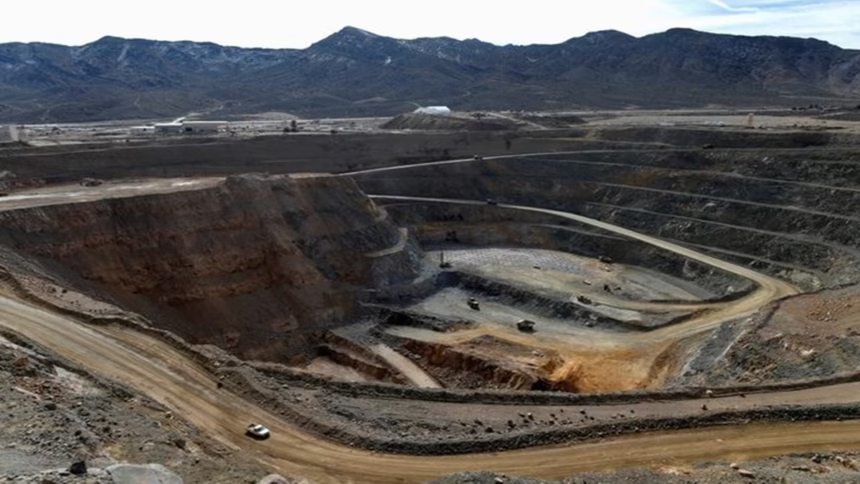
China accounts for a significant share of global rare earth mining and an even larger portion of processing capacity. Rare earth elements such as neodymium, praseodymium, dysprosium, and terbium are essential for permanent magnets used in EV motors. These magnets improve efficiency, reduce size, and enhance performance.
While rare earth deposits exist in countries including Australia, the United States, and parts of Africa, processing infrastructure remains heavily concentrated in China. This structural imbalance means that export controls have immediate global impact. Even when mining occurs elsewhere, refining often routes through Chinese facilities.
The tightening of export requirements introduces additional compliance checks and potential shipment delays. For manufacturers operating on just in time supply chains, timing disruptions can translate into production bottlenecks.
Impact on Global EV Manufacturing
The electric vehicle industry depends on stable access to rare earth magnets for traction motors. Leading automakers across Europe, North America, and Asia rely on integrated supply chains that span multiple countries. When a key input faces restrictions, cost structures and delivery timelines are affected.
Higher raw material costs could emerge if supply tightens and prices rise in response. Battery and motor manufacturers may pass these costs downstream, potentially influencing vehicle pricing. Although major automakers typically maintain diversified supplier networks, rapid shifts in sourcing are complex and capital intensive.
Some EV producers have invested in magnet technologies that reduce heavy rare earth usage. Others are exploring induction motor designs that require fewer rare earth elements. However, large scale transition to alternative technologies takes time and engineering validation.
Geopolitics and Critical Mineral Strategy
The tightening of rare earth export controls fits into a broader geopolitical context where critical minerals have become strategic assets. Governments in the United States, European Union, Japan, and India have identified rare earths as vital to clean energy transition and national security.
In recent years, initiatives have been launched to build domestic refining capacity, secure mining partnerships, and develop recycling capabilities. Strategic stockpiling has also gained attention as a risk mitigation measure.
However, developing a full rare earth supply chain outside China requires significant investment, environmental approvals, and technical expertise. Processing rare earths is chemically intensive and environmentally sensitive, which has historically limited expansion in some regions.
Supply Chain Shock Risks for EV Growth
The global EV market has expanded rapidly, supported by policy incentives, falling battery costs, and consumer adoption. Supply chain shock risks tied to rare earth export controls could slow this momentum if constraints persist.
Short term volatility in rare earth pricing may affect investor sentiment toward EV manufacturers and component suppliers. Markets often react quickly to signs of input scarcity, particularly in industries tied to energy transition.
Longer term implications depend on how sustained the restrictions become. If export controls remain tight, acceleration of supply chain diversification is likely. Mining projects in Australia and North America could receive increased funding. Recycling of rare earth magnets from end of life electronics and vehicles may also scale faster.
Industry Response and Diversification Efforts
Automakers and suppliers are already exploring vertical integration strategies. Some companies are entering direct agreements with mining firms to secure long term offtake contracts. Others are investing in research to reduce reliance on heavy rare earth elements in motor designs.
Technology innovation may play a central role in mitigating risk. Advances in magnet efficiency, alternative chemistries, and material substitution could gradually reduce vulnerability. At the same time, policymakers are likely to accelerate permitting processes for domestic critical mineral projects.
Despite the immediate concerns, global EV demand drivers remain intact. Climate targets, urban air quality policies, and consumer preference for low emission vehicles continue to support long term growth.
Takeaways
Bold China’s rare earth export controls increase supply chain risk for global EV manufacturers
Bold Rare earth processing concentration amplifies global dependency on Chinese facilities
Bold EV motor and battery costs could face upward pressure if supply tightens
Bold Diversification, recycling, and alternative technologies are key mitigation strategies
FAQs
What are rare earth elements used for in electric vehicles?
They are primarily used in permanent magnets for traction motors, improving efficiency and performance.
Why do China’s export controls matter so much?
China dominates rare earth processing capacity, making global supply chains highly dependent on its policies.
Can EV makers avoid using rare earth materials?
Some alternative motor designs reduce reliance, but large scale transition requires time and technical adaptation.
Will this slow down global EV adoption?
Short term disruptions are possible, but long term EV growth depends on broader policy, technology, and demand factors.