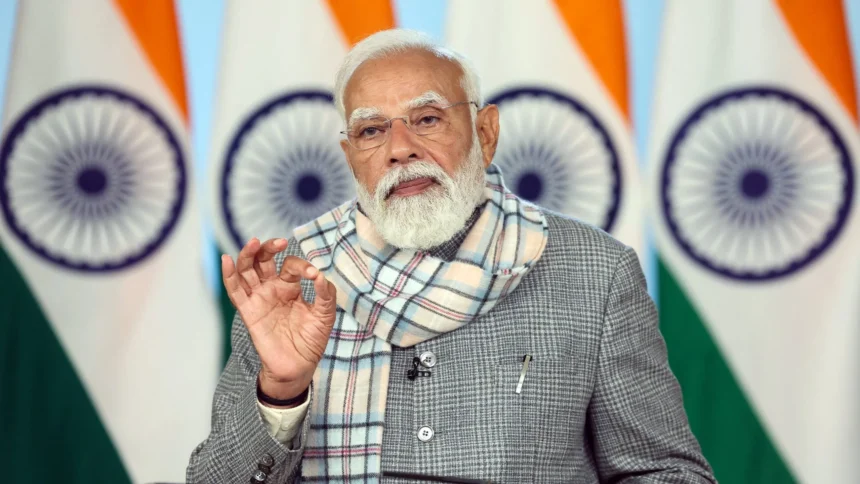
Prime Minister Narendra Modi said India’s expanding Free Trade Agreements reflect rising global confidence in the country’s economic trajectory. The remarks, made at a high level summit, triggered immediate market reactions as investors assessed trade access, export potential and sectoral impact.
Prime Minister Narendra Modi’s statement that FTAs are proof of global confidence in India places Free Trade Agreements at the center of the country’s trade and growth narrative. India has signed or concluded trade deals with partners including the United Arab Emirates and Australia, and has advanced negotiations with the United Kingdom and the European Union. These agreements are positioned as strategic tools to deepen export access, attract investment and integrate India into global value chains. Financial markets responded with selective gains in export oriented sectors as investors recalibrated expectations.
India’s Expanding FTA Network and Trade Strategy
India’s Free Trade Agreements mark a shift from earlier caution toward deeper trade integration. The Comprehensive Economic Partnership Agreement with the UAE reduced tariffs on a wide range of goods, boosting sectors such as gems and jewelry, textiles and engineering products. The Economic Cooperation and Trade Agreement with Australia opened opportunities in services, education and resources.
Negotiations with the UK and the EU are significant because these markets represent high value consumer bases. Tariff reductions, simplified customs procedures and recognition of standards can enhance competitiveness for Indian exporters. The government has increasingly emphasized balanced agreements that protect sensitive sectors while expanding market access.
By projecting FTAs as evidence of global confidence in India, the Prime Minister underscored that major economies are willing to anchor long term trade relationships with the country. This reflects India’s economic size, reform momentum and political stability.
Markets React to Trade Access Signals
Equity markets tend to respond positively to clarity on trade policy. Following remarks highlighting FTAs, shares of export driven sectors such as textiles, pharmaceuticals, auto components and information technology often attract attention. Investors assess whether tariff reductions will translate into higher order books and margin expansion.
Currency markets also track trade developments. Stronger export prospects can support foreign exchange inflows over time. However, the impact is rarely immediate. Trade agreements require implementation timelines, compliance alignment and business adaptation before benefits fully materialize.
Bond markets view FTAs through the lens of macro stability. If trade expansion supports GDP growth without widening the current account deficit, sovereign risk perception improves. The broader market reaction therefore depends on execution rather than announcement alone.
Export Growth and Global Value Chains
FTAs are not merely about tariff cuts. They influence supply chain integration and investment flows. Global companies seeking diversification beyond single country sourcing view India as a viable manufacturing base. Trade agreements provide predictability and reduce friction in cross border transactions.
Sectors such as electronics, chemicals, food processing and renewable energy components stand to gain from deeper value chain integration. Rules of origin provisions determine how much local value addition qualifies for preferential tariffs. This encourages domestic manufacturing.
Services exports also benefit. India’s strength in IT, consulting and financial services aligns with markets that recognize professional qualifications and ease mobility provisions. While goods trade dominates headlines, services liberalization can generate significant revenue gains.
Policy Balance and Domestic Industry Safeguards
Despite optimism, FTAs require careful calibration. Domestic industries often express concerns about import competition. India has historically been cautious in trade negotiations to avoid sudden surges in cheaper imports affecting small producers.
Modern agreements therefore include safeguard clauses and phased tariff reductions. The objective is to provide adjustment time for sensitive sectors while expanding export opportunities. Policymakers must ensure that competitiveness improves through infrastructure upgrades, logistics efficiency and skill development.
Trade agreements also intersect with regulatory alignment. Standards on environment, labor and intellectual property increasingly shape negotiations. Compliance readiness becomes essential for exporters to actually benefit from preferential access.
Long Term Economic Confidence Narrative
By framing FTAs as proof of global confidence in India, the government reinforces a broader narrative of economic ascent. Investors interpret sustained trade engagement as validation of India’s reform path and growth prospects. However, global trade remains exposed to geopolitical risks and protectionist pressures.
India’s challenge is to translate trade agreements into measurable export growth, higher employment and improved current account stability. Announcements create sentiment. Implementation drives outcomes.
Takeaways
India’s recent FTAs signal deeper integration into global trade networks.
Markets respond positively when trade access improves for export oriented sectors.
Execution and compliance determine whether tariff benefits convert into real gains.
Balanced agreements aim to protect domestic industry while expanding exports.
FAQs
What are Free Trade Agreements
Free Trade Agreements are treaties between countries that reduce or eliminate tariffs and trade barriers on goods and services to promote cross border commerce.
How do FTAs affect Indian markets
Export oriented stocks often gain on expectations of higher sales and improved margins. Currency and bond markets assess broader economic impact.
Which sectors benefit most from FTAs
Textiles, pharmaceuticals, auto components, engineering goods and IT services are among the sectors that typically benefit from improved market access.
Are there risks associated with FTAs
Yes. Increased imports can pressure domestic industries if competitiveness does not improve. Careful negotiation and phased implementation are important.