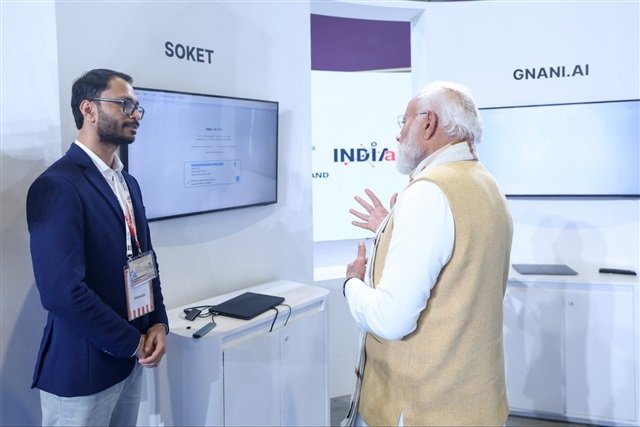
PM Modi expanded India’s artificial intelligence infrastructure push as the AI Impact Expo opened to the public, signaling a deeper integration of policy vision with economic ambition. The move highlights India’s intent to scale compute capacity, support startups, and strengthen its global AI position.
PM Modi’s AI infrastructure push took center stage as India opened the AI Impact Expo to public participation, blending policy announcements with industry engagement. The event reflects a strategic shift from high level AI discussions toward tangible infrastructure expansion and ecosystem building. By aligning government support with private sector innovation, India is positioning artificial intelligence as a core pillar of economic growth.
AI Infrastructure as Economic Strategy
Artificial intelligence infrastructure has become a national priority due to its role in driving productivity, innovation, and competitiveness. Compute capacity, data availability, semiconductor access, and cloud expansion form the backbone of AI deployment. The AI Impact Expo provided a platform to showcase initiatives designed to scale these foundational elements.
India has been working to expand high performance computing resources and encourage domestic AI model development. Strengthening digital public infrastructure, which previously enabled large scale fintech and identity platforms, now supports broader AI experimentation. The policy direction suggests that infrastructure readiness is viewed as essential to attracting investment and nurturing domestic innovation.
By opening the expo to the public, the government signaled transparency and inclusivity. Students, entrepreneurs, and technology professionals gained exposure to live demonstrations, research showcases, and startup exhibits.
Public Access to the AI Impact Expo
Opening the AI Impact Expo to public visitors transforms it from a policy forum into a broader innovation showcase. Public access allows emerging entrepreneurs and academic researchers to interact directly with industry leaders and policymakers. This democratization of access supports talent discovery and ecosystem expansion.
The expo format typically includes interactive booths, startup pitch sessions, and demonstrations of AI applications across sectors such as healthcare, agriculture, logistics, and education. By highlighting applied use cases, the government reinforces the economic value of artificial intelligence beyond theoretical discussions.
Public participation also strengthens domestic awareness. As AI adoption accelerates globally, countries that cultivate early familiarity among their workforce gain long term advantages in skill readiness and enterprise deployment.
Policy Meets Startup Ecosystem Growth
A core theme of the AI infrastructure push is enabling startups to scale. Early stage companies often face barriers related to compute costs and data access. Policy support aimed at subsidized infrastructure, research grants, and public private partnerships can reduce entry friction.
India’s startup ecosystem has grown rapidly over the past decade, particularly in fintech, ecommerce, and software services. Extending this momentum into artificial intelligence requires targeted support. Infrastructure investments, combined with regulatory clarity, create a predictable environment for founders and investors.
The AI Impact Expo also serves as a networking hub. Venture capital firms, global technology corporations, and domestic innovators share platforms. Such interactions accelerate commercialization pathways and potential cross border collaborations.
Global Positioning in Artificial Intelligence
PM Modi’s AI infrastructure push carries geopolitical implications. Artificial intelligence is increasingly linked to economic sovereignty and strategic autonomy. Nations investing in domestic compute capacity and talent development reduce reliance on external technology providers.
By showcasing infrastructure expansion at a national level event, India reinforces its ambition to become a competitive AI hub. This positioning matters for attracting foreign direct investment and collaborative research partnerships.
Global companies seeking diversified technology ecosystems may view India’s proactive policy approach as a positive signal. Consistent infrastructure scaling and ecosystem development enhance credibility in international technology dialogues.
Economic Multiplier Effects
Investments in AI infrastructure have ripple effects across sectors. Data centers create demand for energy, real estate, and hardware manufacturing. Training programs expand high skill employment opportunities. Startups developing AI solutions stimulate downstream industries through automation and analytics services.
The AI Impact Expo demonstrates how policy decisions intersect with broader economic outcomes. By aligning infrastructure expansion with workforce development, India can create multiplier effects that extend beyond the technology sector.
Moreover, as AI tools enhance productivity in agriculture, manufacturing, and public services, economic efficiency gains may support long term growth targets. The integration of AI into governance systems can also improve service delivery and transparency.
Challenges and Execution Priorities
While policy announcements are important, execution remains critical. Infrastructure projects require coordination between central and state authorities, private cloud providers, and hardware suppliers. Ensuring equitable access to compute resources across regions is also a challenge.
Talent development must keep pace with infrastructure expansion. Investments in education, research institutions, and industry training programs are essential to prevent skill shortages.
Sustained policy consistency will determine whether the AI infrastructure push translates into durable economic advantage. Transparent benchmarks and measurable progress indicators can strengthen investor confidence.
Takeaways
India is positioning artificial intelligence infrastructure as a core economic growth driver.
Opening the AI Impact Expo to the public supports talent discovery and ecosystem engagement.
Startup scaling depends on affordable compute access and policy clarity.
Infrastructure investment in AI has broader multiplier effects across sectors.
FAQs
What is the AI Impact Expo?
It is a national level event showcasing artificial intelligence initiatives, startups, research projects, and policy frameworks.
Why is AI infrastructure important for economic growth?
Compute capacity, data access, and cloud infrastructure enable innovation, productivity gains, and competitive technology development.
How does this benefit startups?
Improved infrastructure and policy support reduce operational barriers and create opportunities for funding and partnerships.
What is the long term goal of the AI push?
The objective is to strengthen domestic AI capabilities, attract investment, and integrate artificial intelligence into multiple sectors of the economy.