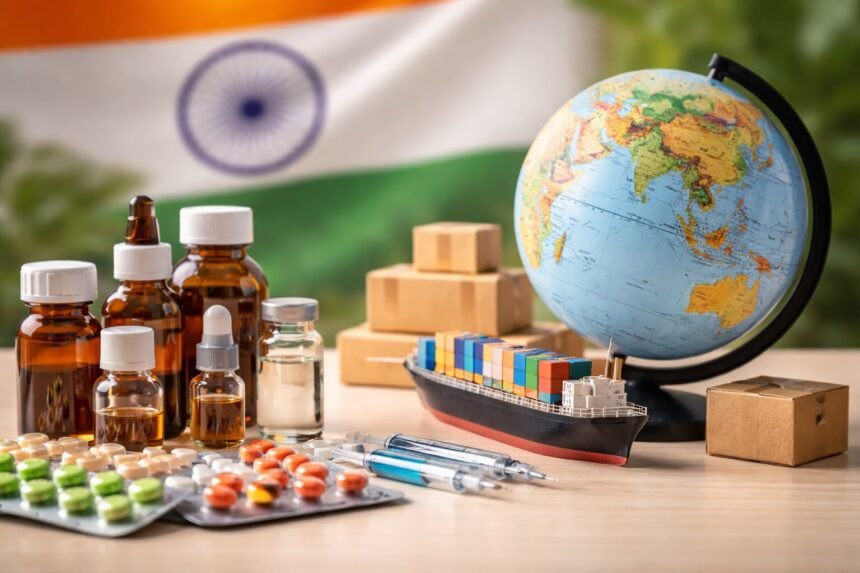
Indian pharma exports hit $30.47 billion in FY25, marking steady expansion in global demand for affordable medicines and vaccines. With strong generic drug supply and regulatory compliance in key markets, the industry is now targeting double digit export growth through 2027.
Indian pharma exports at $30.47 billion in FY25 underline the sector’s resilience amid global supply chain shifts and pricing pressures. The growth reflects sustained demand from regulated markets such as the United States and Europe, along with expanding footprints in Africa, Latin America, and parts of Asia. Industry leaders are projecting double digit export growth over the next two years, supported by product diversification and complex generics.
The performance also reinforces India’s position as one of the world’s largest suppliers of generic medicines by volume. Export momentum is increasingly linked to value added formulations rather than bulk commodity shipments.
Drivers Behind FY25 Export Growth
The FY25 export figure of $30.47 billion has been driven primarily by formulations and biologics, which account for a significant share of outbound shipments. Indian pharmaceutical companies continue to supply a large proportion of generic prescriptions in major regulated markets, particularly the United States.
The US remains a key revenue generator due to high generic penetration. Indian firms benefit from a strong pipeline of abbreviated new drug applications and ongoing approvals. Europe also contributes steadily, although pricing pressures are more intense.
Emerging markets have become increasingly important. Countries in Africa and Latin America rely on Indian medicines for cost effective treatment options. Vaccines, antiretroviral therapies, and chronic disease medications are among the high demand categories.
Role of Generics and Complex Products
Generic drugs remain the backbone of Indian pharma exports. However, growth is gradually shifting toward complex generics, biosimilars, and specialty formulations. These segments offer higher margins and face relatively lower competition compared to plain vanilla generics.
Indian manufacturers have invested in advanced research and development capabilities to move up the value chain. Complex injectables, inhalation therapies, and modified release products are gaining traction in export markets.
Compliance with stringent regulatory standards is central to sustaining export growth. Facilities approved by international regulators enhance credibility and allow companies to participate in high value tenders. Quality audits and remediation efforts over recent years have strengthened the industry’s global reputation.
Outlook for Double Digit Growth Through 2027
The industry’s ambition for double digit export growth through 2027 is anchored in multiple factors. First, patent expiries in developed markets are expected to open new generic opportunities. As blockbuster drugs lose exclusivity, Indian firms can launch competitive alternatives.
Second, global healthcare systems continue to prioritize cost containment. Generics and biosimilars offer significant savings compared to branded therapies. This structural demand trend supports long term export prospects.
Third, government policy support and production linked incentive schemes have encouraged domestic manufacturing of active pharmaceutical ingredients and key starting materials. Reducing import dependence for raw materials can improve supply chain stability and margins.
However, achieving sustained double digit growth will require careful navigation of pricing erosion in mature markets and currency volatility. Exporters must also manage rising compliance costs and evolving regulatory requirements.
Competitive Landscape and Market Risks
The global pharmaceutical market is highly competitive. Indian companies face rivalry from manufacturers in China, Eastern Europe, and other emerging markets. In certain segments, price competition can compress margins rapidly.
Regulatory scrutiny remains a constant factor. Any observations related to manufacturing standards can disrupt exports from specific plants. Companies are therefore increasing investment in quality systems and digital monitoring tools.
Trade policy changes and geopolitical tensions could also affect market access. While India enjoys a strong reputation as a reliable supplier, diversification of export destinations remains essential to mitigate concentration risks.
Long Term Structural Strengths
Despite short term challenges, Indian pharma exports benefit from structural advantages. A large pool of scientific talent, established manufacturing infrastructure, and decades of experience in reverse engineering complex molecules provide a competitive edge.
The country’s cost advantage compared to developed markets continues to attract global buyers. Additionally, collaboration with multinational pharmaceutical companies through contract development and manufacturing services is expanding.
Digitalization and supply chain transparency are becoming increasingly important. Companies investing in data analytics, traceability, and automation may gain operational efficiency and improved compliance outcomes.
The $30.47 billion export milestone in FY25 is therefore not an endpoint but part of a longer growth trajectory. If innovation intensity increases and market diversification continues, the industry’s double digit growth target through 2027 appears achievable under stable global conditions.
Takeaways
• Indian pharma exports reached $30.47 billion in FY25, reflecting steady global demand
• Generics remain dominant, with rising focus on complex products and biosimilars
• Double digit export growth through 2027 depends on patent expiries and cost competitiveness
• Regulatory compliance and market diversification are critical for sustained expansion
FAQs
Q1: What drove Indian pharma exports to $30.47 billion in FY25?
Growth was supported by strong generic drug demand in the US and Europe, expanding presence in emerging markets, and increased focus on complex formulations.
Q2: Why is the industry targeting double digit growth through 2027?
Upcoming patent expiries, global cost pressure in healthcare, and capacity expansion provide opportunities for sustained export growth.
Q3: What are the main risks to export growth?
Pricing erosion, regulatory scrutiny, currency volatility, and global competition are key challenges.
Q4: How important are emerging markets for Indian pharma?
Emerging markets play a growing role by providing demand for affordable medicines and vaccines, helping diversify export revenues.