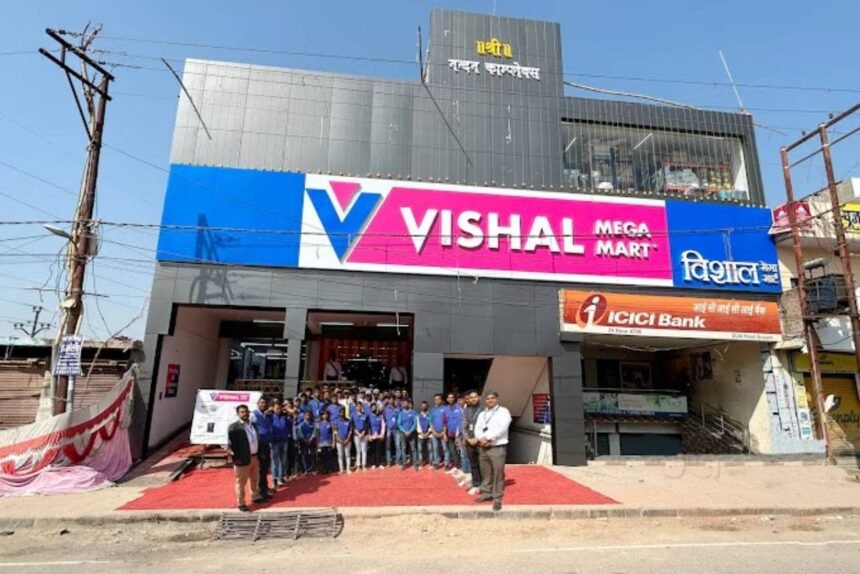
Block deal buzz around Vishal Mega Mart has intensified as the promoter group considers a 6.5 percent exit at a valuation exceeding ₹3,500 crore. The potential transaction has drawn investor attention to India’s value retail segment and promoter stake realignment trends.
Block deal buzz surrounding Vishal Mega Mart has gained traction in market circles, with reports indicating that the promoter is exploring the sale of a 6.5 percent stake at a valuation of more than ₹3,500 crore. Such a transaction, if executed, would represent a significant liquidity event and could reshape the company’s shareholding structure. Investors are closely tracking developments as block deals of this size often influence short term stock movement and broader sector sentiment.
Vishal Mega Mart operates in the affordable retail segment, catering largely to value conscious consumers across tier two and tier three cities. The company’s positioning in fashion, general merchandise, and fast moving consumer goods has aligned it with rising consumption in non metro markets.
Understanding the Block Deal Structure
A block deal typically involves the bulk transfer of shares between large institutional or promoter entities through a dedicated trading window. These transactions are executed within a specified time frame and are often priced at a discount or premium to the prevailing market price.
In this case, a 6.5 percent stake sale would indicate partial monetization rather than a full exit. Promoters often pursue such moves to unlock value, rebalance portfolios, or bring in strategic investors. The ₹3,500 crore plus valuation reflects investor confidence in the retailer’s scale and growth prospects.
Large block deals can temporarily increase volatility in the stock due to supply adjustments. However, the long term impact depends on the identity of the incoming investor and the company’s operational performance.
Valuation Context and Retail Sector Dynamics
A valuation exceeding ₹3,500 crore places Vishal Mega Mart firmly within the mid sized organized retail bracket. The Indian retail sector has undergone rapid transformation over the past decade, with formal retail chains expanding into smaller towns and benefiting from rising disposable incomes.
Value retail has shown resilience during inflationary cycles. Consumers tend to shift toward discount and private label offerings when price sensitivity rises. Vishal Mega Mart’s business model, which focuses on affordability and wide distribution, positions it to capture this demand.
Comparable retail players have also witnessed valuation re rating based on store expansion, improved supply chain efficiencies, and stronger inventory management. Investors evaluate metrics such as same store sales growth, operating margins, and expansion pipeline when assessing fair value.
Promoter Strategy and Capital Allocation
When promoters mull a partial stake sale, the strategic intent becomes a focal point. Monetization does not necessarily signal reduced confidence. In many cases, it reflects capital recycling or diversification.
If the stake sale is absorbed by institutional investors, it could enhance liquidity and broaden the shareholder base. Increased institutional ownership often improves corporate governance perception and research coverage.
However, market participants also assess promoter holding levels post transaction. A meaningful reduction in promoter stake can influence voting power and long term control dynamics. Transparent communication around the purpose of the sale becomes critical in managing investor sentiment.
Market Reaction and Investor Sentiment
Block deal buzz often triggers speculative trading activity. Short term traders attempt to anticipate pricing bands and possible discounts attached to the transaction. If the deal is priced attractively for institutional buyers, it may lead to temporary pressure on the stock.
Conversely, if the stake is absorbed without significant discounting and signals strong institutional appetite, it can reinforce confidence in the company’s fundamentals. Retail investors typically watch volume patterns and price stability in the sessions following such announcements.
The broader equity market environment also plays a role. In volatile conditions, large secondary transactions can amplify price swings. In stable markets, they are often digested smoothly.
Growth Outlook for Vishal Mega Mart
India’s organized retail penetration continues to rise, particularly in apparel and household goods. Expansion into smaller cities remains a key growth lever. Companies that optimize logistics and leverage data driven inventory management can scale efficiently.
Vishal Mega Mart’s footprint in value retail aligns with demographic trends. Rising urbanization, improved connectivity, and increasing aspirations in semi urban regions support sustained demand.
Investors evaluating the ₹3,500 crore plus valuation will consider revenue growth trajectory, store addition pace, and operating margin trends. Consistency in execution will determine whether valuation multiples remain justified.
The potential 6.5 percent stake sale by the promoter represents a noteworthy corporate development rather than a fundamental shift in business direction. The outcome will depend on pricing, investor mix, and clarity around capital allocation plans.
Takeaways
• Promoter is reportedly considering a 6.5 percent stake sale via block deal
• Valuation above ₹3,500 crore reflects investor interest in value retail
• Market reaction will depend on pricing and incoming investor profile
• Long term impact hinges on operational performance and growth execution
FAQs
Q1. What is a block deal in the stock market?
A block deal is a large share transaction executed between two parties within a special trading window, typically involving significant ownership transfer.
Q2. Does a promoter stake sale signal negative outlook?
Not necessarily. Promoters may sell shares to unlock value, diversify holdings, or bring in institutional investors.
Q3. How can this affect the stock price?
Short term volatility may occur due to increased supply, but long term impact depends on business fundamentals and investor confidence.
Q4. Why is the ₹3,500 crore valuation significant?
It indicates the market’s assessment of the company’s scale, growth prospects, and position within the organized retail sector.