
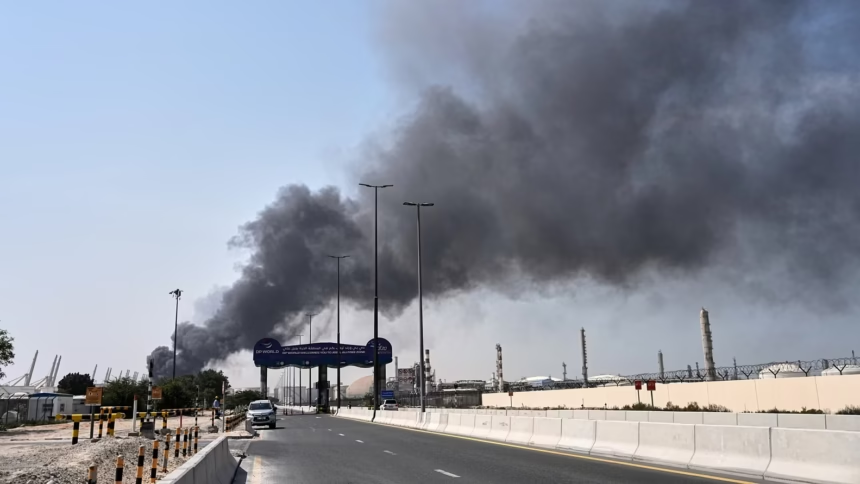
Global equities slump as U.S. Israel strikes on Iran stoke risk off sentiment across financial markets. Investors rushed toward safe haven assets as geopolitical tensions escalated, triggering sharp declines in major stock indices and renewed volatility in commodities and currencies.
Global equities slump amid rising geopolitical tensions
Global equities slump after reports of coordinated U.S. and Israel strikes on Iran heightened fears of a broader regional conflict. Equity markets across Asia, Europe, and North America opened lower, reflecting a swift shift toward risk aversion.
Major benchmark indices recorded broad based declines as investors reassessed geopolitical risk exposure. Technology, banking, and industrial stocks led losses in several markets, while defensive sectors such as utilities and consumer staples outperformed on a relative basis.
The immediate reaction followed a familiar pattern seen during geopolitical escalations. Investors moved capital out of equities and into perceived safe assets, including gold and government bonds. The rapid repricing of risk underscores how sensitive global markets remain to developments in the Middle East.
Risk off markets push investors toward safe havens
The phrase risk off markets accurately captures the mood across trading floors. In periods of heightened geopolitical uncertainty, investors reduce exposure to volatile assets and seek safety in instruments that historically preserve value.
Gold prices rose sharply as demand increased. US Treasury yields declined in early trading as bond prices climbed, reflecting safe haven flows. The US dollar strengthened against several emerging market currencies, supported by its status as a global reserve currency.
Emerging market equities experienced deeper declines compared to developed markets. Capital typically flows out of higher risk assets first during global stress episodes. This dynamic amplifies volatility in countries dependent on foreign portfolio investment.
Oil prices also reacted strongly. Iran’s strategic role in global energy supply means any military action involving the country raises concerns about potential disruptions in oil production or transportation routes.
Energy markets and inflation concerns resurface
Crude oil markets responded immediately to the escalation. Oil prices surged on fears that regional instability could affect supply chains in the Gulf. Even the possibility of shipping disruptions through critical transit points can push prices higher.
Higher oil prices have direct consequences for inflation expectations worldwide. Energy costs influence transportation, manufacturing, and household expenses. If crude prices remain elevated, central banks may face renewed pressure to maintain tighter monetary conditions.
For oil importing nations, rising energy costs can widen trade deficits and weaken local currencies. For oil exporters, short term revenue gains may be offset by broader economic instability if the conflict escalates further.
The interaction between geopolitical risk and inflation expectations adds complexity to the global policy outlook. Markets now weigh not only military developments but also their macroeconomic implications.
Impact on global indices and sectoral performance
In the United States, equity futures turned lower before the opening bell. European markets followed suit, reflecting synchronized global reaction. Asian markets closed in negative territory, with export oriented sectors particularly vulnerable.
Technology stocks, which tend to be sensitive to shifts in risk appetite, experienced notable declines. Financial stocks also weakened as volatility increased and investors priced in potential economic slowdown risks.
Defensive sectors showed relative resilience. Utilities and healthcare stocks attracted interest due to their stable earnings profiles. However, broad based selling pressure limited gains across most regions.
Volatility indices climbed, indicating heightened investor anxiety. Trading volumes increased as institutions adjusted portfolios in response to breaking developments.
Short term outlook remains volatile
The near term trajectory of global equities will depend heavily on how the situation evolves. Markets are highly reactive to headlines in fast moving geopolitical crises. Any signs of de escalation could trigger a technical rebound, while further escalation may deepen losses.
Investors will monitor diplomatic efforts, energy market stability, and official policy responses. Central banks may not intervene directly in response to geopolitical events, but sustained market stress could influence liquidity measures.
Portfolio managers are likely to prioritize risk management and capital preservation strategies in the short term. Diversification and hedging become critical tools during periods of elevated uncertainty.
While geopolitical shocks often trigger sharp but temporary corrections, the duration and intensity of the current downturn will depend on whether tensions remain contained or expand into a broader regional conflict.
Takeaways
Global equities fell sharply following U.S. and Israel strikes on Iran.
Investors shifted toward safe haven assets such as gold and government bonds.
Oil prices surged, reviving global inflation concerns.
Market volatility is likely to persist until geopolitical clarity emerges.
FAQs
Why did global stock markets fall after the strikes?
Military action increased geopolitical uncertainty, prompting investors to reduce exposure to equities and move toward safer assets.
How do oil prices affect stock markets?
Rising oil prices can increase inflation and corporate costs, which may pressure profit margins and economic growth expectations.
Which assets benefit during risk off periods?
Gold, government bonds, and the US dollar often gain as investors seek stability during uncertain times.
Is this type of market reaction common?
Yes. Geopolitical tensions frequently trigger short term volatility as markets reprice risk based on evolving developments.


