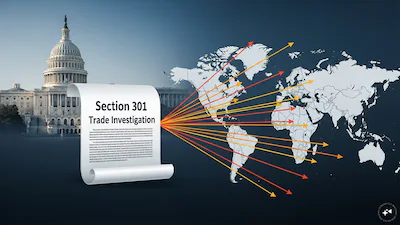
The United States has initiated a broad trade investigation into forced labour practices involving imports from India and 59 other economies. The probe could reshape global supply chains and increase compliance pressure on exporters whose goods enter the US market.
US Forced Labour Trade Probe Targets Global Supply Chains
The US forced labour trade probe has triggered global attention as Washington expands scrutiny of imports suspected to involve forced labour. The investigation covers India and 59 other economies and forms part of a broader effort to strengthen supply chain transparency.
US authorities have increasingly focused on labour practices in international manufacturing sectors, especially industries that rely on complex supplier networks. The probe is expected to evaluate whether certain goods entering the United States are produced using forced labour conditions or exploitative labour systems.
This type of investigation is significant because the United States is one of the world’s largest import markets. Any trade restrictions imposed after the probe could affect exporters, manufacturing companies, and multinational corporations that rely on global production networks.
For India, which exports a wide range of goods to the US including textiles, pharmaceuticals, engineering products, and electronics, the investigation adds a new layer of regulatory scrutiny.
Trade Compliance and Forced Labour Regulations Expanding
The forced labour regulations in global trade have tightened significantly over the past decade. Governments are increasingly using trade laws to enforce labour standards and ethical sourcing requirements.
The United States already enforces strict rules under laws that allow authorities to block imports produced with forced labour. If goods are suspected to violate labour rights, they can be detained at US ports or banned from entering the market.
The new probe appears to be part of a wider enforcement strategy designed to identify risk areas across multiple economies. Instead of focusing on a single country or product category, authorities are examining broader supply chains that span several regions.
Companies exporting to the US may now face stronger documentation requirements. Businesses could be required to demonstrate that their supply chains are free from forced labour through audits, supplier verification, and transparent labour practices.
India’s Export Industries Could Face Higher Scrutiny
India’s export sectors may experience increased compliance pressure as the investigation progresses. Key industries such as garments, leather products, agriculture, and manufacturing often rely on large supplier networks where monitoring labour practices can be complex.
The US remains one of India’s largest trading partners. In recent years, bilateral trade between the two countries has expanded significantly, with exports from India covering both traditional manufacturing sectors and high value industries.
While the probe does not automatically imply violations, it signals closer monitoring of supply chains connected to US imports. Indian companies that export to American markets may need to strengthen due diligence procedures and improve labour compliance reporting.
Many global companies already conduct regular social compliance audits to ensure suppliers meet labour standards. The investigation could accelerate this trend as firms attempt to reduce legal and reputational risks.
Global Businesses Preparing for Stronger Supply Chain Audits
The global supply chain compliance environment has changed rapidly as governments link trade access to labour rights enforcement. Multinational corporations are increasingly required to track working conditions across multiple tiers of suppliers.
For companies that rely on outsourcing or contract manufacturing, verifying labour conditions throughout the supply chain can be challenging. However, regulators are pushing businesses to implement stronger monitoring systems and digital supply chain tracking.
The US probe may also influence corporate procurement strategies. Businesses may prefer suppliers with stronger labour certifications, verified factory audits, and transparent worker protections.
This shift could create opportunities for manufacturers that demonstrate high compliance standards while creating risks for those with weak oversight mechanisms.
Trade Policy and Ethical Sourcing Becoming Interconnected
Trade policy and labour rights enforcement are becoming closely linked in global commerce. Governments are increasingly using import regulations to encourage ethical sourcing and responsible production practices.
The US forced labour trade probe reflects this broader policy direction. By investigating imports across multiple economies, regulators aim to strengthen accountability throughout global supply chains.
For exporters, the message is clear. Access to major international markets increasingly depends on transparent labour practices and compliance with global human rights standards.
As the investigation continues, its outcomes could influence future trade policies and set new benchmarks for supply chain governance across industries worldwide.
Takeaways
The United States has launched a trade investigation covering imports from India and 59 other economies.
The probe focuses on identifying potential forced labour risks in global supply chains.
Exporters may face stronger compliance requirements and supply chain transparency rules.
The investigation reflects a broader global trend linking trade access with labour standards.
FAQs
What is the US forced labour trade probe about?
The investigation examines whether imported goods entering the United States are produced using forced labour or exploitative labour conditions within global supply chains.
Does the probe mean India has violated trade rules?
No. The investigation does not automatically indicate violations. It represents a broader review covering multiple economies and industries.
Which sectors could be affected by the investigation?
Industries with complex supply chains such as textiles, manufacturing, agriculture, and consumer goods may face greater scrutiny.
How can exporters reduce risks related to forced labour regulations?
Companies can strengthen supplier audits, implement supply chain transparency tools, and ensure labour practices comply with international standards.