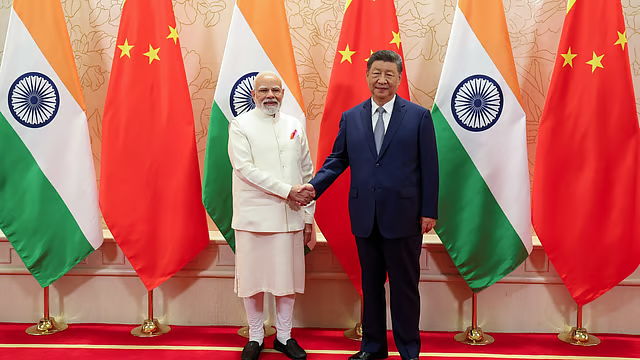
India is considering easing the Press Note 3 rules that restrict foreign investments from neighboring countries. The move aims to unlock funding for startups facing capital shortages while maintaining safeguards around strategic sectors and national security.
India is exploring potential changes to the Press Note 3 policy as policymakers evaluate ways to revive startup funding and attract greater foreign investment. Press Note 3 rules have governed foreign direct investment from countries sharing land borders with India since 2020, requiring government approval for such investments. The regulation was introduced to prevent opportunistic acquisitions during the pandemic, but industry leaders argue that the rules have also slowed funding flows into Indian startups. With venture capital investments moderating over the past two years, discussions about easing the restrictions have gained momentum.
Background of Press Note 3 and Foreign Investment Rules
Press Note 3 was introduced in April 2020 during the early phase of the global pandemic. The policy mandated that companies from countries sharing a land border with India must obtain government approval before investing in Indian firms. The rule primarily affected investors from China, though it technically applied to several neighboring countries.
Before the rule came into effect, Chinese venture capital firms and technology investors were actively funding Indian startups across sectors including fintech, e commerce, mobility, and gaming. Major Indian startups had raised significant rounds from global funds with Chinese backing.
The policy change aimed to prevent distressed acquisitions when many companies were struggling due to the economic shock of the pandemic. However, over time, startups and investors began highlighting unintended consequences such as longer approval timelines and limited access to certain pools of capital.
The debate has intensified as startup funding cycles tightened globally in 2023 and 2024.
Startup Funding Slowdown Drives Policy Reassessment
India’s startup ecosystem has experienced a significant slowdown in venture funding compared with the record investment surge seen in 2021. Global macroeconomic conditions, higher interest rates, and cautious investor sentiment have reduced large funding rounds.
In this environment, policymakers are evaluating ways to support the startup ecosystem without compromising national security considerations. Easing Press Note 3 rules could help restore some funding channels that were previously available to Indian startups.
Several industry bodies and startup founders have suggested that a more streamlined approval mechanism could reduce delays and improve investor confidence. Some proposals include setting faster review timelines or creating sector specific guidelines that allow investments in non sensitive industries.
For early stage startups that rely heavily on venture capital, access to diverse funding sources remains critical for growth and innovation.
Impact on India Startup Ecosystem and Venture Capital
India has emerged as one of the largest startup ecosystems in the world with thousands of technology driven companies operating across sectors such as fintech, edtech, health technology, logistics, and artificial intelligence.
Foreign venture capital has historically played an important role in scaling these startups. Global investors provide not only capital but also strategic expertise, international networks, and market expansion opportunities.
If Press Note 3 restrictions are relaxed, analysts believe it could help increase funding availability, particularly for growth stage startups that require larger investment rounds.
The move could also encourage global venture capital firms to re engage more aggressively with Indian startup opportunities. Many investors continue to view India as a long term technology market due to its large digital consumer base, strong engineering talent, and expanding internet penetration.
At the same time, policymakers are expected to maintain safeguards around critical sectors such as telecommunications infrastructure, financial systems, and defense related technologies.
Balancing National Security and Investment Growth
The discussion around easing Press Note 3 highlights the broader challenge of balancing national security priorities with economic growth and investment openness.
India has taken several steps in recent years to strengthen oversight of strategic investments while still attracting foreign capital. Regulatory clarity and predictable approval processes are considered important factors for global investors when evaluating emerging markets.
Any potential changes to Press Note 3 are likely to focus on improving transparency and reducing bureaucratic delays rather than completely removing oversight mechanisms.
Government officials are also evaluating how similar investment screening frameworks operate in other major economies. Several countries including the United States and members of the European Union maintain national security review processes for foreign investments in sensitive sectors.
For India, the goal is to maintain investment security while ensuring that its rapidly growing startup ecosystem continues to attract global capital.
Takeaways
India is considering easing Press Note 3 restrictions to improve startup funding access
The policy currently requires government approval for investments from neighboring countries
Startup funding slowdown has increased pressure to simplify foreign investment rules
Any policy change is expected to maintain safeguards for sensitive sectors
FAQs
What is Press Note 3 in India?
Press Note 3 is a foreign investment rule introduced in 2020 requiring government approval for investments from countries that share a land border with India.
Why is India considering easing Press Note 3 rules?
Policymakers are reviewing the rule to help increase foreign funding for startups and reduce delays in investment approvals.
Which investors are affected by Press Note 3?
The policy applies to investors from neighboring countries that share land borders with India, including China.
How could easing the rule affect Indian startups?
Relaxing the restrictions could improve access to venture capital and increase funding opportunities for growing startups.