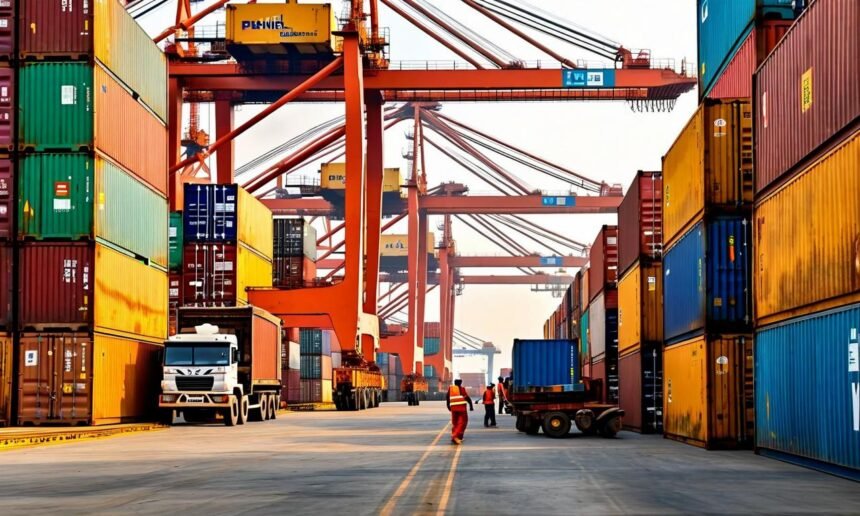
India’s trade deficit has widened in recent data as import growth continues to outpace exports, reflecting pressure on the country’s external balance. The trend signals strong domestic demand but also raises concerns around currency stability and global trade headwinds.
India’s trade deficit expands as rising imports, particularly crude oil and electronics, continue to exceed export growth. This widening gap highlights the imbalance between domestic consumption strength and slowing global demand, placing renewed focus on India’s trade strategy and macroeconomic stability.
Rising Imports Push Trade Deficit Higher
The sharp increase in imports is the primary driver behind the widening trade deficit. India’s dependence on crude oil imports makes it highly sensitive to global energy prices. With oil prices remaining elevated, the import bill has expanded significantly.
Beyond energy, imports of electronics, machinery, and gold have also increased. These categories are closely linked to consumer demand, industrial activity, and investment cycles. For instance, rising smartphone and semiconductor imports reflect both consumption growth and manufacturing dependency.
This trend indicates that domestic economic activity remains strong. However, it also means a higher outflow of foreign exchange, which directly contributes to the expanding trade deficit. The balance becomes harder to manage when import growth consistently outpaces export performance.
Export Growth Slows Amid Global Uncertainty
While imports are accelerating, export growth is facing visible constraints. Weak demand from key global markets such as the United States and Europe is impacting Indian exports across multiple sectors.
Engineering goods, textiles, and gems and jewellery have seen uneven demand. Even sectors that previously showed resilience, such as IT services and pharmaceuticals, are experiencing moderated growth due to global economic slowdown.
Geopolitical tensions and shifting trade routes are also affecting export momentum. Increased shipping costs and supply chain disruptions make it harder for exporters to maintain competitive pricing. As a result, export expansion is not keeping pace with the surge in imports.
Impact on Rupee and Inflation Dynamics
A widening trade deficit has direct implications for the Indian rupee and overall inflation. Higher imports increase demand for foreign currencies, particularly the US dollar, which can weaken the rupee.
A weaker currency raises the cost of imports further, especially fuel and essential commodities. This creates inflationary pressure across sectors, affecting transportation, manufacturing, and household expenses.
The Reserve Bank of India typically monitors such developments closely. Currency volatility and inflation risks often influence monetary policy decisions, including interest rate adjustments and forex interventions.
Managing the trade deficit becomes critical in maintaining macroeconomic stability, especially during periods of global uncertainty.
Policy Measures and Trade Strategy Adjustments
The government has been actively working to address the structural challenges behind the trade deficit. Initiatives such as production linked incentive schemes aim to boost domestic manufacturing and reduce reliance on imports.
Efforts are also underway to diversify export markets. India is strengthening trade relations with emerging economies and negotiating agreements that can improve market access for Indian goods.
Improving logistics infrastructure and reducing export bottlenecks remain key priorities. Faster port operations, better connectivity, and lower compliance costs can enhance export competitiveness over time.
However, these measures take time to deliver results. In the short term, the trade deficit is likely to remain influenced by global commodity prices and external demand conditions.
Broader Economic and Investment Implications
The widening trade deficit is not just a trade issue. It has broader implications for economic growth and investor confidence. Persistent deficits can raise concerns among foreign investors about external vulnerabilities.
Portfolio flows and foreign direct investment decisions often factor in macroeconomic indicators such as trade balance and currency stability. A rising deficit may lead to cautious investment behavior in the short term.
At the same time, India’s strong domestic demand continues to support economic growth. The challenge lies in balancing this growth with sustainable external accounts.
If export competitiveness improves and import dependence reduces over time, the current imbalance can be corrected. Until then, the trade deficit will remain a key indicator to watch.
Takeaways
• India’s trade deficit is widening due to faster growth in imports compared to exports
• Crude oil, electronics, and gold imports are major contributors to the surge
• Export growth is slowing بسبب weak global demand and supply chain challenges
• Currency pressure and inflation risks increase as the deficit expands
FAQs
What is driving India’s trade deficit higher?
The main driver is a surge in imports, especially crude oil and electronics, combined with slower export growth due to weak global demand.
How does a widening trade deficit affect the economy?
It can weaken the currency, increase inflation, and create pressure on foreign exchange reserves if not managed properly.
Is strong import growth always negative?
Not necessarily. It can reflect strong domestic demand and investment, but it needs to be balanced with export growth.
What steps are being taken to reduce the deficit?
India is focusing on boosting domestic manufacturing, diversifying export markets, and improving trade infrastructure.