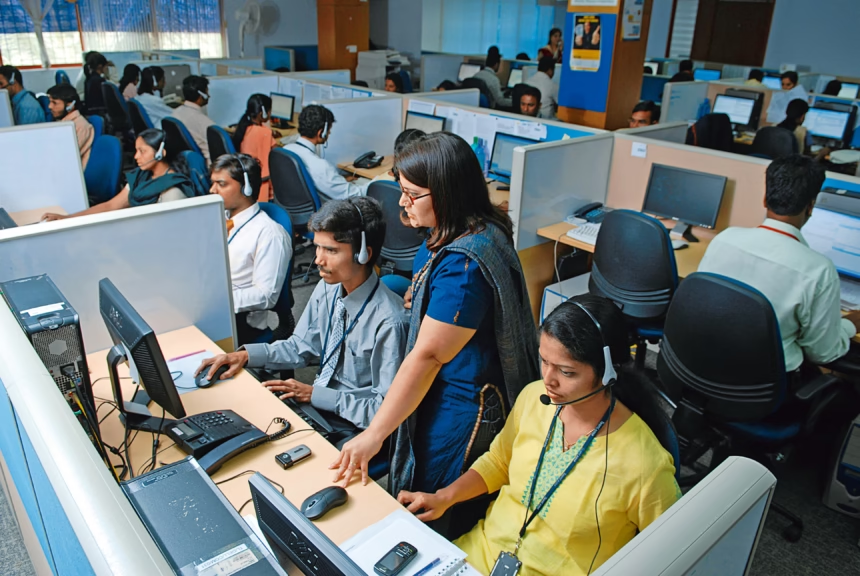
Indian IT firms have triggered work from home policies and travel curbs as the West Asia crisis intensifies, reflecting growing concern over employee safety and business continuity. The move highlights how geopolitical tensions are directly impacting global service operations.
Indian IT firms trigger WFH and travel curbs over West Asia crisis as companies activate contingency plans to manage rising geopolitical risks. With employees stationed across global delivery centers, firms are prioritizing safety while ensuring minimal disruption to client services.
West Asia Crisis Forces Immediate Corporate Response
The decision by Indian IT firms to implement work from home and restrict travel is a direct response to escalating tensions in West Asia. The region plays a strategic role in global business operations, with multiple IT firms maintaining offices, clients, and workforce presence.
Geopolitical instability increases risks related to employee safety, infrastructure disruptions, and cross border mobility. In such situations, companies typically shift to remote operations to maintain continuity.
The current response indicates that firms are not treating the situation as short term volatility. Instead, they are preparing for prolonged uncertainty. This includes limiting non essential travel, especially to sensitive regions, and closely monitoring developments on a daily basis.
Business Continuity Plans Activated Across IT Sector
Indian IT companies are known for robust business continuity frameworks, developed over years of managing global disruptions. The current situation has triggered these systems at scale.
Work from home enables uninterrupted service delivery for global clients. IT services such as software development, cloud management, and customer support can be handled remotely with minimal impact if infrastructure is stable.
However, travel restrictions add complexity. Client meetings, on site deployments, and project transitions often require physical presence. Companies are now shifting these interactions to virtual formats, which can impact execution timelines in certain cases.
Firms are also increasing coordination between global teams to redistribute workloads if specific locations face disruptions.
Employee Safety and Risk Management Take Priority
Employee safety has become the central focus of these decisions. IT companies employ thousands of professionals across international locations, including regions affected by geopolitical tensions.
Organizations are issuing advisories, tracking employee locations, and offering relocation support where required. Emergency response teams are being activated to handle potential crises.
Travel curbs are not limited to affected regions alone. Many firms are reviewing all international travel plans, especially for senior executives and project critical staff.
These measures are designed to reduce exposure to risk while maintaining operational resilience.
Impact on Client Deliveries and Global Operations
While work from home ensures continuity, there are operational trade offs. Certain projects that require on site execution may face delays or require restructuring.
Clients in sensitive regions may also experience disruptions due to broader geopolitical factors. This creates a complex environment where both service providers and clients need to adapt quickly.
Despite these challenges, Indian IT firms have a track record of managing global disruptions. The pandemic period demonstrated their ability to scale remote operations rapidly while maintaining service quality.
This experience is now being leveraged to handle the current crisis more effectively.
Market Reaction and Investor Sentiment
The move to enforce WFH and travel curbs has also caught the attention of investors. Geopolitical risks often influence stock market sentiment, particularly for globally exposed sectors like IT.
Investors are assessing potential impacts on revenue growth, project pipelines, and client spending. Any prolonged disruption in key regions could affect deal closures and execution.
However, the proactive response by companies may also be seen as a positive signal. It indicates preparedness and risk management capability, which are critical in uncertain environments.
Stock performance in the IT sector is likely to remain sensitive to further developments in the West Asia crisis.
Long Term Implications for IT Industry Operations
The current situation may reinforce long term shifts in how IT companies manage global operations. Hybrid work models, decentralized teams, and reduced dependency on physical travel are becoming standard practices.
Companies are likely to invest further in digital collaboration tools and distributed delivery models. This reduces vulnerability to regional disruptions and enhances flexibility.
Geopolitical risk assessment is also expected to become a more integral part of business strategy. Firms may diversify their global presence to avoid concentration in high risk regions.
The West Asia crisis is another reminder that global IT operations are deeply interconnected with geopolitical stability.
Takeaways
• Indian IT firms have implemented WFH and travel curbs due to West Asia crisis risks
• Employee safety and business continuity are the primary drivers of these decisions
• Remote work ensures service delivery but may impact certain on site projects
• Investor sentiment remains cautious as geopolitical uncertainty continues
FAQs
Why are Indian IT firms enforcing work from home policies?
They are prioritizing employee safety and ensuring uninterrupted operations amid rising geopolitical risks in West Asia.
How do travel curbs affect IT operations?
Travel restrictions limit on site work and client interactions, which may impact project timelines and execution.
Will this impact IT sector growth?
Short term disruptions are possible, but strong remote capabilities help maintain overall stability.
Are these measures temporary or long term?
They are immediate responses to current risks, but may influence long term operational strategies.