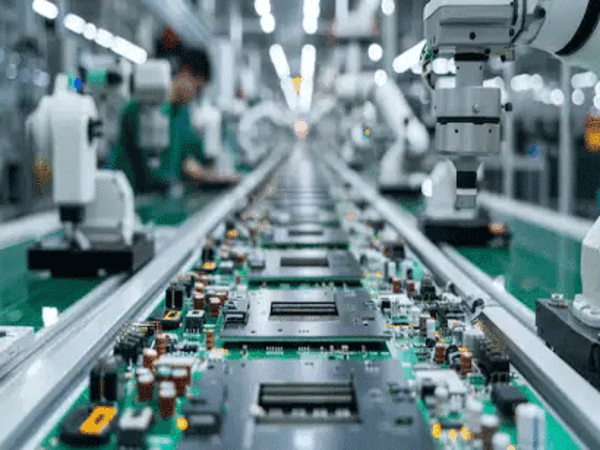
Government PLI scheme review in the electronics sector signals a fresh evaluation of India’s flagship manufacturing incentive program. Authorities are assessing performance, output targets, and investment commitments as the country pushes to strengthen domestic electronics production and reduce import dependence.
Government PLI Scheme Review Signals Policy Recalibration
Government PLI scheme review has gained attention as policymakers assess how effectively the Production Linked Incentive program has delivered on its core objectives. Introduced to boost domestic manufacturing, the scheme offers financial incentives tied to incremental production.
The electronics sector, particularly mobile manufacturing, has been one of the biggest beneficiaries. India has seen a significant rise in smartphone production and exports over the past few years.
However, the review indicates a shift from expansion to optimization. Authorities are now focusing on whether companies are meeting targets, creating jobs, and building long-term capabilities rather than just scaling output.
This evaluation comes at a time when global supply chains are being reshaped, and countries are competing to attract manufacturing investments.
Electronics Manufacturing Growth Under PLI Scheme
Government PLI scheme review is closely examining growth trends in electronics manufacturing. India has emerged as a major assembly hub for smartphones, with several global brands increasing local production.
The scheme has attracted both multinational companies and domestic players, leading to increased investments in manufacturing facilities. Export volumes in electronics, especially mobile devices, have also grown significantly.
However, much of the growth has been concentrated in assembly rather than deep manufacturing. High-value components such as semiconductors and display units are still largely imported.
The review is expected to address this gap by encouraging more value addition within the country.
Focus on Value Addition and Supply Chain Depth
A key aspect of the government PLI scheme review is the focus on improving domestic value addition. While production volumes have increased, the share of locally sourced components remains relatively low.
Policymakers are likely to push for stronger integration of local suppliers into the electronics ecosystem. This includes incentivizing component manufacturing and reducing reliance on imports.
Building a deeper supply chain is critical for long-term competitiveness. It not only reduces costs but also enhances resilience against global disruptions.
The review may lead to adjustments in incentive structures to reward companies that invest in upstream manufacturing capabilities.
Compliance, Targets, and Performance Monitoring Tighten
Government PLI scheme review also involves stricter monitoring of company performance. Firms participating in the scheme are required to meet specific production and investment targets to qualify for incentives.
Authorities are evaluating whether these targets are being met consistently and whether companies are delivering on their commitments.
There is also increased focus on transparency and compliance. Companies may face tighter reporting requirements and audits to ensure accountability.
This shift reflects a broader move toward ensuring that public funds are used efficiently and deliver measurable outcomes.
Industry Response and Investment Outlook
The industry response to the government PLI scheme review is mixed. While companies welcome policy support, they are also seeking clarity on future incentive structures and compliance requirements.
Some firms are calling for more flexibility, especially in light of global economic uncertainties and supply chain disruptions. Others are advocating for additional incentives to support component manufacturing.
Despite these concerns, India remains an attractive destination for electronics manufacturing. The combination of a large domestic market, skilled workforce, and policy support continues to draw investment.
The review is unlikely to slow down investment momentum but may lead to more targeted and efficient deployment of incentives.
What This Means for India’s Manufacturing Strategy
Government PLI scheme review marks an important phase in India’s manufacturing journey. The focus is shifting from rapid expansion to sustainable growth and deeper industrial capabilities.
If the review leads to improved value addition and stronger supply chains, it could significantly enhance India’s position in global electronics manufacturing.
The outcome will also influence future policy design across other sectors where PLI schemes have been introduced.
For India, the challenge is not just to become a manufacturing hub but to move up the value chain and capture higher economic value.
Takeaways
Government is reviewing PLI scheme performance in electronics sector
Focus is shifting toward value addition and supply chain depth
Stricter compliance and performance monitoring are expected
The review aims to strengthen long-term manufacturing capabilities
FAQs
What is the PLI scheme in electronics?
It is a government initiative that provides financial incentives to companies based on incremental production to boost domestic manufacturing.
Why is the government reviewing the scheme now?
The review aims to assess effectiveness, ensure targets are met, and improve policy outcomes.
Has the PLI scheme been successful so far?
It has boosted production and exports, especially in smartphones, but challenges remain in local value addition.
What changes can be expected after the review?
Possible changes include revised incentives, stricter compliance, and greater focus on component manufacturing.