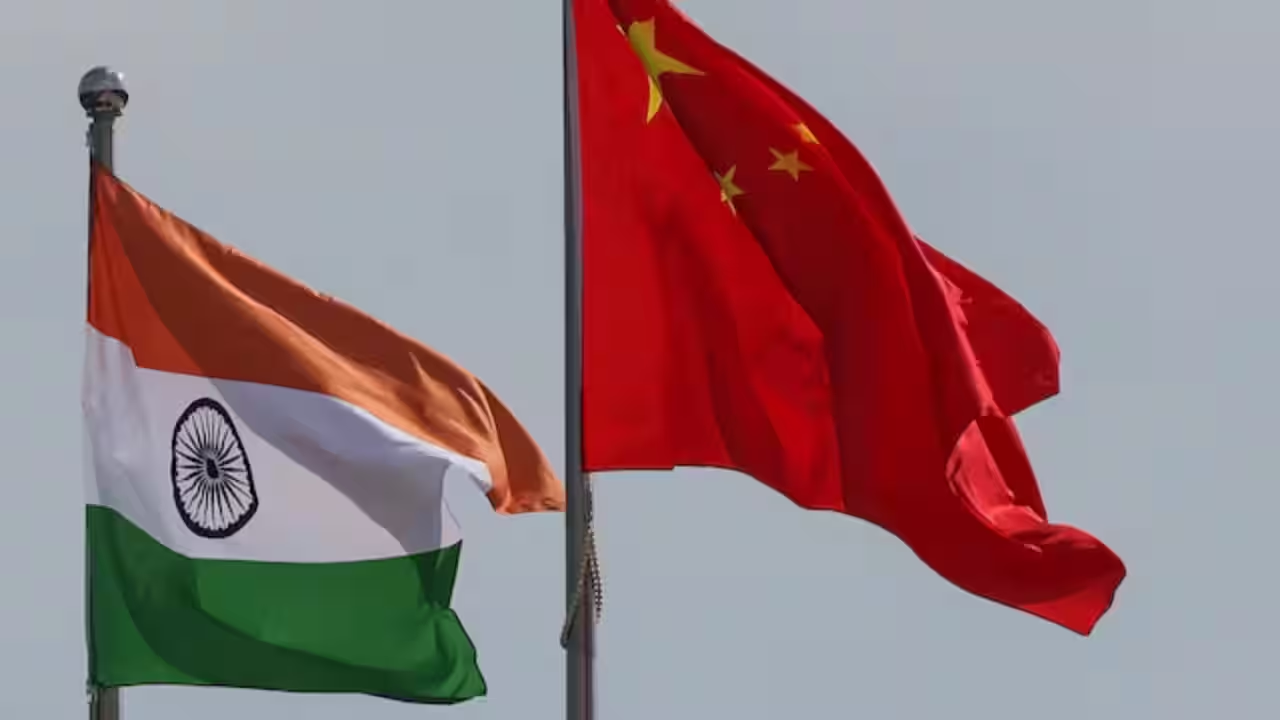
India has reportedly eased restrictions on Chinese procurement for public sector units as power sector stress intensifies. The move signals a pragmatic shift in policy to ensure uninterrupted supply chains and prevent disruptions in critical infrastructure projects.
India quietly easing China procurement curbs for PSUs has emerged as a significant development as the country grapples with rising power demand and infrastructure pressure. Since 2020, India had imposed tighter scrutiny on imports and contracts involving Chinese firms, especially for public sector undertakings, citing security and strategic concerns. The latest signals indicate a calibrated relaxation driven by immediate operational needs.
Policy shift driven by power sector challenges
India’s power sector has been under sustained pressure due to rising electricity demand, coal logistics constraints, and ongoing capacity expansion projects. Public sector units in power generation and transmission rely heavily on imported equipment such as turbines, boilers, and electrical components, many of which are sourced from Chinese manufacturers due to cost and availability advantages.
The government’s earlier procurement rules required prior approval for contracts involving companies from countries sharing a land border with India. While the policy aimed to reduce dependency and address national security concerns, it also slowed down project execution timelines.
Recent adjustments suggest that approvals are being processed faster or certain categories of procurement are being treated with more flexibility. This allows PSUs to avoid delays in ongoing projects, especially in thermal and renewable energy installations where equipment timelines are critical.
Balancing national security and economic realities
India’s approach reflects a balancing act between strategic caution and economic necessity. The restrictions introduced after 2020 were part of a broader effort to reduce reliance on Chinese imports across sectors. However, complete decoupling has proven difficult, particularly in infrastructure-heavy industries.
Chinese suppliers remain deeply integrated into global supply chains for power equipment, solar modules, and grid components. Domestic manufacturing capacity in India is growing but is not yet sufficient to fully replace imports in the short term.
By easing procurement curbs selectively, policymakers are attempting to ensure that critical projects are not stalled while continuing to encourage long-term self-reliance under initiatives like “Make in India.” This dual approach highlights the complexity of managing trade dependencies in a globalized economy.
Impact on PSUs and infrastructure projects
For public sector units, the easing of procurement restrictions could translate into faster project execution and reduced cost pressures. Delays in equipment sourcing often lead to cost overruns, which ultimately impact electricity tariffs and financial health of utilities.
Power generation companies, transmission firms, and renewable energy developers stand to benefit from smoother procurement processes. This is particularly relevant as India prepares for peak summer demand periods when electricity consumption typically surges.
The move may also help accelerate stalled projects and improve overall capacity addition timelines. In recent years, India has set ambitious targets for expanding renewable energy capacity alongside maintaining stable thermal power output. Reliable access to equipment is essential to meet these goals.
Industry reactions and strategic implications
Industry stakeholders have responded cautiously to the development. Many companies view the relaxation as a necessary step to address immediate challenges, while others emphasize the need to continue building domestic manufacturing capabilities.
There is also a geopolitical dimension. India’s trade relationship with China remains complex, marked by both economic interdependence and strategic rivalry. Any policy shift in procurement is likely to be closely watched both domestically and internationally.
Experts suggest that the easing is unlikely to signal a broader policy reversal. Instead, it appears to be a targeted response to sector-specific stress. Over the long term, India is expected to continue diversifying its supply chains and investing in local production.
What this means for India’s energy roadmap
India’s energy transition strategy depends on timely infrastructure development, including expansion of generation capacity and modernization of transmission networks. Procurement flexibility can play a key role in ensuring that these projects stay on track.
At the same time, policymakers will need to address structural issues such as domestic manufacturing gaps and supply chain resilience. The current situation underscores the importance of building a robust ecosystem that can support large-scale infrastructure growth without excessive external dependence.
As demand for electricity continues to rise, especially with increasing urbanization and industrial activity, ensuring stable and efficient power supply remains a top priority. Policy adjustments like this reflect the government’s willingness to adapt in response to evolving ground realities.
Takeaways
- India is easing China-related procurement restrictions for PSUs to address power sector stress
- The move aims to prevent project delays and ensure timely infrastructure development
- Domestic manufacturing gaps make short-term import flexibility necessary
- The policy shift reflects a balance between strategic caution and economic needs
FAQs
What are the China procurement curbs for PSUs?
These are restrictions requiring government approval for procurement from companies in countries sharing a land border with India, including China.
Why is India easing these restrictions now?
The power sector is facing stress due to rising demand and project delays, making faster procurement essential.
Does this mean India is reversing its China policy?
No, the easing appears to be selective and temporary, focused on addressing immediate operational challenges.
Which sectors are most affected by this change?
Primarily the power and infrastructure sectors, including generation, transmission, and renewable energy projects.