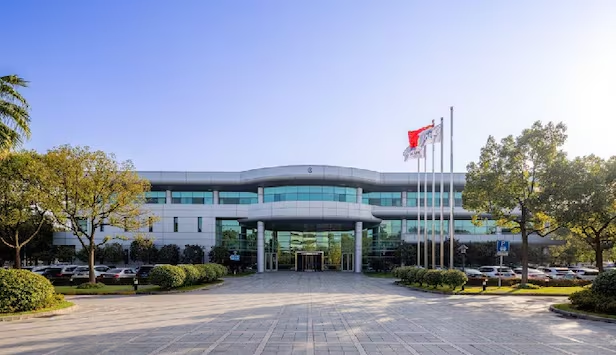
Washington has officially tightened the screws on China’s semiconductor ambitions by ordering top American equipment manufacturers to pause certain tool shipments to Hua Hong Semiconductor. The directive, issued via the Bureau of Industry and Security, specifically targets facilities suspected of developing advanced logic chips that could bolster China’s sovereign artificial intelligence capabilities. This administrative action bypasses the standard, lengthy rulemaking process, allowing for immediate enforcement against specific entities.
The primary targets of these letters include industry titans such as Applied Materials, Lam Research, and KLA Corporation. These companies are now required to secure special licenses before exporting sensitive lithography and etching materials to Hua Hong and its subsidiary, Huali Microelectronics. Analysts suggest this maneuver is a direct response to reports that Hua Hong has been quietly retooling its Shanghai-based Fab 6 to compete with industry leader SMIC in the 7nm process node.
Global Foundries and Toolmakers Trade in the Red
The ripple effects of the Washington directive have hit global equity markets with significant force this morning. In pre-market trading and Asian sessions, shares of major semiconductor equipment manufacturers saw steep declines. Lam Research and Applied Materials both slipped over 4 percent as investors weighed the potential loss of billions in Chinese revenue. The impact was not limited to US firms; global foundry giants like TSMC and Samsung also saw marginal retreats as fears of retaliatory trade measures from Beijing clouded the sector’s outlook.
In the secondary markets, the news has sparked a “de-risking” trend among tech-heavy portfolios. Investors are concerned that the widening scope of US export controls—now moving from memory giants to diversified foundries like Hua Hong—signals a permanent fragmentation of the global chip supply chain. This fragmentation threatens to increase production costs for consumer electronics and automotive chips, as manufacturers are forced to seek more expensive, non-restricted alternatives outside of the Chinese ecosystem.
Impact on China’s 7nm AI Chip Roadmap
The timing of this shipment halt is particularly critical for China’s “Big Fund” initiatives. Hua Hong had recently made strides in developing advanced 22nm and 14nm processes, with ambitious plans to reach 7nm by the end of 2026. By cutting off access to specialized American etching and deposition tools, the US effectively blocks the precision required for multi-patterning techniques used in sub-10nm manufacturing. Without these specific US-made components, Hua Hong’s progress toward indigenous AI chip production faces a multi-year setback.
Furthermore, the restrictions target Huali Microelectronics, the group’s contract manufacturing arm, which is rumored to be the primary partner for Huawei’s next-generation processors. If Hua Hong cannot source the necessary hardware to maintain its production yields, the broader Chinese tech ecosystem will remain heavily dependent on SMIC, creating a single point of failure for the nation’s domestic high-end computing needs. This bottleneck is precisely what the latest US policy aims to exploit to maintain a technological lead.
Geopolitical Tensions and the Upcoming May Summit
The escalation comes at a sensitive diplomatic juncture, with a high-level summit between US and Chinese leadership scheduled for later this month. Beijing’s Foreign Ministry has already expressed “strong dissatisfaction,” urging Washington to maintain the stability of global industrial chains. Market observers believe this move may be a leverage play by the Trump administration to secure concessions on broader trade and digital IP issues before the upcoming talks.
As the tech war enters this more aggressive phase, the focus shifts to how allies like the Netherlands and Japan will respond. The US is reportedly pressing for a unified front to include DUV (Deep Ultraviolet) lithography tools in these specific shipment bans. If a multilateral agreement is reached, the “silicon curtain” will be fully drawn, forcing a total decoupling of advanced chip manufacturing that could redefine global trade for the remainder of the decade.
Key Takeaways
- The US Department of Commerce halted tool shipments to Hua Hong to block its transition to 7nm chip production.
- Major toolmakers Applied Materials and Lam Research saw stock declines exceeding 4 percent due to high revenue exposure in China.
- The restrictions utilize “is-informed” letters to bypass traditional regulatory delays for immediate national security enforcement.
- This move increases pressure on China’s domestic AI chip roadmap and its strategic partnership with Huawei.
Frequently Asked Questions
What are “is-informed” letters in US export policy?
These are specific notices sent by the Bureau of Industry and Security that inform companies they need a license for certain exports because of a high risk of diversion to a military end-use or a restricted program. They allow the government to act swiftly without changing general export laws.
How will this affect global smartphone and car prices?
While the ban focuses on advanced 7nm nodes used for AI, any disruption to major foundries like Hua Hong can lead to a shift in manufacturing loads. This often increases lead times and costs for the “mature” chips used in cars and consumer electronics.
Can Hua Hong replace US tools with Chinese alternatives?
While China has domestic toolmakers like AMEC and Naura, they still rely on global components for the highest precision levels. Replacing the entire stack for sub-14nm production is currently considered a 5 to 10 year challenge for the Chinese industry.
Why is the 7nm node so important in this trade war?
The 7nm node is the threshold for high-performance AI processors and advanced mobile CPUs. Controlling access to the equipment needed for this node ensures that the most powerful AI hardware remains tied to Western-aligned supply chains.