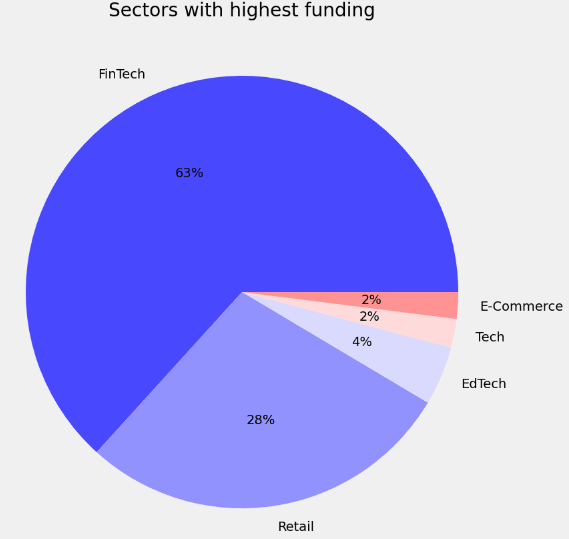
Fintech led Indian startup funding charts in a late April surge, reflecting strong investor interest in digital finance solutions. The trend highlights continued confidence in fintech business models despite an overall cautious funding environment across the startup ecosystem.
Fintech leads Indian startup funding surge in late April
Fintech leads Indian startup funding charts in late April surge, making this a time sensitive development tied to current deal activity. The sector accounted for a significant share of capital raised during the period, even as total funding levels remained below previous peaks.
Investors are prioritizing fintech due to its strong growth potential and alignment with India’s expanding digital economy. The adoption of digital payments, lending platforms, and financial inclusion initiatives has created a robust foundation for fintech innovation.
The late April surge reflects a cluster of deals closing within a short timeframe, indicating that capital is still available for sectors with proven demand and scalable business models.
Digital payments and lending drive fintech investment momentum
The fintech funding surge is largely driven by segments such as digital payments, lending platforms, and financial infrastructure. These areas continue to benefit from high transaction volumes and increasing user adoption.
India’s payments ecosystem, supported by platforms like National Payments Corporation of India, has enabled fintech companies to scale rapidly. Unified Payments Interface has become a backbone for digital transactions, creating opportunities for startups to build value added services.
Lending fintechs are also attracting investor interest as they address credit gaps in both consumer and small business segments. Data driven underwriting models and faster loan disbursement processes have improved efficiency and accessibility.
These factors make fintech one of the most resilient sectors in the current funding environment.
Investor preference shifts toward scalable and revenue driven models
The late April funding activity highlights a broader shift in investor behavior. Capital is flowing toward startups that demonstrate clear revenue streams, sustainable unit economics, and strong customer engagement.
Fintech companies often meet these criteria due to their transaction based business models and recurring revenue potential. This makes them attractive compared to sectors that rely heavily on customer acquisition spending without immediate returns.
Investors are also focusing on startups that can scale efficiently with technology. Fintech platforms, by design, are able to expand user bases without proportional increases in operational costs.
This preference for scalable and revenue driven models is shaping the overall funding landscape, with fintech emerging as a key beneficiary.
Funding surge contrasts with broader startup slowdown
While fintech has led funding charts, the broader startup ecosystem continues to face a slowdown. Total funding levels remain lower compared to previous years, and large ticket deals are still limited.
Late stage funding in particular has been affected by weak IPO markets and limited exit opportunities. However, fintech startups have managed to attract capital even in this environment due to their strong fundamentals.
This contrast highlights the uneven nature of the current funding cycle. Certain sectors continue to thrive, while others struggle to secure investment.
The ability of fintech to outperform during a slowdown reinforces its importance within India’s startup ecosystem.
Regulatory support and market demand sustain fintech growth
Regulatory developments have also played a role in supporting fintech growth. Policies aimed at improving financial inclusion and strengthening digital infrastructure have created a favorable environment for innovation.
At the same time, consumer demand for digital financial services continues to rise. Increasing smartphone penetration and internet access have expanded the reach of fintech solutions across urban and rural areas.
Startups are leveraging these trends to build products that cater to a wide range of users, from individuals to small businesses. This broad market appeal further strengthens investor confidence.
The combination of regulatory support and market demand positions fintech as a long term growth sector.
What the fintech surge means for investors and startups
The late April surge in fintech funding signals that investors are not retreating from the market but are becoming more selective. Sectors that offer clear value and scalability continue to attract capital.
For startups, this means that aligning business models with investor expectations is critical. Companies that can demonstrate efficiency, profitability, and growth potential are more likely to secure funding.
For investors, fintech offers opportunities to invest in a sector with strong fundamentals and long term demand. However, competition is intensifying as more players enter the market.
The current trend suggests that fintech will remain a dominant force in India’s startup funding landscape in the near term.
Takeaways
- Fintech led Indian startup funding charts in a late April surge
- Digital payments and lending are key drivers of fintech investment
- Investors are focusing on scalable and revenue driven business models
- The broader startup ecosystem remains cautious despite fintech growth
FAQs
Q1. Why is fintech attracting more funding in India?
Fintech offers scalable business models, strong revenue potential, and aligns with India’s digital economy growth.
Q2. Which fintech segments are seeing the most investment?
Digital payments and lending platforms are leading due to high demand and user adoption.
Q3. Is overall startup funding recovering?
Funding remains cautious overall, but certain sectors like fintech are performing better than others.
Q4. What role does regulation play in fintech growth?
Supportive policies and digital infrastructure have created a favorable environment for fintech innovation.