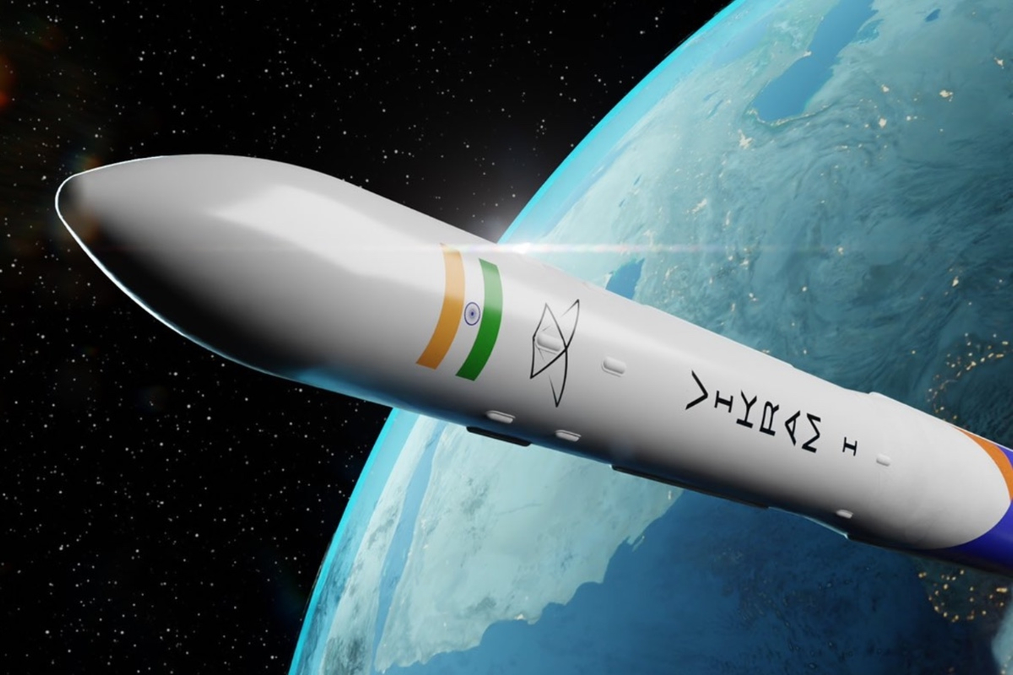
Skyroot Aerospace is set to launch Vikram-1, India’s first privately developed orbital rocket, from Sriharikota on July 18. The mission is a major milestone for India’s private space sector and reflects the country’s growing ambitions in the global commercial launch market.
The Skyroot Vikram-1 launch has become one of the most significant technology stories in India this week. Scheduled for July 18 from the Satish Dhawan Space Centre in Sriharikota, Vikram-1 will be the first privately developed Indian rocket to attempt placing payloads into orbit. The mission, named Aagaman, represents a defining moment for India’s private space industry and demonstrates how the country’s space reforms are beginning to produce globally competitive launch companies.
This is a time-sensitive news story. The reporting below reflects the latest confirmed information available ahead of the scheduled launch.
Vikram-1 Becomes India’s First Private Orbital Rocket
Skyroot Aerospace was founded in Hyderabad in 2018 by former ISRO scientists with the vision of building affordable launch vehicles for the commercial satellite market. The company gained international attention in 2022 after successfully launching Vikram-S, India’s first privately built suborbital rocket.
Vikram-1 is considerably more advanced. It is an orbital-class launch vehicle capable of deploying satellites into Low Earth Orbit. Standing roughly the height of a seven-storey building, the rocket uses three solid propulsion stages along with a restartable liquid-fuel upper stage designed for accurate satellite deployment.
The maiden mission is primarily a technology demonstration. Engineers will evaluate propulsion performance, stage separation, guidance systems, navigation, telemetry and orbital insertion before moving toward regular commercial launches. Skyroot has already validated nearly 80 percent of the rocket’s technologies through earlier testing programmes, reducing technical risk ahead of launch.
India’s Space Reforms Are Creating New Commercial Opportunities
The Vikram-1 launch comes at a time when India’s space sector is undergoing its biggest transformation in decades.
For many years, ISRO handled almost every major launch activity in the country. That changed after the government introduced reforms allowing private companies to develop rockets, satellites and launch services. The establishment of the Indian National Space Promotion and Authorization Centre, better known as IN-SPACe, has encouraged startups and private investment across the sector.
Skyroot has become one of the leading beneficiaries of these reforms. Rather than replacing ISRO, companies like Skyroot are expected to complement the national space programme by focusing on commercial launches and serving international customers.
Industry experts believe a successful Vikram-1 mission would demonstrate that India’s private sector can independently develop sophisticated launch vehicles while strengthening the country’s reputation as a reliable space technology destination.
Mission Aagaman Targets the Growing Small Satellite Market
Demand for launching small satellites has increased rapidly over the past decade. Governments, universities, research organisations and private companies are deploying satellites for communication, Earth observation, navigation, climate monitoring and scientific research.
Vikram-1 has been designed specifically to serve this expanding market. According to Skyroot, the maiden mission will carry multiple technology payloads from Indian and international customers, providing an opportunity to demonstrate both the rocket’s engineering capability and its commercial potential.
The company plans to use this first mission to validate its launch systems before beginning routine commercial operations. If successful, Vikram-1 could position Skyroot to compete with established global launch providers in the rapidly growing small satellite segment.
Why the Launch Matters Beyond the Space Industry
The importance of Vikram-1 extends far beyond a single rocket launch.
A successful mission would highlight India’s progress in advanced manufacturing, aerospace engineering, precision electronics and deep technology innovation. It would also provide confidence to domestic and international investors that Indian startups are capable of executing highly complex engineering projects.
The launch is equally significant for India’s startup ecosystem. Deep technology companies typically require years of research before generating commercial revenue, making investor confidence critical. Demonstrating orbital launch capability could encourage additional venture capital investment across India’s growing space technology sector.
For policymakers, the mission validates recent reforms that opened the space sector to private participation. It also supports India’s long-term objective of increasing its share of the global space economy by encouraging innovation beyond government institutions.
A Defining Test for India’s Commercial Space Ambitions
Although Vikram-1 is officially classified as a developmental mission, its outcome will be watched closely across the global aerospace industry.
Every milestone achieved during the flight, including liftoff, stage separation, navigation accuracy and orbital insertion, will provide valuable engineering data for future launches. Even if improvements are required after the maiden mission, successfully executing India’s first private orbital launch campaign would itself represent a historic achievement.
The mission also signals the growing maturity of India’s private space ecosystem. With startups developing launch vehicles, satellites, propulsion systems and space applications, the country is steadily building a diversified commercial space industry.
As the countdown approaches, Vikram-1 has become more than a technology demonstration. It represents India’s confidence in private innovation and its ambition to become a major player in the global commercial space economy.
Takeaways
- Vikram-1 is India’s first privately developed orbital launch vehicle and is scheduled for launch on July 18.
- The mission aims to validate Skyroot Aerospace’s orbital launch technology before commercial operations begin.
- The launch highlights the success of India’s private space sector reforms and expanding startup ecosystem.
- A successful mission could strengthen India’s position in the global commercial satellite launch industry.
Frequently Asked Questions
Q1. What is Vikram-1?
Vikram-1 is an orbital-class rocket developed by Skyroot Aerospace to place small satellites into Low Earth Orbit.
Q2. Why is this launch important?
It is India’s first attempt to launch a privately developed orbital rocket, making it a landmark event for the country’s commercial space industry.
Q3. Where will Vikram-1 be launched from?
The rocket will lift off from the First Launch Pad at the Satish Dhawan Space Centre in Sriharikota.
Q4. What does the mission mean for India’s private space sector?
A successful launch would validate India’s growing private launch capabilities, strengthen investor confidence and support the country’s ambition to become a leading global space economy.