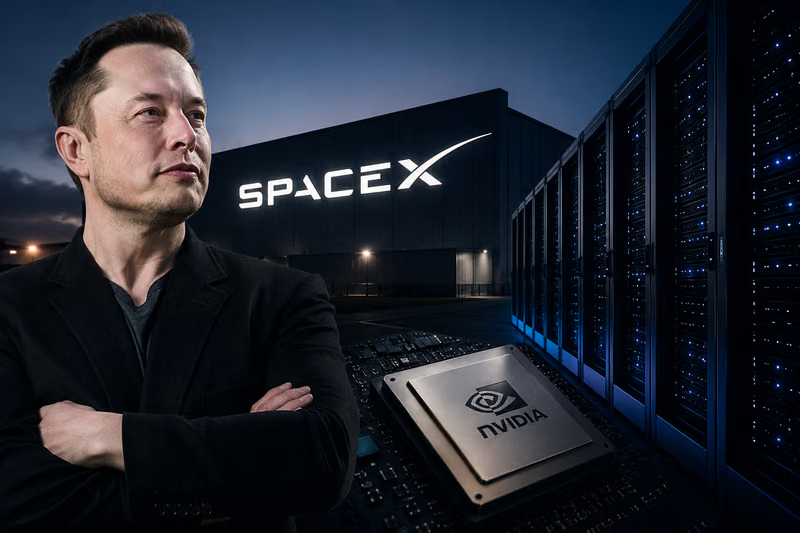
SpaceX’s latest earnings have renewed investor attention on one of the biggest themes shaping global markets in 2026, the rapid expansion of AI infrastructure. While the company’s revenue growth impressed Wall Street, its aggressive spending on artificial intelligence, cloud computing, and data centre capacity has also raised fresh questions about how much investment the AI boom will require and when those investments will begin delivering sustained profits.
The latest earnings report confirms that AI infrastructure has become a core business strategy rather than a side project. Investors are increasingly evaluating companies not only on revenue growth but also on their ability to build the computing power needed to support generative AI, enterprise software, autonomous systems, and large language models. SpaceX’s results have therefore become a broader indicator of where the AI economy is heading.
Strong Revenue but Massive AI Investment Remains the Focus
SpaceX reported quarterly revenue of approximately $7.8 billion, comfortably ahead of analyst expectations, driven by strong performance across its launch business, Starlink satellite internet services, and AI operations. However, investors paid even closer attention to the company’s capital expenditure, which was significantly higher than expected as management accelerated spending on AI infrastructure.
The company continues investing billions of dollars into advanced computing facilities, graphics processing units, cloud infrastructure, and AI model development. These investments are intended to support both internal artificial intelligence projects and commercial computing services offered to enterprise customers.
Despite strong revenue growth, the scale of AI investment resulted in a quarterly net loss, highlighting the enormous financial commitment required to compete in the global AI race. Analysts noted that while near term profitability remains under pressure, management believes these investments will support long term growth across multiple business segments.
AI Infrastructure Is Becoming the New Competitive Battlefield
The discussion following SpaceX’s earnings extends far beyond one company’s financial results. Across the technology sector, companies are investing heavily in AI infrastructure as demand for computing power continues to surge.
Large language models, AI assistants, autonomous systems, enterprise automation, scientific research, and cloud applications all require enormous processing capacity. As a result, businesses are competing to build advanced data centres equipped with specialised AI chips capable of handling increasingly complex workloads.
SpaceX has indicated that much of its AI revenue is already being generated through enterprise cloud agreements, demonstrating that commercial demand for large scale computing infrastructure continues to grow rapidly. This supports a broader trend seen across the technology industry, where AI infrastructure providers are emerging as major beneficiaries of digital transformation.
Starlink and Space Business Continue Supporting Growth
Although AI attracted the most attention, Starlink remained one of SpaceX’s strongest financial contributors. Satellite broadband services continued expanding across consumer, enterprise, aviation, and government markets, providing a relatively stable source of recurring revenue.
Meanwhile, the company’s launch operations continued advancing Starship development, which remains central to SpaceX’s long term strategy of reducing launch costs and expanding commercial space activity.
Executives believe these businesses complement the AI division by generating cash flow while enabling future opportunities in communications, defence, cloud services, and potentially space based computing infrastructure.
Analysts, however, continue to point out that the company’s long term valuation depends not only on technological innovation but also on successfully converting heavy investment into sustainable earnings growth.
Investors Debate Whether AI Spending Is Sustainable
The earnings report has intensified debate among investors regarding the pace of AI investment across the technology sector.
Supporters argue that today’s capital spending resembles the early expansion of cloud computing, where companies invested heavily before eventually generating strong recurring profits. They believe businesses that build computing infrastructure today will control one of the most valuable segments of tomorrow’s digital economy.
Others remain cautious. Massive capital expenditure creates pressure on profitability and increases financial risk if enterprise demand slows or competition intensifies. Investors are therefore becoming increasingly selective, rewarding companies that demonstrate measurable AI revenue instead of simply announcing ambitious technology plans.
SpaceX’s earnings illustrate both sides of this debate. Revenue growth remains exceptionally strong, but maintaining leadership in AI infrastructure requires continuous investment measured in billions of dollars.
Why the Earnings Matter Beyond SpaceX
SpaceX’s financial results have become an important signal for the broader market because they highlight how artificial intelligence is reshaping investment priorities across industries.
Semiconductor manufacturers, cloud computing companies, power infrastructure providers, networking firms, and data centre operators all stand to benefit if AI adoption continues accelerating. At the same time, companies without sufficient computing capacity may struggle to remain competitive as AI becomes integrated into everyday business operations.
The latest earnings reinforce a growing consensus that the next phase of the AI boom will depend less on software announcements and more on the physical infrastructure needed to support advanced computing at global scale.
As investors continue analysing quarterly earnings from major technology companies, AI infrastructure spending is likely to remain one of the most closely watched indicators of future market direction.
Takeaways
- SpaceX reported strong quarterly revenue while continuing aggressive investment in AI infrastructure.
- Heavy capital expenditure has reignited debate over the cost and sustainability of the global AI boom.
- Enterprise demand for AI computing services continues supporting growth in cloud infrastructure.
- Investors are increasingly focusing on companies that convert AI investments into measurable business performance.
FAQ
Q1. Why did SpaceX’s earnings attract attention from investors?
The earnings highlighted strong revenue growth alongside significant investment in AI infrastructure, making the report an important indicator of how technology companies are funding the next phase of artificial intelligence development.
Q2. What is AI infrastructure?
AI infrastructure includes data centres, AI processors, cloud computing platforms, networking equipment, storage systems, and software required to train and operate advanced artificial intelligence models.
Q3. Why are companies spending billions on AI infrastructure?
Growing demand for generative AI, enterprise automation, cloud services, and machine learning applications requires far greater computing capacity than traditional digital services.
Q4. What does SpaceX’s earnings indicate about the AI market?
The results suggest that AI remains a major growth opportunity, but companies will need sustained investment before achieving long term profitability from large scale AI infrastructure.