
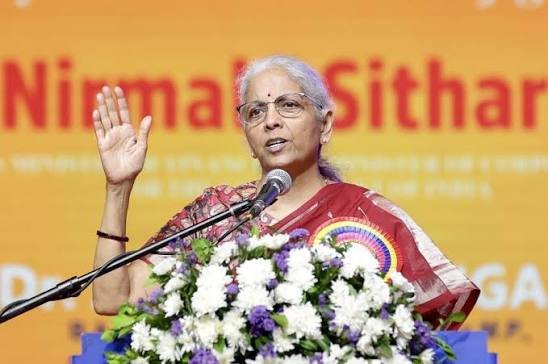
The Centre has brought state and Union Territory finance ministers and finance secretaries together in New Delhi for a two-day conference on financing India’s development journey towards Viksit Bharat. The September 18-19 meeting will focus on financing challenges, policy coordination and investment priorities.
Centre Calls State Finance Ministers for Funding Talks
The Union Finance Ministry is holding the conference titled Financing India’s Journey towards Viksit Bharat on September 18 and 19, 2026. Finance ministers and finance secretaries from states and Union Territories with legislatures are participating, along with several chief ministers and senior state officials. Finance Minister Nirmala Sitharaman is also attending the meeting.
The meeting comes as the Centre and states face the challenge of financing infrastructure, agriculture, energy and other development priorities while maintaining fiscal discipline.
Rather than focusing on a single funding scheme, the conference is designed around broader financing challenges and policy priorities. The Finance Ministry said the discussions will examine policy complementarities between the Centre and states and combine academic perspectives with practical policymaking.
The timing makes the meeting significant for state governments that are looking at ways to expand capital spending and attract private investment while managing their own fiscal constraints.
Viksit Bharat Financing Takes Centre Stage
The conference is focused on the financing requirements associated with India’s longer-term development goals under the Viksit Bharat framework.
According to the Finance Ministry, discussions are being organised around macroeconomic developments, agricultural transformation and the energy transition. These areas require substantial investment from both public and private sources, making financing mechanisms a central issue for policymakers.
The discussions are also expected to look at how private investment can be mobilised for development projects.
For states, this is particularly relevant because many large infrastructure and economic projects require coordination between state governments, central ministries, financial institutions and private companies.
The conference therefore brings together policymakers who control different parts of the public investment process. The objective is to examine where policies can complement one another and where financing gaps may need new approaches.
The Centre has framed the event as part of the broader effort to coordinate national and state-level economic priorities.
State Funding Needs Meet Private Investment Push
One of the key themes is how India can mobilise more private capital for development.
Government budgets alone cannot finance every infrastructure requirement. Roads, logistics networks, industrial projects, renewable energy facilities and urban infrastructure can require long-term funding that involves banks, institutional investors and private companies.
The Finance Ministry’s conference is expected to examine ways to leverage private investment alongside government resources.
For state governments, attracting private investment can also support employment, industrial development and expansion of local economic activity.
However, private capital generally depends on the availability of viable projects, predictable regulations, suitable returns and clear implementation frameworks. State-level policies can therefore have a direct influence on whether investors are willing to commit funds.
The discussions in New Delhi are taking place against this wider financing challenge, with the Centre and states looking at ways to improve coordination rather than treating public and private investment as separate tracks.
Agriculture Financing Gets Separate Attention
Agricultural transformation is another major theme at the two-day conference.
Agriculture remains closely connected to rural incomes, food supply chains, processing industries and exports. Financing in this sector is therefore not limited to farm credit. It can also include investment in storage, irrigation, logistics, food processing, agricultural markets and technology.
The conference is expected to examine agricultural market development alongside wider financing issues.
Better market infrastructure can help connect farmers with buyers and reduce inefficiencies across supply chains. But such projects often require coordination between state governments, central schemes and private-sector participants.
States also have different agricultural structures, resource availability and infrastructure requirements. A financing model that works in one state may not necessarily fit another.
The Centre’s effort to bring state finance officials into the same discussion provides an opportunity to compare these requirements and examine how policy and funding can be better aligned.
Energy Transition Creates New Financing Demands
Energy transition is the third major theme identified for the conference.
India’s shift towards cleaner energy requires investment across several areas, including renewable power generation, electricity transmission, storage and emerging technologies.
The conference is also expected to discuss green energy infrastructure and carbon capture technologies.
These investments involve long project timelines and can require substantial upfront capital. Governments therefore face the challenge of creating financing structures that can support infrastructure development without placing excessive pressure on public finances.
States are particularly important to the energy transition because land, electricity distribution, industrial development and several implementation responsibilities fall within state-level systems.
Coordination between the Centre and states can consequently influence how quickly large energy projects move from planning to execution.
The financing discussion is not only about finding money for individual projects. It is also about creating conditions that allow different sources of capital to participate.
Macroeconomic Conditions Add to Financing Challenge
The conference comes at a time when global and domestic financial conditions remain important for Indian borrowers.
Interest rates, inflation, exchange rates, commodity prices and global capital flows can influence the cost of raising funds. State governments and companies operating within their economies are affected by these conditions in different ways.
Recent movements in global interest rates have also raised questions around external borrowing costs for Indian companies. At the same time, elevated energy prices can increase pressure on import costs and public finances.
For state governments, the financing challenge therefore extends beyond budget allocations. The cost of borrowing and the availability of investment capital can affect the pace at which infrastructure projects are executed.
This makes macroeconomic discussions an important part of the New Delhi conference.
The Finance Ministry has positioned the event as a forum for examining these broader financing conditions alongside sector-specific priorities.
Technology and Governance Also Enter Discussion
The conference will also examine how technology can support better measurement of development outcomes and improve governance.
For policymakers, measuring whether public spending is producing the intended economic and social outcomes is becoming increasingly important.
Technology can help governments track projects, monitor spending, analyse data and assess outcomes. Better measurement can also provide policymakers with more information when deciding where additional public funding may be required.
The Finance Ministry has highlighted the importance of measuring growth outcomes and integrating new technologies into governance discussions.
This adds a performance dimension to the financing debate.
Instead of looking only at how much money is allocated, governments increasingly need to examine how effectively funds are converted into infrastructure, services, jobs and economic activity.
The approach could become particularly relevant for large multi-year projects where outcomes depend on coordination between multiple government departments.
Centre-State Coordination Becomes Key
The participation of state finance ministers and finance secretaries puts cooperative policymaking at the centre of the conference.
States are responsible for a substantial share of public spending and have different development priorities. Some may require greater investment in urban infrastructure, while others may focus on agriculture, industrial corridors, energy or transport.
The Centre, meanwhile, controls national-level policy frameworks, central schemes and a significant portion of public financial resources.
Bringing these policymakers together allows financing issues to be discussed from both perspectives.
The Finance Ministry has described the conference as a platform for examining policy complementarities between the Centre and states.
That does not mean the meeting automatically results in new funding announcements. The immediate purpose is discussion, coordination and policy deliberation around India’s development financing requirements.
Any specific financial measures or policy decisions would depend on subsequent government announcements.
What the Two-Day Meeting Could Shape
The September 18-19 conference places financing at the centre of India’s Viksit Bharat development agenda.
The discussions span three areas with major investment requirements: macroeconomic policy, agricultural transformation and energy transition. They also include private investment, green infrastructure, agricultural markets, carbon capture and technology-enabled governance.
For businesses and investors, the outcome could be relevant if the discussions eventually translate into changes in financing frameworks, project pipelines or Centre-state investment coordination.
For states, the focus is on how development priorities can be financed while maintaining fiscal sustainability.
The meeting itself is a policy discussion rather than a single funding package. Its significance will ultimately depend on what proposals emerge from the deliberations and whether they are followed by concrete policy or financing measures.
For now, the Centre’s decision to bring state finance leadership together signals that financing India’s long-term development is being treated as a shared Centre-state policy challenge.
Key Takeaways
- The Union Finance Ministry is holding a two-day conference on September 18-19 in New Delhi focused on financing India’s journey towards Viksit Bharat.
- Finance ministers and finance secretaries from states and eligible Union Territories are participating, along with several chief ministers and senior officials.
- The main themes include macroeconomic developments, agricultural transformation and the energy transition.
- Discussions are also expected to cover private investment, agricultural market development, green energy infrastructure, carbon capture and technology-enabled governance.
FAQ
Why is the Centre meeting state finance ministers?
The Finance Ministry is bringing state finance ministers and finance secretaries together to discuss financing challenges and policy priorities connected with India’s development journey towards Viksit Bharat.
When is the Viksit Bharat financing conference being held?
The two-day conference is being held in New Delhi on September 18 and 19, 2026. The Union Finance Minister is participating along with state-level political and administrative officials.
What are the main subjects being discussed?
The conference covers macroeconomic developments, agricultural transformation and the energy transition. Discussions also include private investment, agricultural markets, green energy infrastructure, carbon capture technologies and the use of technology in governance.
Does the conference announce a new funding package for states?
The Finance Ministry has described the event as a conference for deliberating on financing challenges, policy complementarities and development priorities. The announcement of the conference itself does not establish a new blanket funding package for states.
(Internal keyword suggestions: Viksit Bharat financing, state finance ministers meeting, Centre state finance meeting, India development financing, Viksit Bharat 2047, Finance Ministry conference 2026, state government funding, India infrastructure financing, agricultural financing India, energy transition financing India)