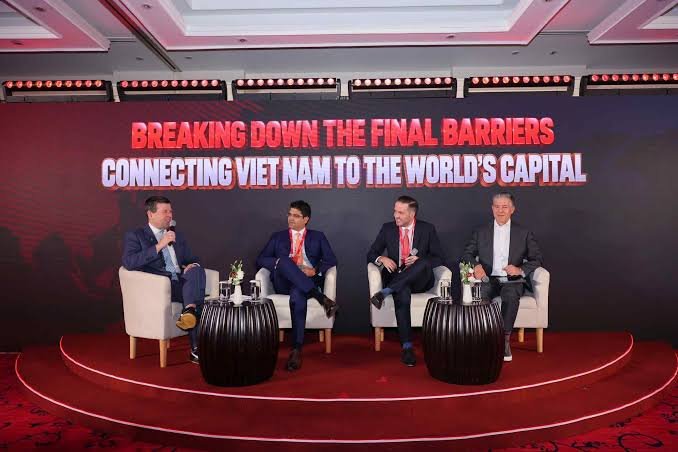
Vietnam has officially entered FTSE Russell’s Secondary Emerging Market category, opening the door to potentially up to $6 billion in foreign investment. The September 21 upgrade follows years of market reforms and could increase Vietnam’s exposure to global institutional investors through phased index inclusion.
Vietnam Enters FTSE Emerging Market Indexes
Vietnam’s stock market officially joined FTSE Russell’s emerging market indexes on September 21, marking the completion of a reclassification process that began years ago. FTSE Russell moved Vietnam from Frontier Market to Secondary Emerging Market status after reviewing reforms aimed at improving foreign investor access and market infrastructure.
The upgrade places Vietnam alongside markets such as China, India, Indonesia, Malaysia, the Philippines and Thailand within FTSE Russell’s emerging market universe.
The change matters because global investment funds frequently use major equity indexes as benchmarks for allocating capital. When a country moves into a broader index category, companies from that market can become eligible for consideration by funds that track or benchmark against the relevant indexes.
FTSE Russell estimates that the reclassification could channel up to $6 billion into Vietnamese equities as funds adjust their portfolios. That figure is an estimate rather than a guaranteed inflow, and the money is expected to arrive gradually rather than in a single transaction.
FTSE Upgrade Follows Years of Market Reforms
Vietnam’s move into the emerging market category did not happen overnight.
FTSE Russell first placed Vietnam on its watchlist for possible reclassification in 2018. Since then, Vietnamese authorities have worked on several aspects of market accessibility and trading infrastructure.
One important development was the move away from mandatory pre-funding requirements for foreign institutional investors. Vietnam also introduced a framework designed to give international investors access through global brokers and established procedures for handling failed trades.
FTSE Russell said in its April 2026 review that Vietnam had made sufficient progress on the Global Broker model and confirmed that the September reclassification could proceed. The index provider said Vietnam met the criteria for Secondary Emerging Market status under its equity country classification framework.
The reforms were important because international funds need predictable trading, settlement and custody arrangements when entering a market at scale.
$6 Billion Inflow Will Happen in Phases
The expected capital inflow will not arrive all at once.
Vietnamese equities are being added to FTSE Russell’s global equity indexes through several stages. The initial inclusion began with a 10% inclusion factor in September 2026. That is scheduled to rise to 20% in March 2027, followed by 35% in June 2027 and another 35% in September 2027.
The phased structure is intended to make the transition more orderly and accommodate the capacity of Vietnam’s local market.
For investors, each phase can create another round of portfolio adjustments by passive funds and other investors that benchmark against FTSE indexes.
That means the September 21 upgrade is only the beginning of the reclassification process. The effect on Vietnamese stocks could therefore develop over several quarters rather than being concentrated around the initial inclusion date.
Vanguard Plans Around $2.5 Billion in Vietnam
The FTSE upgrade has already been accompanied by increased interest from large international investors.
Vanguard’s Asia-Pacific investment management division said it expects to invest approximately $2.5 billion in Vietnam over the coming years. The figure is separate from the broader $6 billion estimate for potential capital flows associated with the FTSE reclassification.
Foreign investor activity also increased before the official upgrade. Reuters reported that overseas investors purchased a net 2.7 trillion Vietnamese dong, equivalent to about $104 million, in Vietnamese shares during the week from September 14 to September 18.
However, foreign investors were still net sellers in Vietnam over the longer period. This shows that the FTSE upgrade has attracted fresh interest but has not completely reversed existing foreign selling patterns.
The actual pace of new investment will depend on index weights, market liquidity, company eligibility and the investment decisions of active and passive funds.
Banks and Large Listed Companies Could See More Attention
The companies receiving increased attention are likely to be those that meet FTSE’s investability requirements, including sufficient market capitalisation, liquidity and free float.
FTSE Russell identified 27 Vietnamese stocks for inclusion in its indexes. Companies mentioned in reporting around the reclassification include Vingroup, FPT and Hoa Phat, among other large Vietnamese businesses.
Banks are particularly important in the Vietnamese stock market because of their large representation among listed companies.
Reuters reported that FTSE’s inclusion could bring additional demand for stocks such as Vingroup, FPT and Hoa Phat, while research firms have identified several other large companies that could receive passive fund flows as the inclusion factor increases.
The impact will not necessarily be identical across all companies. Stocks with higher foreign ownership headroom and greater free float can be more accessible to international investors than companies where ownership restrictions limit foreign participation.
Vietnam Stocks Did Not Rally Immediately
Despite the long-awaited upgrade, Vietnam’s benchmark stock market did not deliver a straightforward rally when the reclassification became effective.
The VN-Index fell on September 21, its first day in the FTSE emerging market benchmarks. Foreign investors were also net sellers on that day, according to local market data.
The reaction highlights an important distinction between a market’s long-term index status and its short-term trading performance.
Some investors may have positioned themselves before the official reclassification, meaning part of the expected impact could already have been reflected in share prices. Others may wait for subsequent inclusion phases before increasing their exposure.
The Business Times also reported that Vietnamese stocks slipped on the first day of the new classification, suggesting that investors were looking beyond the headline upgrade toward the timing and scale of actual fund flows.
Foreign Ownership Limits Remain a Challenge
Vietnam’s emerging market upgrade does not eliminate all barriers for international investors.
Foreign ownership limits remain an issue for some Vietnamese companies. The availability of shares that foreign investors can actually purchase, known as free float or foreign ownership headroom, can influence how much capital can enter individual stocks.
This is particularly important because index inclusion does not mean every company receives the same amount of foreign investment.
Analysts cited by Fortune noted that the composition of the Vietnamese market can create a mismatch between the country’s export-driven economy and the listed companies that qualify for major global indexes. Financial companies make up a substantial portion of the stocks eligible for international index exposure.
That means the economic benefits of the FTSE upgrade may not be distributed evenly across Vietnam’s corporate sector.
MSCI Upgrade Remains a Separate Question
Vietnam’s FTSE reclassification should not be confused with an MSCI emerging market upgrade.
MSCI continues to classify Vietnam as a Frontier Market. Its assessment uses a separate framework and includes market accessibility requirements that Vietnam has not yet fully satisfied.
One area being watched is the development of a central counterparty clearing mechanism. Vietnamese authorities have been working on further market infrastructure reforms that could improve the country’s prospects for eventual MSCI reclassification.
An MSCI upgrade would be a separate process and is not automatically triggered by the FTSE decision.
For now, the FTSE move represents a significant step in Vietnam’s integration into global capital markets, while further reforms will determine whether the country can attract a broader range of international investors over time.
Vietnam’s Capital Market Gets a New Global Role
The immediate financial impact of the FTSE upgrade will depend on how much money actually enters Vietnamese equities and how quickly it arrives.
The potential $6 billion figure is important because it gives investors a sense of the possible scale of new foreign demand. But the final amount will depend on fund mandates, index weights, liquidity and the ability of Vietnamese companies to absorb foreign investment.
Vietnam’s government also sees deeper capital markets as a way to diversify financing beyond bank credit. The country has set a goal of raising substantial capital through its markets by 2030.
The September upgrade therefore has implications beyond individual stocks. It places Vietnam more firmly inside the investment universe followed by global institutional investors and gives its financial market reforms greater international visibility.
The next major milestones will be the subsequent FTSE inclusion phases in 2027 and Vietnam’s continued work on foreign investor access, clearing infrastructure and market transparency.
Key Takeaways
- Vietnam entered FTSE Russell’s Secondary Emerging Market category on September 21, 2026, after years of market reforms.
- FTSE Russell estimates the reclassification could channel up to $6 billion into Vietnamese equities, but the figure is an estimate rather than guaranteed investment.
- Index inclusion will be phased through 2027, with the inclusion factor increasing from 10% initially to 20% in March and 35% in June and September.
- Vanguard has said it expects to invest approximately $2.5 billion in Vietnam over the coming years, while foreign ownership and market-access constraints remain important issues.
FAQ
Why was Vietnam upgraded by FTSE Russell?
Vietnam was upgraded after making progress on market accessibility and infrastructure, including reforms around foreign investor trading, non-prefunding and global broker access. FTSE Russell confirmed that Vietnam met the requirements for Secondary Emerging Market status.
How much foreign investment could Vietnam receive?
FTSE Russell estimates that the reclassification could channel up to $6 billion into Vietnamese equities. This is a potential capital-flow estimate, not a confirmed investment commitment. Actual inflows will depend on index funds, active investors, stock eligibility and market conditions.
When will Vietnam receive the full FTSE inclusion?
The inclusion is being phased in. The initial 10% inclusion began in September 2026, followed by planned increases to 20% in March 2027 and 35% in both June and September 2027.
Is Vietnam now an emerging market under MSCI too?
No. The FTSE Russell upgrade and MSCI classification are separate. MSCI continues to classify Vietnam as a Frontier Market, with further market-access and infrastructure requirements still relevant to any future reclassification.