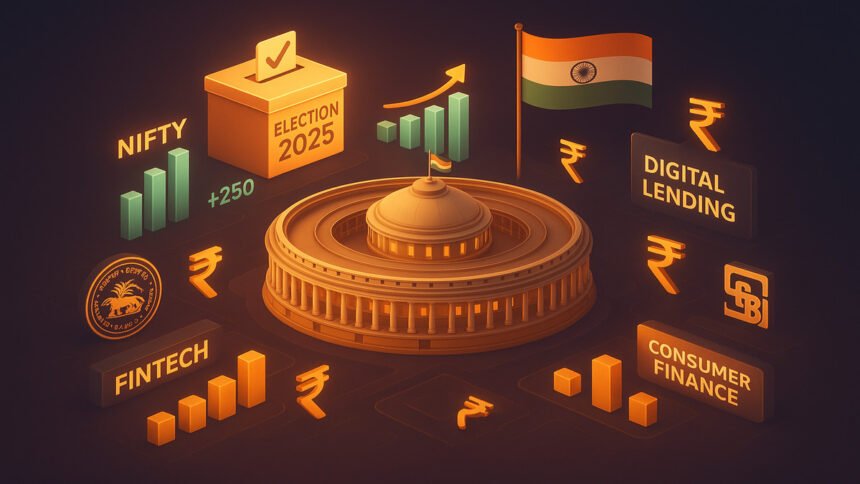
Investor confidence softened this week as election driven caution from ongoing state polls, including the closely watched Bihar contest, weighed on market sentiment even though India’s macro fundamentals remain stable. The hesitation reflects a familiar pattern where political uncertainty temporarily overrides improving economic signals.
India’s equity market has been sensitive to political cues during state election cycles, and the current phase is no different. While fundamentals such as consumption trends, manufacturing output and credit growth continue to show resilience, investors are refraining from aggressive positioning until clearer political outcomes emerge. The result is a period of muted risk appetite and selective market participation.
Why State Elections Matter For Market Sentiment
State election cycles rarely change India’s long term economic trajectory but they influence near term decision making. Investors treat these political windows as uncertainty zones because policy continuity, administrative alignment and state level reforms all affect corporate planning. With Bihar delivering mixed voting signals across early trends, traders are avoiding large directional bets. This caution gets amplified when global cues are also soft, making investors focus on capital protection rather than immediate returns.
Historically, markets stabilise quickly once results are known. The current hesitation is therefore less about long term economic health and more about the lack of clarity during the polling phase.
Fundamentals Remain Intact Despite Political Noise
Underneath the election noise, India’s economic fundamentals remain broadly supportive. Urban consumption is holding, credit growth remains healthy, tax collections are strong and corporate commentary does not reflect recessionary stress. Manufacturing indicators and services activity are still expanding.
Foreign portfolio flows have been uneven but not structurally negative, suggesting global investors remain constructive over India’s medium term positioning. Bond markets have also stayed stable, indicating confidence that macro stability will not be disrupted by short term political events. For domestic institutional investors, earnings visibility and balance sheet strength continue to be favourable anchors.
Sector Specific Reactions As Investors Turn Selective
During election linked volatility, investors tend to gravitate toward defensive sectors while trimming exposure in cyclicals. This pattern is visible again. FMCG, healthcare and select private banks have drawn relative interest because they offer earnings stability. Meanwhile, autos, real estate and capital goods have seen reduced momentum as traders avoid high beta segments until political clarity improves.
Mid caps and small caps are experiencing sharper reactions because they carry higher risk perception in uncertain periods. Large cap indices show softer movement but not structural weakness. This divergence underscores how caution plays out differently across market layers.
What Investors Should Watch In The Coming Days
The key determinant for market direction will be clarity on election outcomes and the degree to which results align with expectations. Markets typically reset quickly once uncertainty is removed. A clear mandate generally supports risk appetite, while a fractured or unexpected result tends to extend consolidation.
Beyond elections, global factors remain relevant. Interest rate expectations abroad, commodity price movement and foreign investor flows will interact with domestic political outcomes to shape near term trends. For long term investors, the period may present opportunities as temporary softness often leads to attractive entry points in fundamentally strong companies.
Takeaways
- Election driven caution from state polls such as Bihar is reducing near term investor confidence despite stable fundamentals.
- India’s macro indicators remain resilient, with consumption, credit growth and manufacturing activity holding steady.
- Investors are shifting to defensive sectors and avoiding high beta stocks until political clarity emerges.
- Market direction will hinge on election outcomes and alignment with investor expectations in the coming days.
FAQs
Q: Why do state elections impact the stock market even though national policies drive the economy?
State elections influence administrative continuity, local reforms and governance stability, all of which affect business environments. Investors avoid uncertainty until results become clear.
Q: Are fundamentals strong enough to prevent a deep correction?
Yes. Current economic indicators do not point to structural weakness. Market softness is sentiment driven rather than fundamental.
Q: Should investors exit positions during election uncertainty?
Not necessarily. For long term portfolios, election linked volatility is temporary. Disciplined investors often use such phases to accumulate strong stocks at better prices.
Q: What will restore confidence quickly?
Clear election results, stable global cues and confirmation that policy continuity remains intact typically restore investor confidence within days.