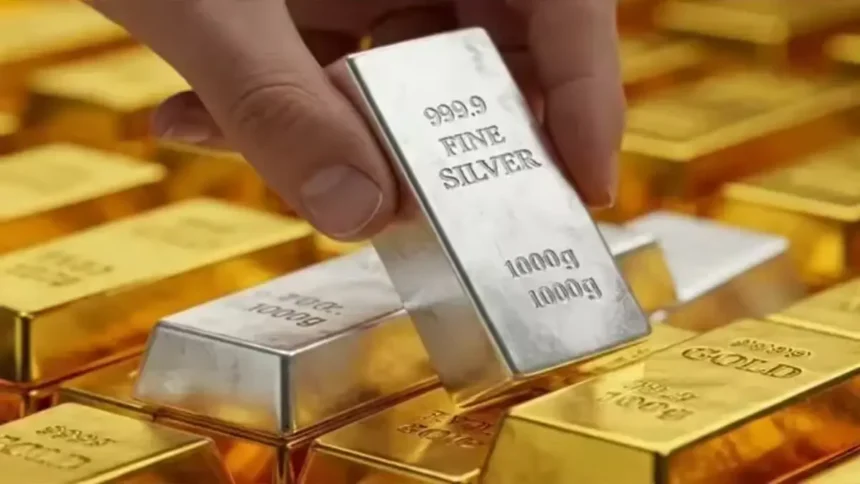
Gold and silver prices fluctuate amid global uncertainty as investors shift toward safe haven assets. Market volatility, geopolitical tensions, and inflation concerns are driving renewed interest in precious metals, influencing both domestic and international price trends.
Gold and Silver Prices Fluctuate Amid Global Uncertainty
Gold and silver prices fluctuate as global uncertainty continues to shape investor sentiment. Precious metals have traditionally acted as safe haven assets during periods of economic instability, and the current environment is reinforcing that trend.
Recent movements in gold and silver prices reflect a mix of factors, including geopolitical tensions, fluctuating crude oil prices, and changing interest rate expectations. When uncertainty rises, investors tend to move capital into assets perceived as stable, such as gold.
Silver, while also considered a safe haven, behaves differently due to its industrial demand component. This dual nature often makes silver more volatile compared to gold.
In India, domestic prices of gold and silver are also influenced by currency movements and import duties, adding another layer of complexity.
Safe Haven Demand Drives Precious Metals Rally
Safe haven demand has increased significantly as investors seek protection against market volatility. Equity markets have shown signs of instability, prompting a shift toward assets that historically preserve value.
Gold is often the first choice during such periods. Central banks, institutional investors, and retail buyers all contribute to increased demand. This demand can push prices higher even when other asset classes are under pressure.
Silver benefits from this trend but also reacts to industrial demand cycles. As a result, its price movements can be sharper in both directions.
Exchange traded funds linked to gold and silver have also seen increased inflows, reflecting growing investor interest in these metals as a hedge.
Impact of Inflation and Interest Rates on Gold Prices
Inflation and interest rates play a crucial role in determining gold price trends. When inflation rises, the purchasing power of currency declines, making gold an attractive store of value.
At the same time, interest rate movements influence gold’s appeal. Higher interest rates can reduce demand for gold, as investors may prefer interest-bearing assets. Conversely, when rate cuts are expected or real interest rates remain low, gold tends to perform better.
The current environment presents a mixed scenario. Inflation concerns are supporting gold prices, while uncertainty around central bank policies is adding volatility.
Silver, being partly an industrial metal, is also influenced by economic growth expectations, which adds to its price fluctuations.
Indian Market Trends and Currency Influence
In India, gold and silver prices are closely tied to global benchmarks but are also affected by the rupee’s movement against the US dollar. A weaker rupee makes imports more expensive, pushing domestic prices higher.
India is one of the largest consumers of gold, driven by cultural demand, jewelry purchases, and investment preferences. Seasonal factors such as weddings and festivals can further influence demand.
Silver demand in India comes from both investment and industrial usage, including electronics and solar panels. This makes its price sensitive to both global and domestic trends.
Retail investors are increasingly turning to digital gold and silver products, reflecting a shift in how precious metals are accessed.
Outlook for Precious Metals in Volatile Markets
The outlook for gold and silver remains closely linked to global economic conditions. If geopolitical tensions persist and inflation remains elevated, safe haven demand is likely to stay strong.
However, any signs of economic stabilization or rising interest rates could moderate price gains. Investors are closely monitoring central bank actions, currency movements, and global growth indicators.
For long-term investors, gold continues to serve as a portfolio diversifier. Silver, while more volatile, offers both investment and industrial exposure.
Market participants should expect continued price fluctuations as multiple factors interact in shaping precious metal trends.
Key Takeaways
- Gold and silver prices are fluctuating due to global uncertainty and market volatility
- Safe haven demand is driving increased investor interest in precious metals
- Inflation and interest rate expectations are key factors influencing price movements
- Domestic prices in India are also affected by currency trends and seasonal demand
FAQs
Q1. Why are gold and silver prices fluctuating?
Prices are influenced by global uncertainty, inflation concerns, interest rate expectations, and changes in investor sentiment.
Q2. Why is gold considered a safe haven asset?
Gold is seen as a stable store of value that tends to retain its worth during economic or market instability.
Q3. How does the rupee affect gold prices in India?
A weaker rupee increases the cost of imports, leading to higher domestic gold prices.
Q4. Is silver a good investment during uncertain times?
Silver can be attractive due to its dual role as a safe haven and industrial metal, but it is generally more volatile than gold.