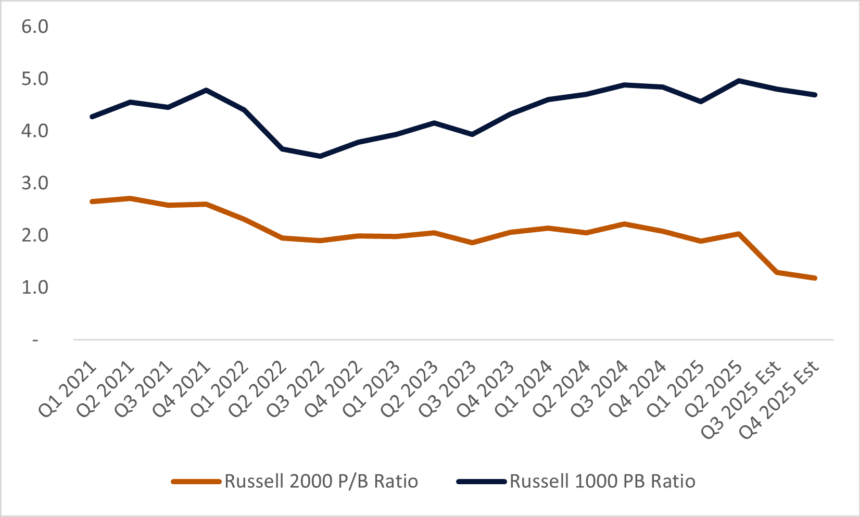
Growth vs valuation is becoming the defining debate in Indian equities as large caps continue to rally while hundreds of mid and small caps remain under water. This widening divergence is reshaping the risk reward matrix for investors and forcing a recalibration of sector preferences, liquidity expectations and valuation discipline.
Short summary: Large caps are driving the current market rally, but mid and small caps remain deeply in correction territory. The disconnect highlights valuation fatigue, liquidity stress and selective earnings resilience, signalling a shift in how investors assess risk across market segments.
Large Caps Extend Gains While Broader Market Struggles
India’s benchmark indices remain near lifetime highs, powered by strong institutional flows into heavyweight stocks across financials, IT services, industrials and energy. These companies have delivered consistent earnings, clearer visibility and stable balance sheets. Their weight in indices ensures that even limited participation can lift headline benchmarks.
However, beneath this rally, a much weaker picture emerges. Hundreds of mid and small cap stocks are still down sharply from their highs. Many remain 30 to 50 percent below peak valuations. The bifurcation shows that investors are demanding more evidence of earnings durability before returning to broader market segments. With risk appetite still uneven, large caps continue to absorb the bulk of liquidity.
Why Mid And Small Caps Remain Under Pressure
Valuation excesses unwinding after last year’s surge
The mid and small cap rally of the previous year drove valuations to levels that required exceptional earnings growth. When earnings normalised and macro uncertainty increased, these inflated valuations became difficult to justify. The result is a prolonged correction that still has not fully stabilised.
Companies with inconsistent profitability, stretched balance sheets or limited pricing power have borne the brunt of the downturn. Investors are increasingly unwilling to pay premium multiples for cyclical or speculative narratives.
Liquidity constraints magnify downside in broader markets
Large caps benefit from institutional flows, index-linked funds and steady participation from foreign investors. Mid and small caps depend heavily on retail flows and selective domestic institutional interest. When sentiment weakens or volatility rises, liquidity drains from these pockets quickly.
Thin liquidity increases price impact during correction phases. Even moderate selling pressure can lead to steep declines, keeping many stocks under water despite supportive top-down macro signals.
How Growth Versus Valuation Is Driving Reallocation
Investors prioritise stability over high beta bets
The current environment shows a clear preference for companies with stable earnings, predictable cash flows and visibility across business cycles. This aligns with the risk off tone in global markets and persistent uncertainty surrounding commodity prices, global demand and monetary policy cycles.
Large caps fit this requirement. Mid and small caps, unless backed by exceptional fundamentals, do not. As a result, investors are shifting allocations toward safety, even if near term growth in those segments is moderate.
Valuation resets create selective opportunities
While correction phases can be painful, they also create opportunities. Some mid and small caps now trade at more reasonable valuations compared to last year. Investors who use bottom up filters are finding selectively attractive opportunities in manufacturing, chemicals, building materials, pharmaceuticals and niche financials.
However, the bar for inclusion is much higher. Companies must demonstrate strong governance, balance sheet health and consistent earnings. Growth narratives alone are no longer enough to attract inflows.
What The Divergence Means For Market Outlook
Narrow market leadership is not sustainable indefinitely
A rally driven by a dozen large cap names can hold for a period, but long term sustainability requires breadth. If mid and small caps do not show signs of stabilisation, the market may face phases of consolidation. Large caps cannot indefinitely offset weakness in other segments, particularly when global conditions turn volatile.
Breadth indicators, delivery volumes and earnings guidance for broader market segments will determine whether participation expands in coming months.
Earnings season could shift sentiment
The next earning cycle will play a decisive role in determining whether the divergence holds. Strong mid cap earnings could revive confidence and attract flows back to underperforming segments. Conversely, if earnings disappoint, investors may continue to cluster around large caps, reinforcing the current gap.
What Investors Should Track In The Coming Weeks
Monitor foreign institutional investor behaviour, liquidity trends in mid and small cap funds, sector leadership rotation and global risk appetite. A decline in crude prices, improvement in export demand or clearer central bank guidance could strengthen confidence in broader equity segments.
However, if valuations stay stretched and liquidity remains selective, the market will stay polarised, rewarding quality and punishing speculative narratives.
Takeaways
Large caps are rallying while hundreds of mid and small caps remain sharply below recent peaks.
Valuation excesses, earnings uncertainty and liquidity constraints continue to weigh on broader market segments.
Investors are prioritising stability, governance and predictable earnings over speculative growth stories.
Long term sustainability of the rally depends on broader market participation and mid cap earnings recovery.
FAQ
Why are large caps outperforming while mid and small caps lag?
Because large caps offer stability, strong balance sheets and institutional support, while broader market segments face valuation and liquidity challenges.
Is this a good time to buy mid and small caps?
Selective opportunities exist, but the bar for quality is high. Investors should focus on strong fundamentals rather than narratives.
Can the divergence persist for long?
It can persist temporarily but not indefinitely. Sustainable market rallies require broader participation.
What could trigger a turnaround in mid and small caps?
Stronger earnings, improved liquidity, renewed foreign flows and lower commodity costs could revive sentiment.