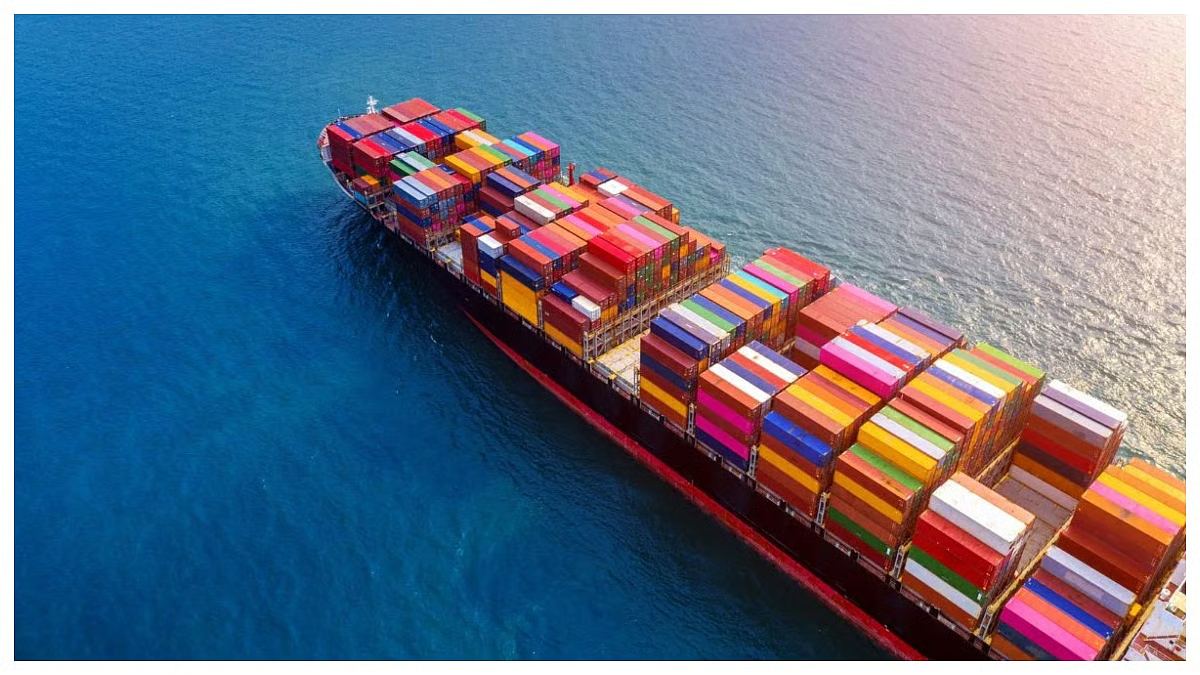
Gujarat blue economy summit is set to become a defining moment for India’s marine exports strategy as the state positions itself to move beyond volume driven trade toward higher value, sustainable, and technology enabled ocean based industries. The development is time sensitive and closely tied to current policy planning and investment intent.
The summit reflects a broader push to integrate ports, fisheries, coastal manufacturing, and marine services into a single economic vision. For Gujarat, which already dominates India’s port activity, the blue economy framework is about capturing more value per tonne rather than just moving cargo.
Why the blue economy matters for Gujarat now
The Gujarat blue economy summit comes at a time when India is reassessing how coastal states contribute to exports, employment, and climate aligned growth. Gujarat has the longest coastline among Indian states and handles a large share of India’s maritime trade, yet much of its marine export activity remains commodity oriented.
Global demand patterns are shifting toward traceable seafood, marine biotechnology, offshore renewable energy, and ocean services. States that align early with these trends stand to gain long term export competitiveness.
For Gujarat, the timing is strategic. Infrastructure capacity already exists. The next step is upgrading the economic model around it.
Reframing marine exports beyond raw volumes
A key theme expected at the Gujarat blue economy summit is the need to move marine exports up the value chain. Traditional exports such as frozen seafood, raw salt, and bulk cargo face pricing pressure and limited margins.
The new strategy emphasizes processed seafood, marine based nutraceuticals, specialty chemicals derived from marine resources, and ship repair and maintenance services. These segments generate higher revenue per unit and support skilled employment.
Value addition also improves resilience. When global prices fluctuate, diversified marine exports provide stability to coastal economies.
Ports as integrated economic clusters
Gujarat’s ports are central to the blue economy vision. Rather than functioning solely as transit points, ports are being positioned as integrated industrial and logistics clusters.
The summit agenda is expected to highlight port led development models where processing units, cold chains, shipbuilding yards, and export services operate in proximity. This reduces logistics costs, improves turnaround times, and strengthens export competitiveness.
Such clustering also attracts private investment, as companies prefer ecosystems over standalone facilities. Gujarat’s existing port infrastructure gives it a head start in executing this model.
Fisheries modernization and sustainable practices
Fisheries remain a core pillar of the blue economy, but the focus is shifting from catch expansion to productivity and sustainability. Overfishing, post harvest losses, and inconsistent quality have limited export potential in the past.
The summit is expected to address modern fishing practices, cold storage expansion, traceability systems, and export compliant processing standards. Technology adoption, including digital catch monitoring and supply chain transparency, is critical to accessing premium global markets.
Sustainability is no longer optional. Export buyers increasingly demand compliance with environmental and labor standards, making modernization essential.
Emerging sectors within the blue economy
Beyond fisheries and ports, the Gujarat blue economy summit is likely to spotlight emerging marine sectors. Offshore renewable energy, especially wind, has gained attention as Gujarat’s coastline offers favorable conditions.
Marine biotechnology, including pharmaceuticals and bio inputs derived from ocean resources, represents another high value opportunity. Coastal tourism and cruise services also form part of the broader blue economy, linking services exports with physical infrastructure.
By presenting a diversified portfolio, Gujarat aims to attract investors looking for long term plays rather than short term extraction.
Policy alignment and investment signals
A major outcome of the summit will be policy signaling. Investors are looking for clarity on land use, environmental approvals, export incentives, and long term regulatory stability.
Gujarat’s approach has traditionally emphasized execution speed and ease of doing business. Extending this to marine sectors could unlock private capital across logistics, processing, and technology.
Alignment with national initiatives such as port modernization, coastal economic zones, and export promotion schemes strengthens the credibility of the blue economy roadmap.
Employment and regional development impact
The blue economy strategy has direct implications for employment along Gujarat’s coast. Value added marine industries generate more jobs per unit of output compared to bulk exports.
Skill development in processing, logistics, marine engineering, and quality control becomes critical. The summit is expected to highlight partnerships between industry, training institutions, and local communities.
Balanced coastal development also helps reduce migration pressure on urban centers by creating opportunities closer to traditional livelihoods.
Competitive positioning against global peers
Globally, countries such as Vietnam, Indonesia, and Norway have successfully leveraged blue economy strategies to dominate marine exports. Gujarat is studying these models to adapt best practices.
The competition is not just on cost but on reliability, sustainability, and compliance. Buyers prefer suppliers who can deliver consistent quality at scale.
Gujarat’s advantage lies in its infrastructure readiness and administrative experience. The challenge is execution across diverse marine sectors without fragmenting focus.
Risks and execution challenges
Despite strong intent, the blue economy transition carries risks. Environmental concerns, coastal community resistance, and coordination between agencies can slow progress.
There is also the risk of overemphasis on infrastructure without adequate market linkage. Export success depends on demand alignment, not just capacity creation.
Clear project pipelines, stakeholder engagement, and phased implementation will be essential to convert summit announcements into measurable outcomes.
What success would look like
If the Gujarat blue economy summit delivers on its promise, success will be measured by a shift in export composition, higher export realizations, and diversified marine revenue streams.
Over time, Gujarat could emerge as India’s primary blue economy hub, influencing national marine export strategy. The summit is a starting point, not the finish line.
Takeaways
- Gujarat blue economy summit aims to move marine exports up the value chain
- Ports are being repositioned as integrated economic clusters
- Sustainability and technology are central to future export growth
- Execution and policy clarity will determine long term impact
FAQs
What is the blue economy in simple terms?
It refers to economic activities linked to oceans and coasts, including fisheries, ports, marine energy, and ocean services.
Why is Gujarat focusing on marine exports now?
Global demand is shifting toward value added and sustainable marine products, creating new export opportunities.
Which sectors will benefit most from the new strategy?
Processed seafood, port led industries, offshore energy, and marine services are key beneficiaries.
Will this impact coastal employment?
Yes. Value added marine industries generate more skilled and stable jobs along the coast.