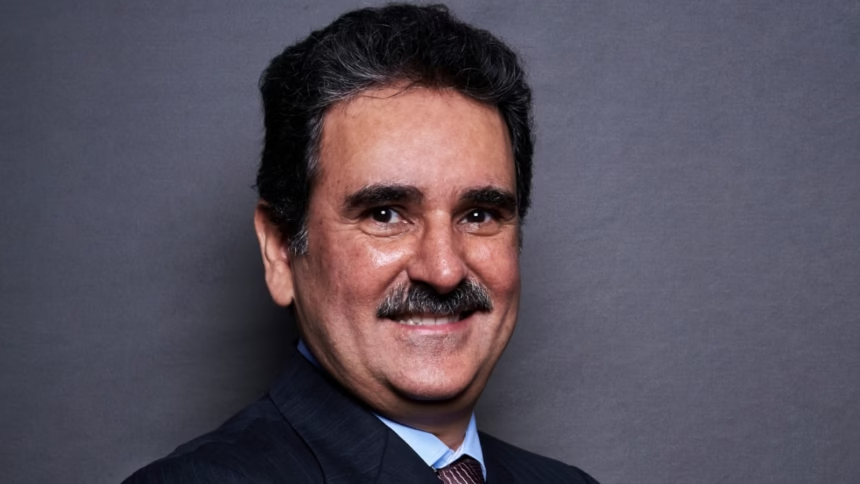
Helios Capital founder Dinshaw Irani has projected a return of foreign institutional investors in 2026 while expressing optimism on domestic consumption driven stocks. The view reflects shifting market dynamics where local demand, earnings visibility, and valuation comfort are reshaping investment priorities.
Market View Signals Shift in Investment Cycle
The Helios FII return 2026 outlook is a time sensitive news development tied to evolving capital flow expectations. Dinshaw Irani’s assessment comes amid a phase where foreign institutional investors have remained selective due to global interest rate uncertainty, geopolitical risks, and uneven growth signals across emerging markets.
Irani has indicated that while FII participation has moderated, the underlying structural story of India remains intact. He expects global investors to re engage once monetary conditions stabilize and earnings growth regains momentum. According to his view, the pause in foreign flows is cyclical rather than structural, and 2026 could mark a renewed allocation phase for India within global portfolios.
Why FIIs Have Stayed Cautious
Foreign institutional investors have been cautious over the past year due to multiple global factors. Elevated interest rates in developed markets have kept risk free yields attractive, reducing urgency to chase emerging market equities. Currency volatility and intermittent risk off phases have further influenced allocation decisions.
Irani has pointed out that FIIs tend to return when earnings visibility improves and valuation gaps narrow. India’s equity markets have delivered strong returns driven largely by domestic institutional and retail participation. While this has supported market resilience, it has also pushed valuations higher in certain segments, making FIIs more selective in the near term.
Domestic Consumption as the Core Bull Case
Helios Capital’s bullish tilt toward domestic consumption stocks reflects confidence in India’s internal demand drivers. Consumption led sectors benefit from rising incomes, urbanization, and expanding middle class participation. Irani has emphasized that consumption is less vulnerable to global slowdowns compared to export oriented sectors.
Segments such as consumer staples, discretionary spending, retail focused financials, and select services are seen as long term beneficiaries. These businesses typically offer predictable cash flows and pricing power, making them attractive during periods of global uncertainty. Irani’s stance aligns with a broader market trend where investors favor earnings stability over cyclical exposure.
Earnings Visibility and Balance Sheet Strength
A key factor behind Helios’ consumption focus is earnings visibility. Companies serving domestic demand often have clearer revenue trajectories and faster demand recovery cycles. Irani has stressed the importance of balance sheet strength and disciplined capital allocation in stock selection.
Many consumption focused companies have reduced leverage, improved supply chains, and invested in distribution reach. This positions them well to capture incremental demand without aggressive capital expenditure. In contrast, sectors dependent on global trade or commodities face higher volatility and margin pressure.
What Could Trigger FII Re Entry
According to Irani’s perspective, multiple triggers could support FII return in 2026. A clear signal of interest rate easing in developed markets would lower the opportunity cost of investing in equities. Stable currency conditions and improved global growth outlook would further enhance risk appetite.
Additionally, consistent earnings delivery by Indian corporates could re attract long term foreign capital. FIIs tend to respond positively to sustained profit growth rather than short term market rallies. Policy continuity and macro stability also remain critical factors influencing global investor confidence.
Domestic Investors Continue to Drive Markets
Until FIIs return in force, domestic investors are expected to remain the primary drivers of Indian equity markets. Systematic investment flows, insurance capital, and retail participation have created a steady demand base. Irani has acknowledged that this structural shift has reduced India’s dependence on foreign flows compared to previous cycles.
However, foreign capital still plays a role in market depth, valuation discovery, and sector leadership. A synchronized participation of domestic and foreign investors typically supports broader market expansion and liquidity.
Risks to the Outlook
While optimistic, the outlook is not without risks. A prolonged global slowdown, renewed inflationary pressures, or unexpected policy shifts could delay FII return beyond 2026. Domestically, consumption growth could face headwinds from rural demand fluctuations or cost pressures.
Irani’s comments suggest cautious optimism rather than aggressive positioning. The emphasis remains on selective stock picking, valuation discipline, and focusing on businesses with durable demand rather than chasing momentum.
What This Means for Investors
For investors, Helios’ view reinforces the importance of aligning portfolios with structural themes rather than short term flows. Domestic consumption continues to offer a relatively stable growth path, while patience may be required for broader FII driven rerating.
The expectation of FII return in 2026 suggests that current phases could present accumulation opportunities in quality companies ahead of renewed global interest.
Takeaways
• Helios Capital expects foreign institutional investors to return in 2026
• Dinshaw Irani is bullish on domestic consumption driven stocks
• Earnings visibility and balance sheet strength are key investment criteria
• Domestic investors are currently anchoring market stability
FAQs
Why does Helios expect FIIs to return in 2026
The expectation is based on anticipated global rate easing, improved earnings visibility, and macro stability.
Which sectors does Helios favor
Helios is positive on domestic consumption oriented sectors with predictable demand and strong fundamentals.
Are FIIs completely absent from Indian markets
No, FIIs are selective rather than absent, with flows influenced by global conditions and valuations.
What should investors focus on now
Investors may focus on quality businesses, valuation discipline, and long term demand drivers rather than short term market noise.