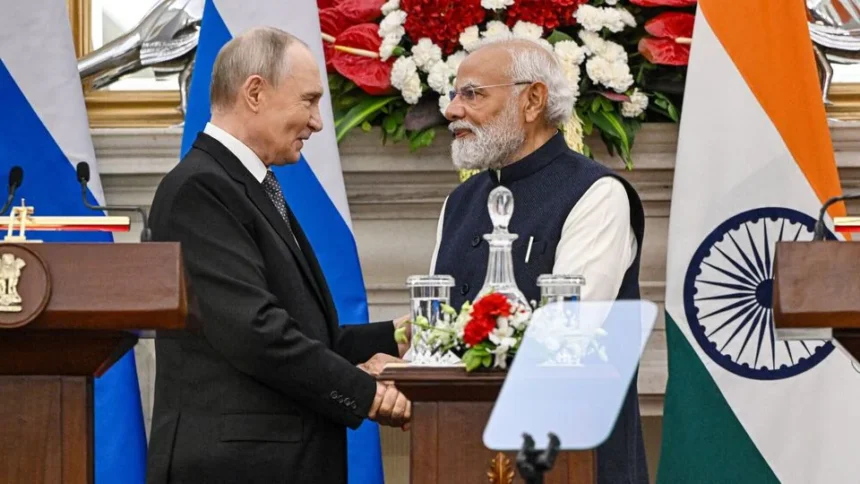
The Vladimir Putin Narendra Modi summit ending with a pledge to double India Russia trade by 2030 marks a significant geopolitical and economic development. The topic is time sensitive because the commitments influence energy security, critical minerals supply chains and high tech cooperation in an evolving global landscape.
The meeting reinforced long standing bilateral ties while shifting focus toward sectors that will define future competitiveness. Both countries outlined clearer pathways for technology partnerships, diversified trade routes and investments aimed at reducing supply chain vulnerabilities created by geopolitical realignments.
Leaders set ambitious trade target driven by strategic sectors
Doubling India Russia trade by 2030 requires accelerating engagement in sectors such as energy, critical minerals, nuclear cooperation and advanced manufacturing. Current trade volumes remain below potential, largely concentrated in oil imports, defence procurement and fertilisers. The summit emphasised diversification to reduce concentration risk and stabilise long term commercial relations.
Energy remains the anchor component. India continues to source discounted crude from Russia as part of a broader strategy to diversify suppliers and contain domestic fuel inflation. Long term energy contracts, expanded shipping arrangements and joint investments in refining infrastructure are expected to support trade growth. Russia’s interest in securing stable buyers aligns with India’s need for predictable supply, creating a strategic fit that enhances bilateral bargaining power.
Critical minerals and resource security gain priority
Critical minerals such as cobalt, lithium, nickel and rare earth elements featured prominently in summit discussions. These minerals are essential for electric vehicles, batteries, renewable energy infrastructure and semiconductor fabrication. As global competition intensifies, India seeks reliable supply partners to hedge against concentrated mineral markets dominated by a few countries. Russia possesses significant reserves and is seeking diversified export partners due to shifting geopolitical dynamics.
The two countries discussed frameworks for long term offtake agreements, joint exploration projects and value addition within India. Establishing processing capabilities on Indian soil would help reduce import dependency and integrate India more deeply into clean energy supply chains. These initiatives align with India’s broader goals under its energy transition agenda and manufacturing push.
High tech and innovation partnerships strengthen bilateral relevance
High tech cooperation emerged as a key talking point during the summit. Both leaders highlighted areas such as quantum technologies, cybersecurity, defence electronics, space collaboration and advanced materials research. India’s expanding digital economy and Russia’s experience in niche defence technologies create opportunities for co development projects. Joint research centres, technology transfer mechanisms and startup exchange programs were discussed to accelerate innovation.
The semiconductor ecosystem is another area where collaboration may expand. India is investing heavily in chip manufacturing and design capabilities, while Russia is looking to stabilise its supply chain through international partnerships. Opportunities may emerge in equipment sourcing, materials development and specialised fabrication processes.
Space cooperation remains an established pillar of bilateral engagement. The summit reaffirmed commitments to satellite navigation integration, manned mission support and earth observation technologies. These initiatives support India’s ambition to scale its space program and Russia’s intention to remain a key player in the global space industry.
Geopolitical shifts influence trade routes and payment mechanisms
The summit also focused on strengthening transport corridors, particularly the International North South Transport Corridor. The corridor aims to reduce transit times between India and Russia by connecting ports through Iran and Central Asia. Enhancing this connectivity would reduce logistics costs, support energy shipments and expand market access for Indian exporters. The improved corridor can also serve as an alternative route for European and Middle Eastern trade segments affected by geopolitical disruptions.
Payment settlement mechanisms were another key concern. Both nations discussed expanding the use of domestic currencies in bilateral trade to reduce exposure to sanctions risk and currency volatility. Increasing rupee based settlements and exploring options for digital payment integration support greater financial autonomy. These steps could accelerate trade volumes by simplifying transactions and reducing conversion costs for exporters and importers.
Defence and security cooperation remain steady but evolve slowly
Defence collaboration remains steady but is undergoing adjustments as India diversifies suppliers and expands domestic capability. However, Russia continues to play a central role in India’s defence ecosystem through spare parts supply, maintenance contracts and co development of key platforms. The summit reinforced continuity in these areas while signalling openness to new defence technologies, including unmanned systems and electronic warfare solutions.
Security cooperation also extends to counterterrorism, intelligence sharing and cyber threat mitigation. These domains require confidential frameworks that benefit from high level political backing. The summit served to reaffirm commitment to strategic trust even as both countries calibrate their global positions.
Takeaways
India and Russia aim to double bilateral trade by 2030 through targeted sector expansion
Energy and critical minerals form the backbone of the new trade roadmap
High tech collaboration set to expand across quantum, space and advanced materials
New transport corridors and local currency settlements expected to facilitate trade growth
FAQs
Why is doubling India Russia trade significant
It strengthens economic resilience for both countries, diversifies supply chains and expands cooperation beyond traditional sectors like defence and energy.
Which sectors will drive future trade expansion
Energy, critical minerals, high tech collaboration, space research, advanced manufacturing and digital economy linkages are expected to lead growth.
How will new transport corridors impact trade
Improved connectivity through the International North South Transport Corridor will reduce transit time, lower logistics costs and improve access to Eurasian markets.
Will payment mechanisms change in bilateral trade
Both countries are exploring increased use of local currencies and digital settlement channels to reduce reliance on traditional cross border systems.