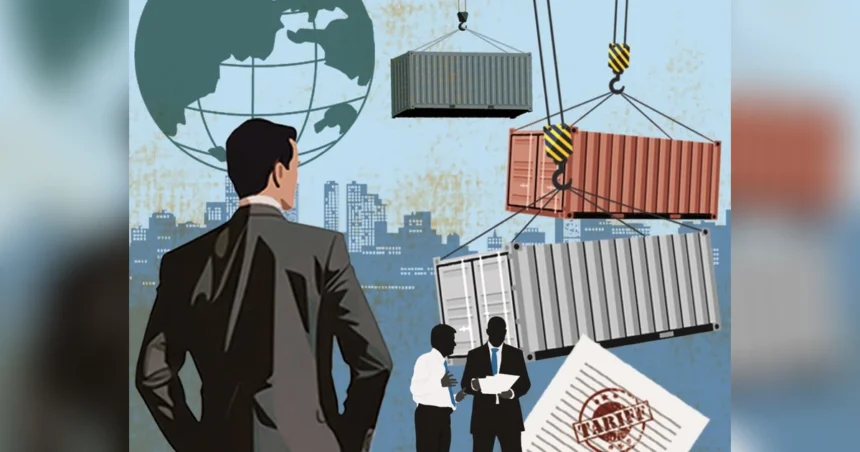
The Indian government has approved a relief package of ₹45,060 crore to bolster exporters, especially in the garment and leather sectors, following the imposition of steep U.S. tariffs. The package includes a ₹25,060 crore Export Promotion Mission and a ₹20,000 crore Credit Guarantee Scheme.
Trade headwinds intensify for exporters
India’s exporters are facing heightened pressure after the United States imposed tariffs of up to 50 percent on a range of Indian goods, including textiles, apparel and leather items. These tariffs have translated into order cancellations, cash-flow stress for micro, small and medium enterprises (MSMEs), and a sharp drop in shipments to the U.S., India’s key export market.
In response, the government’s relief package aims to support liquidity, access to finance and diversification into new markets.
What the support package contains
The relief package is structured around two major components:
- Export Promotion Mission (EPM): With an outlay of ₹25,060 crore over six years (FY 26 to FY 31), the mission offers two sub-schemes: Niryat Protsahan (trade-finance support) and Niryat Disha (non-finance export readiness). Under Niryat Protsahan MSMEs can access interest subvention, export factoring, collateral guarantees and e-commerce export credit-cards. Under Niryat Disha, support covers compliance, branding, packaging, logistics and trade-fair participation. Priority sectors include textiles, leather, gems & jewellery, engineering goods and marine products.
- Credit Guarantee Scheme for Exporters (CGSE): Allocated ₹20,000 crore, this scheme allows additional working-capital support of up to 20 percent of sanctioned export limits, collateral-free credit for exporters and 100 percent government guarantee via the National Credit Guarantee Trustee Company. The scheme is valid up to March 31, 2026 and covers labour-intensive sectors hit hardest by the tariff shock.
Impact on key sectors
Textile and garment units, many of them MSMEs concentrated in regions like Tirupur, Ludhiana and Surat, have been hit by order cancellations and delayed payments, raising NPA risks. Leather goods exporters also face a squeeze in their U.S. shipments. The relief measures aim to cushion immediate liquidity stress, preserve jobs and give companies time to re-orient to alternative markets such as Europe, Middle East and Latin America.
Why now matters
With global merchandise trade growth predicted to hover around 2.4 percent in 2025 and just 0.5 percent in 2026, export-led growth is under threat. The government’s intervention comes at a strategic moment: exports account for roughly 21 percent of India’s GDP and jobs in export-oriented industries exceed 45 million. A prompt and effective response can prevent a broader manufacturing and jobs setback.
Additionally, discussions between India and the U.S. on a trade deal remain alive; meanwhile, the tariff pressure provides incentive for India to accelerate diversification and strengthen non-tariff export readiness.
Next steps for exporters
- MSME exporters must apply quickly for trade-finance subvention and collateral-free credit under the CGSE.
- Firms should invest in meeting international standards (quality, packaging, logistics) as the Niryat Disha scheme enables non-financial support.
- Exporters should reassess their market exposure: reduce dependence on the U.S., build presence in emerging geographies and track country-specific standards and non-tariff barriers.
- Industry associations and states should coordinate to streamline implementation of the relief measures so that funds flow efficiently to needy exporters.
Takeaways
- The relief package of ₹45,060 crore signals the government’s acknowledgment of the U.S. tariff shock and its impact on India’s labour-intensive export sectors.
- The two-pronged approach combines finance (via CGSE) and non-finance readiness (via EPM) to enhance export resilience.
- MSMEs in textiles, garments, leather, gems & jewellery are among the most vulnerable and will be first priority for the relief measures.
- Diversification of markets and strengthening of export ecosystem (branding, packaging, compliance) are critical for medium-term resilience beyond immediate relief.
FAQs
Q: Who is eligible for the support under the export relief package?
A: MSMEs and exporters in labour-intensive sectors such as textiles, leather, gems & jewellery, engineering goods and marine products are eligible. The relief covers exporters needing trade finance support, market access support and working-capital guarantees.
Q: How does the Credit Guarantee Scheme (CGSE) work?
A: Under the CGSE, eligible exporters receive collateral-free working-capital credit—up to 20 percent of sanctioned export limits—and the government gives a 100 percent guarantee for these additional credits via the National Credit Guarantee Trustee Company.
Q: Is this relief specific to U.S.-bound exports only?
A: No. While the surge in U.S. tariffs triggered the package, many of the measures are aimed at enhancing overall export competitiveness, market diversification and readiness for non-tariff challenges in various geographies.
Q: When will the relief schemes be implemented and what is the timeline?
A: The Export Promotion Mission spans six years from FY 2025-26 to FY 2030-31. The Credit Guarantee Scheme is valid till March 31, 2026, with possible extension. Implementation guidelines will be issued soon by the Commerce Ministry.