
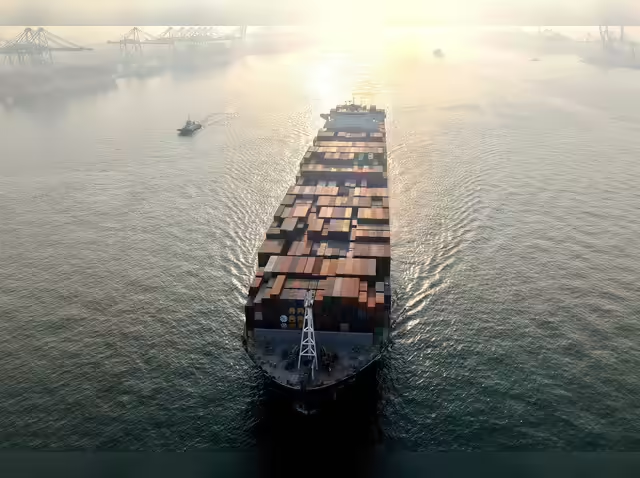
India’s export surge defies US tariffs and is reshaping its negotiating position in ongoing trade talks, as resilient outbound shipments offset external pressure. Strong performance across manufacturing, engineering goods and services has given policymakers fresh confidence amid a challenging global trade environment.
India’s export surge defies US tariffs at a time when global trade flows remain uneven and protectionist signals persist. Despite higher duties on select categories and tighter market access conditions, Indian exporters have managed to sustain volumes and diversify destinations. This resilience is now strengthening India’s leverage in bilateral and multilateral trade discussions, particularly with major developed economies.
Export performance holds firm despite tariff headwinds
Indian exports have continued to post steady growth even as tariff barriers imposed by the United States disrupted certain trade flows. Engineering goods, pharmaceuticals, chemicals and electronics have emerged as key contributors, offsetting weakness in more tariff sensitive segments. Exporters have adapted by recalibrating pricing, improving cost efficiency and tapping alternative markets in Asia, Africa and Latin America.
Policy support has played a role in cushioning the impact. Export incentives, faster tax refunds and logistics improvements have helped firms remain competitive despite higher duties. In several cases, Indian suppliers absorbed part of the tariff cost to retain market share, betting on long term relationships rather than short term margins. This strategy has helped prevent a sharp contraction in exports to the US, even as trade frictions persisted.
Manufacturing and services exports drive resilience
A major factor behind India’s export strength is the combined performance of manufacturing and services. Engineering goods and electronics have benefited from capacity expansion under domestic manufacturing programs, while pharmaceuticals have maintained steady demand due to India’s established role in global supply chains.
Services exports have provided an additional buffer. IT services, business process outsourcing and professional services continue to generate robust foreign exchange inflows, largely insulated from goods tariffs. This diversified export base has reduced India’s vulnerability to unilateral trade measures and reinforced its image as a reliable supplier across sectors.
Exporters have also increased focus on value added products rather than commodity driven shipments. This shift has helped mitigate the impact of price fluctuations and tariff shocks, contributing to more stable export earnings over recent quarters.
Trade negotiations gain momentum from export strength
India’s ability to sustain exports despite tariffs has altered the dynamics of trade negotiations. Policymakers now approach discussions from a position of relative strength, emphasizing reciprocity and fair access rather than defensive concessions. The argument is straightforward: India has demonstrated competitiveness even under restrictive conditions, reducing pressure to accept unfavorable terms.
In talks with the United States, this performance supports India’s case for tariff rationalization and resolution of long pending market access issues. Negotiators are highlighting the role of Indian exports in supporting US supply chains, particularly in pharmaceuticals, auto components and technology services. The underlying message is that easing barriers would benefit both economies rather than undermine domestic interests.
Diversification of export markets strengthens bargaining power
Another critical development is the diversification of India’s export destinations. While the US remains a key market, exporters have expanded aggressively into regions such as Southeast Asia, the Middle East and parts of Europe. Trade agreements and bilateral partnerships have facilitated this shift, reducing overdependence on any single market.
This diversification weakens the impact of tariffs imposed by one country and limits their effectiveness as a negotiating tool. Indian trade officials increasingly point to rising shipments to alternative markets as evidence that exporters have options. This flexibility enhances India’s bargaining power in trade talks and lowers the economic cost of prolonged negotiations.
Small and medium exporters have also benefited from digital platforms and improved logistics, enabling them to access overseas buyers directly. These structural improvements contribute to export sustainability beyond short term policy cycles.
Implications for domestic policy and industry strategy
The export surge has implications beyond trade negotiations. Domestically, it reinforces the case for continued investment in manufacturing competitiveness, infrastructure and ease of doing business. Policymakers view export resilience as validation of recent reforms aimed at lowering costs and improving scale.
For industry, the experience underscores the importance of market diversification and product upgrading. Companies that relied heavily on a single export destination have learned to spread risk, while those investing in technology and compliance standards have fared better under stricter trade regimes. This shift is likely to influence long term export strategies across sectors.
At the macro level, strong exports support currency stability and help manage the current account balance. This provides additional policy space at a time when global financial conditions remain uncertain.
Outlook for trade talks and export momentum
Looking ahead, India’s negotiating stance is expected to remain firm, backed by data showing sustained export performance. While tariff issues will continue to feature in discussions with the United States, the tone is likely to be pragmatic rather than confrontational. Both sides have incentives to stabilize trade relations amid broader geopolitical and economic uncertainty.
Export momentum will depend on global demand trends, but India’s diversified base offers some insulation against external shocks. Continued policy focus on logistics, trade facilitation and market access will be key to maintaining this advantage. For now, India’s ability to defy tariff pressure has reshaped the narrative from vulnerability to leverage.
Takeaways
Indian exports have remained resilient despite higher US tariffs.
Manufacturing and services exports together are driving overall strength.
Export diversification has reduced dependence on any single market.
Strong export performance has improved India’s leverage in trade negotiations.
FAQs
Why did US tariffs not derail Indian exports?
Indian exporters adapted through cost management, market diversification and focus on value added products, limiting the impact of tariffs.
Which sectors supported India’s export surge?
Engineering goods, pharmaceuticals, electronics and services exports played a major role in sustaining growth.
How does export strength affect trade talks?
Resilient exports reduce pressure to make concessions and strengthen India’s bargaining position in negotiations.
Will this export momentum continue?
Sustainability will depend on global demand and policy support, but diversification and structural reforms provide a strong foundation.


