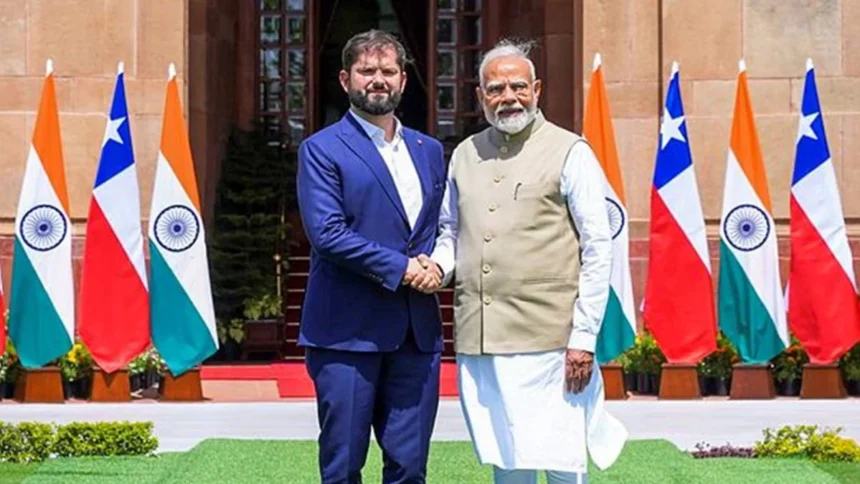
India is exploring a strategic partnership with Chile to secure critical minerals needed for electric vehicle batteries. The move highlights India’s effort to strengthen battery supply chains and reduce dependence on limited global sources for lithium and other essential resources.
India exploring a critical minerals partnership with Chile reflects the country’s growing focus on securing materials essential for the electric vehicle battery supply chain. As EV adoption rises, reliable access to minerals such as lithium has become a key economic and energy priority for India.
India Chile critical minerals partnership gains strategic importance
The proposed India Chile critical minerals partnership is part of India’s wider effort to diversify supply chains for materials used in battery manufacturing. Chile is one of the world’s largest producers of lithium, a core component in lithium ion batteries used in electric vehicles, smartphones, and energy storage systems.
India currently imports most of the lithium required for its growing EV industry. Without domestic reserves large enough to meet demand, the country is seeking long term supply agreements with mineral rich nations.
Chile’s lithium reserves are concentrated in the Atacama salt flats, which hold some of the highest quality lithium brine resources globally. Partnering with Chile could provide Indian companies stable access to these reserves through investment agreements, supply contracts, or joint exploration projects.
Such partnerships are increasingly common as countries compete to secure materials that power the clean energy transition.
EV battery supply chains driving India’s mineral diplomacy
Electric vehicle battery supply chains are becoming a central focus of global economic diplomacy. Governments across the world are racing to secure access to minerals such as lithium, cobalt, nickel, and graphite.
India’s EV industry is expanding rapidly as government policies encourage electrification of transportation. Incentive programs for electric vehicles, local battery manufacturing, and renewable energy integration are pushing demand for battery materials.
Lithium ion batteries currently dominate the EV market because of their energy density and efficiency. Each electric vehicle battery pack requires a substantial quantity of lithium based compounds.
India’s push to establish domestic battery manufacturing under initiatives such as advanced chemistry cell production requires steady mineral supplies. Without secure sources, battery manufacturers face price volatility and potential supply disruptions.
Partnerships with countries like Chile help reduce those risks while strengthening long term industrial planning.
Global competition intensifies for lithium and battery minerals
The race for lithium and other battery minerals has intensified as the global EV market expands. Countries including the United States, China, Japan, and members of the European Union are actively forming supply partnerships with resource rich nations.
China currently plays a dominant role in global lithium processing and battery manufacturing. Many countries are seeking alternative supply chains to reduce reliance on a single region.
Chile, Argentina, and Bolivia together form the region often called the lithium triangle, which contains a large portion of the world’s lithium reserves. Chile has developed a mature lithium extraction industry supported by established mining companies and export infrastructure.
For India, deeper engagement with Chile could include technology cooperation, mineral processing investments, and long term purchase agreements with lithium producers.
Such collaboration could also support India’s goal of developing domestic battery manufacturing capacity over the next decade.
Impact on India’s EV ecosystem and manufacturing sector
A stable supply of battery minerals could significantly strengthen India’s electric vehicle ecosystem. Automakers, battery producers, and energy storage companies rely heavily on predictable access to raw materials.
India’s EV market is projected to expand rapidly across two wheelers, passenger cars, and commercial vehicles. Government policies promoting electric mobility aim to reduce oil imports and lower carbon emissions from transportation.
Battery manufacturing plants planned across several Indian states will require long term lithium supply contracts to remain competitive. Mineral partnerships therefore play a crucial role in enabling industrial expansion.
Beyond electric vehicles, lithium is also important for renewable energy storage systems used in solar and wind power integration. Reliable mineral supplies can therefore support both clean transportation and broader energy transition goals.
By strengthening cooperation with Chile, India aims to position itself more securely within the global clean technology supply chain.
Economic diplomacy shaping future energy security
India’s outreach to Chile reflects a broader shift toward mineral diplomacy. As global industries transition toward electrification and renewable energy, control of critical minerals has become as important as traditional energy resources.
Strategic partnerships allow countries to reduce supply chain vulnerabilities while encouraging international investment and technological collaboration.
For India, securing critical minerals is closely linked to its ambition of becoming a global manufacturing hub for electric vehicles and battery technologies. Long term mineral access will help domestic industries scale production and compete in global markets.
The exploration of a Chile partnership represents an early step in building a diversified network of mineral suppliers that can sustain India’s growing clean energy economy.
Takeaways
India is exploring a critical minerals partnership with Chile to secure lithium supplies
Lithium is a key material used in electric vehicle battery production
Stable mineral supply chains are essential for India’s EV and energy storage industries
Global competition for lithium and battery minerals is increasing rapidly
FAQs
Why is lithium important for electric vehicles?
Lithium is a core component of lithium ion batteries, which power most electric vehicles due to their high energy density and efficiency.
Why is India partnering with Chile for critical minerals?
Chile holds some of the world’s largest lithium reserves, making it an important partner for countries seeking reliable battery mineral supplies.
Does India have its own lithium reserves?
India has identified some lithium resources, but domestic production remains limited compared with global demand for electric vehicle batteries.
How could this partnership affect India’s EV industry?
Securing long term mineral supplies could help battery manufacturers expand production and support the growth of electric vehicles in India.