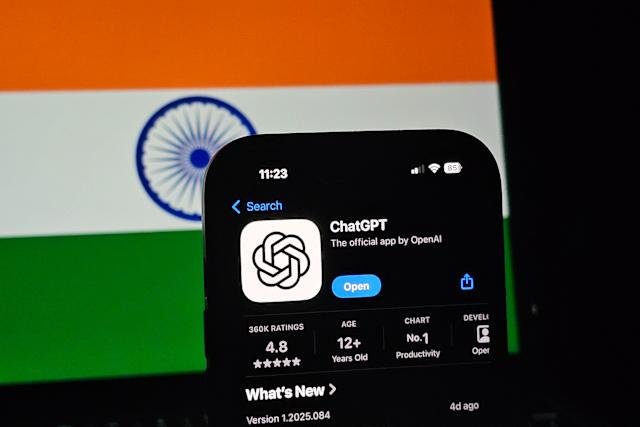
Sam Altman reveals India has 100 million weekly ChatGPT users, highlighting the country’s rapid artificial intelligence adoption and expanding digital ecosystem. The milestone underscores India’s scale advantage in generative AI usage across consumers, startups, and enterprises.
Sam Altman reveals India has 100 million weekly ChatGPT users, a figure that positions the country among the largest markets globally for generative AI platforms. The announcement signals not just consumer curiosity, but a structural shift in how artificial intelligence tools are being integrated into education, business operations, and digital services.
India Emerges as a Major AI Adoption Market
Reaching 100 million weekly users reflects India’s vast internet base and high smartphone penetration. With over half a billion internet users and one of the world’s youngest populations, the country provides fertile ground for rapid technology diffusion.
ChatGPT usage in India spans students, developers, entrepreneurs, and corporate professionals. Educational use cases include language learning, exam preparation, and coding assistance. Small businesses increasingly rely on AI tools for marketing copy, customer communication, and data analysis.
India’s cost sensitive digital environment has also accelerated experimentation with AI tools. Many users engage with free or low cost tiers, driving high engagement volume even if average revenue per user remains lower than in developed markets.
Generative AI Adoption Across Enterprises
The 100 million weekly ChatGPT users milestone is not limited to individual consumers. Indian enterprises are integrating generative AI into workflows across sectors such as IT services, banking, ecommerce, and media.
IT firms use AI models for code generation, documentation, and software testing support. Financial institutions experiment with AI driven chat interfaces for customer queries and risk analysis. Media companies leverage generative tools for content drafting and research assistance.
This adoption trend aligns with India’s strong technology services base. As global clients demand AI enabled efficiency, Indian firms are embedding such tools into service delivery models. The scale of domestic usage provides a large real world testing environment.
Startup Ecosystem and AI Innovation
India’s startup ecosystem is also benefiting from widespread AI engagement. Thousands of early stage companies are building AI powered products in healthcare diagnostics, vernacular language processing, agritech analytics, and education technology.
The presence of 100 million weekly ChatGPT users suggests a broad familiarity with conversational AI interfaces. This lowers customer acquisition friction for startups launching AI driven applications.
Investors are closely tracking generative AI startups in India, particularly those focused on regional language models and domain specific automation. The country’s linguistic diversity creates both challenges and opportunities for AI innovation.
Infrastructure and Digital Public Platforms
India’s digital public infrastructure has played an indirect role in accelerating AI adoption. Widespread digital identity systems, online payment networks, and affordable data access have created a digitally literate user base.
Affordable mobile data pricing has historically driven rapid growth in video streaming, social media, and digital payments. The same ecosystem supports frequent AI platform interaction. Weekly active user numbers reflect not just signups, but sustained engagement.
Cloud computing expansion and local data center investments also provide the backbone required for scaling AI services. As infrastructure improves, enterprise grade AI deployment becomes more feasible across industries.
Global Implications of India’s AI Scale
When Sam Altman reveals India has 100 million weekly ChatGPT users, the implication extends beyond domestic adoption. For global AI companies, India represents a strategic growth market and a large scale feedback loop for product improvement.
High engagement in multilingual environments helps refine model performance across diverse linguistic inputs. India’s usage patterns can influence future product features, localization efforts, and pricing strategies.
From a policy perspective, large scale AI adoption also raises regulatory considerations. Data privacy, misinformation management, and ethical AI deployment remain central topics for policymakers. As user numbers expand, governance frameworks become increasingly important.
Economic and Workforce Considerations
Rapid AI adoption has implications for productivity and employment. Generative AI tools can enhance efficiency in documentation, customer service, and analytics tasks. However, they also prompt discussions about job transformation and skill upgrades.
Educational institutions and training programs are beginning to incorporate AI literacy into curricula. Professionals across sectors are learning to use AI tools as productivity enhancers rather than viewing them solely as automation threats.
The milestone of 100 million weekly ChatGPT users demonstrates that AI interaction is becoming mainstream rather than niche within India’s digital economy.
Takeaways
India has reached 100 million weekly ChatGPT users, signaling mass scale AI adoption.
Usage spans students, startups, enterprises, and technology professionals.
India’s digital infrastructure and large internet base support rapid AI diffusion.
Regulatory and workforce adaptation will shape the next phase of AI integration.
FAQs
What does 100 million weekly users indicate?
It reflects active, recurring engagement with ChatGPT rather than one time signups, highlighting deep market penetration.
Why is India a key AI market?
Large internet adoption, affordable data access, and a strong technology workforce support rapid AI usage growth.
How are businesses using ChatGPT in India?
Companies use it for coding assistance, customer interaction, content creation, and operational automation.
Will AI adoption impact jobs?
AI is likely to transform roles by augmenting productivity, requiring upskilling rather than outright replacement in many cases.