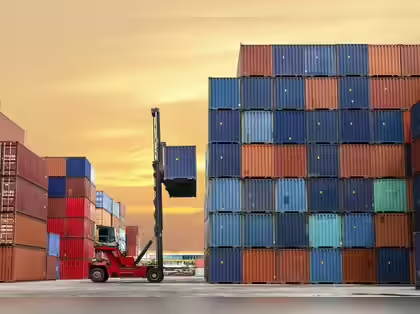
India’s import dependence has emerged as a strategic economic concern as global supply chains undergo rapid restructuring. Rising reliance on foreign inputs in key sectors is prompting policymakers and businesses to reconsider supply resilience and strengthen domestic manufacturing capacity.
India Import Dependence Becomes Strategic Economic Concern
India import dependence is increasingly being discussed as a vulnerability as global supply chains experience disruption and geopolitical tensions reshape international trade. While India has expanded its export sectors in recent years, several critical industries still rely heavily on imported raw materials and intermediate goods.
Key sectors such as electronics manufacturing, energy, fertilizers, and semiconductor components depend significantly on overseas supply networks. When global supply chains face disruptions, these dependencies can create economic pressure through higher costs and delayed production.
The issue has become more relevant as global trade patterns shift due to geopolitical tensions, supply chain diversification strategies, and new industrial policies adopted by major economies.
India’s policymakers are therefore focusing on strengthening domestic manufacturing capabilities to reduce long term reliance on imports in strategically important sectors.
Global Supply Chain Realignment Exposes Import Risks
The global supply chain realignment underway in recent years has exposed the vulnerabilities of import dependent economies. Countries are increasingly reassessing where their critical materials and components originate.
During periods of geopolitical tension or shipping disruptions, heavily import dependent industries may face supply shortages or sudden price increases. This can affect both manufacturing output and consumer prices.
India’s economy has grown rapidly through integration with global trade networks. However, dependence on imported energy, electronics components, and industrial inputs means external shocks can quickly influence domestic economic conditions.
The shift toward supply chain diversification has encouraged many countries to promote local manufacturing and reduce reliance on single source imports.
India is responding through industrial policies designed to strengthen domestic production capabilities in high value sectors.
Electronics and Energy Imports Highlight Structural Gaps
Two major areas that highlight India’s import dependence are electronics and energy. India imports a significant share of its crude oil requirements, making global energy price fluctuations an important factor in economic planning.
Energy imports influence inflation, fiscal spending, and the overall trade balance. When global oil prices rise, transportation costs and industrial expenses increase across multiple sectors.
Electronics manufacturing presents another example of import dependence. India has rapidly expanded its consumer electronics market, yet many key components such as semiconductors, display units, and advanced chipsets are still imported.
As a result, disruptions in global semiconductor supply chains can affect the production of smartphones, consumer electronics, and automotive technology.
Recognizing this challenge, the government has introduced initiatives designed to encourage domestic electronics manufacturing and semiconductor development.
Industrial Policy and Domestic Manufacturing Push
To reduce import vulnerability, India has launched several industrial initiatives aimed at strengthening domestic production. One of the most prominent strategies involves production linked incentive programs designed to attract global manufacturers.
These incentives encourage companies to establish manufacturing facilities within India, particularly in sectors such as electronics, pharmaceuticals, renewable energy equipment, and advanced manufacturing.
The government has also been promoting semiconductor ecosystem development. Building domestic chip manufacturing capabilities could help reduce dependence on foreign technology supply chains over the long term.
Infrastructure development is another important element of the strategy. Expanding logistics networks, industrial corridors, and port connectivity can improve manufacturing competitiveness and reduce production costs.
These policy measures aim to transform India from a primarily consumption driven market into a stronger manufacturing economy.
Balancing Global Trade Integration With Supply Security
Reducing import dependence does not necessarily mean reducing international trade. Instead, policymakers are focusing on balancing global integration with supply chain resilience.
India continues to benefit from global trade through exports of services, pharmaceuticals, and engineering goods. Maintaining strong trade relationships remains important for economic growth.
However, diversifying supply sources and strengthening domestic production capabilities can reduce risks during global disruptions. Businesses are also adapting by exploring multiple supplier networks and regional sourcing strategies.
As global supply chains continue to evolve, economies that successfully balance international trade participation with domestic manufacturing strength are likely to maintain stronger economic resilience.
India’s long term strategy appears to be focused on building this balance while continuing to expand its role in the global economy.
Takeaways
India’s dependence on imported energy and industrial inputs has emerged as an economic vulnerability.
Global supply chain disruptions have highlighted risks associated with import heavy industries.
Government policies are encouraging domestic manufacturing through industrial incentives.
Balancing global trade integration with supply chain resilience is becoming a strategic priority.
FAQs
What does import dependence mean for an economy?
Import dependence occurs when a country relies heavily on foreign suppliers for critical goods, raw materials, or industrial components needed for domestic production.
Which sectors show the highest import dependence in India?
Energy, electronics components, fertilizers, and certain industrial materials are among the sectors that rely significantly on imports.
How can India reduce its import dependence?
Encouraging domestic manufacturing, investing in industrial infrastructure, and developing technology capabilities can gradually reduce reliance on foreign inputs.
Does reducing import dependence mean limiting global trade?
No. The goal is to strengthen domestic production in strategic sectors while maintaining strong participation in global trade networks.