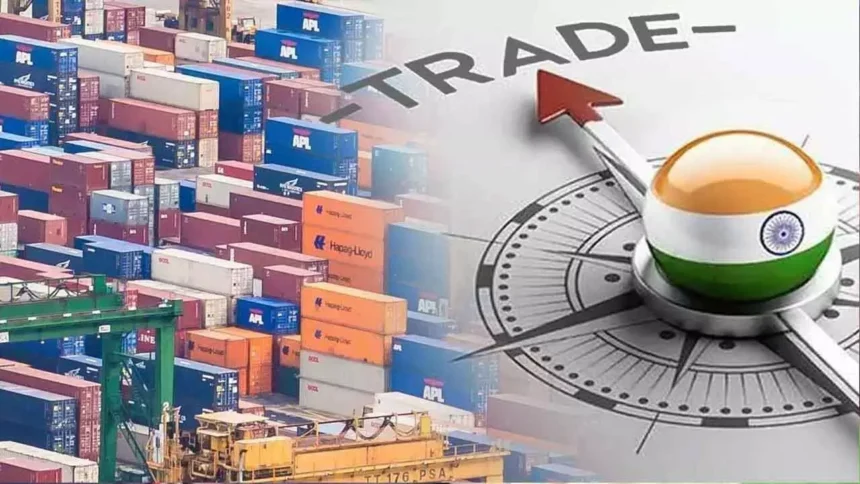
India’s newly announced export-support package is designed to cushion exporters reeling under steep U.S. tariffs, with the main keyword export-support package strengthening trade resilience for affected sectors. The policy step signals Government resolve to protect export-oriented industries and shift toward diversification.
The initiative: what the export-support package covers
The Government has approved a multi-year export support programme combining credit guarantee schemes, trade-finance support and integrated export-promotion tools. Key measures include collateral-free credit guarantees for exporters, affordable trade finance lines for MSMEs, and enhanced support for market access and logistics. The aim is to neutralise the sudden cost disadvantage faced after the U.S. imposed tariffs of as much as 50 per cent on Indian goods. By tying finance support to new markets and value-added segments, the package addresses immediate liquidity stress and longer-term competitiveness simultaneously.
Which sectors benefit most from this support
Labour-intensive and export-dependent sectors are first in line to benefit from this export-support package. Textiles and apparel, leather goods, gems and jewellery, marine products (notably shrimp) and engineering goods face direct tariff pressure and will receive priority support modules such as market-diversification grants, credit access and logistics aid. For example, textile exporters experiencing double-digit export declines will find the credit guarantee scheme particularly relevant. Also, MSME exporters with thin margins will gain from the cheaper trade-finance pathways and collateral-free loan options.
Who might still get hit despite the support
Although the support package is broad, some sectors remain vulnerable and may not fully benefit. Goods that are highly dependent on the U.S. market without ready alternatives face structural risk. Exporters in apparel and leather manufacturing who depend on price competitiveness—not just finance—might suffer margin erosion as tariffs raise competitive barriers. Further, sectors with heavy commodity input costs, weak export-brand value or severe logistics constraints may struggle to pivot quickly. Lastly, future shocks in global demand or new non-tariff trade barriers may blunt the benefit of finance-focused support.
What this means for export strategy and market diversification
The package is a strategic shift away from fragmented subsidy schemes toward a digital-enabled, outcome-oriented export support architecture. By emphasising credit availability, logistics-efficiency and market diversification, India is signalling that export resilience now means moving away from dependence on the U.S. market and low-margin business. Exporters who pivot into higher-value segments, manage global compliance and explore alternate geographies stand to gain. Meanwhile, private-sector lenders and trade-finance institutions will need to recalibrate underwriting frameworks for small exporters entering new markets.
Takeaways
- Urgent liquidity support: The export-support package provides much-needed credit-access and guarantee strength for sectors hit by U.S. tariffs.
- Structural reorientation: Emphasis on market diversification and value addition signals a long-term shift in export strategy.
- Selective resilience: Some sectors with cost-oriented challenges or U.S. dependence may still face pain despite policy support.
- Execution matters: Effective delivery—through digital platforms, timely disbursals and clear outreach—will determine real-world impact.
FAQs
Q: What triggered the export-support package?
A: The support package was triggered by sharp tariff hikes by the U.S., with certain Indian exports facing duties of up to 50 per cent, creating urgent competitiveness and liquidity stress.
Q: Which exporters are eligible for support under the package?
A: The focus is on export-oriented sectors, especially MSME exporters in textiles, leather, gems & jewellery, marine products, engineering goods and those exploring new markets or higher-value segments.
Q: Does the package remove tariff barriers?
A: No. The package does not directly remove tariffs but mitigates their impact via finance, logistics and export-promotion support while exporters move to diversify and add value.
Q: How long will the support measures remain effective?
A: The programme is structured over multiple years to allow structural export diversification and improved competitiveness; the implementation phase is already underway and continuous monitoring will apply.