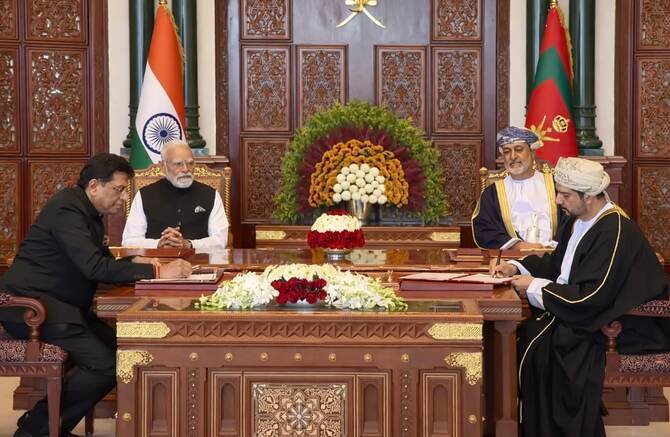
India has signed a comprehensive trade pact with Oman, positioning the agreement as a strategic response to rising U.S. tariffs and shifting global trade alignments. The India Oman trade pact is a time sensitive policy development that immediately reshapes export corridors, supply chain routing, and sector level competitiveness for both economies.
The agreement comes at a moment when Indian exporters are actively diversifying markets to protect margins, manage tariff risks, and secure stable access to West Asian demand centers.
Strategic context behind the India Oman trade pact
The India Oman trade pact is not a routine bilateral agreement. It reflects a deliberate attempt by India to counter external trade pressures, particularly higher tariffs and stricter trade enforcement in key Western markets. With global trade becoming more fragmented, India is accelerating regional and corridor based partnerships to maintain export momentum.
Oman’s geographic position gives the pact added strategic weight. Located along critical maritime routes connecting South Asia, the Middle East, and Africa, Oman offers India a gateway to wider Gulf and African markets. For India, this reduces dependence on a narrow set of export destinations and lowers exposure to tariff shocks from any single economy.
The agreement also aligns with India’s broader push to strengthen economic ties with the Gulf Cooperation Council region, where energy security, diaspora ties, and investment flows intersect with trade policy.
Key provisions shaping bilateral trade flows
At the core of the India Oman trade pact are tariff reductions, streamlined customs procedures, and improved market access for goods and services. The agreement covers merchandise trade, services, investment facilitation, and regulatory cooperation, creating a multi layer framework rather than a narrow tariff deal.
Tariff concessions are expected to benefit Indian exports in engineering goods, textiles, food products, pharmaceuticals, and chemicals. In return, Oman gains improved access for petrochemical products, minerals, and select industrial inputs.
Customs simplification is a critical feature. Faster clearance, predictable documentation standards, and dispute resolution mechanisms are designed to reduce transaction costs. For exporters facing tight delivery timelines and working capital constraints, these operational improvements can be as valuable as tariff cuts.
Export corridors and logistics advantages emerge
One of the most immediate outcomes of the trade pact is the strengthening of India Oman export corridors. Ports in western India are likely to see increased volumes routed through Omani logistics hubs, leveraging Oman’s developed port infrastructure and free zones.
This corridor based trade model allows Indian exporters to consolidate shipments, re export to third markets, and optimize shipping routes. For sectors such as engineering goods and processed food, Oman can function as a redistribution hub into Africa and the broader Middle East.
Logistics firms and port operators stand to gain from higher throughput and long term service contracts. The agreement also improves predictability for supply chain planning, which has become a key competitive factor amid global disruptions.
Sectoral winners from the trade agreement
Several sectors are positioned as clear beneficiaries of the India Oman trade pact. Engineering and manufacturing exporters benefit from lower duties and improved access to infrastructure projects across the Gulf region. Pharmaceuticals gain from regulatory cooperation that can speed up approvals and distribution.
Agricultural and food processing exporters stand to expand shipments of rice, spices, sugar, and value added food products. Oman’s import dependent food market provides stable demand, while the trade pact enhances price competitiveness.
Energy related trade also features prominently. While Oman remains an energy exporter, the agreement facilitates cooperation in downstream petrochemicals and energy services. Indian firms involved in refining, storage, and engineering services may see new contract opportunities.
Implications for exporters facing U.S. tariffs
The timing of the trade pact is critical for Indian exporters navigating higher U.S. tariffs and stricter compliance norms. While the U.S. remains a major market, exporters are increasingly cautious about overreliance on a single destination.
By expanding preferential access to Oman and connected markets, Indian firms can rebalance export portfolios. This reduces revenue volatility and strengthens negotiating power with global buyers. The pact also encourages exporters to redesign supply chains to minimize tariff exposure without sacrificing scale.
For small and mid sized exporters, the agreement lowers entry barriers into West Asian markets where regulatory complexity previously limited participation.
Investment flows and long term economic impact
Beyond trade, the pact signals a push toward deeper investment ties. Investment facilitation provisions aim to encourage Omani capital into Indian manufacturing, logistics, and energy infrastructure. At the same time, Indian companies gain greater clarity when investing in Omani industrial zones and services sectors.
Over the long term, the agreement supports India’s ambition to integrate trade, investment, and logistics into cohesive economic corridors. Success will depend on execution, particularly how quickly tariff schedules are implemented and whether customs reforms deliver on promised efficiency gains.
For Oman, closer ties with India diversify its economic partnerships and support its own diversification goals beyond hydrocarbons.
Takeaways
India Oman trade pact is a strategic response to rising global trade barriers
Export corridors through Oman strengthen India’s access to Gulf and African markets
Engineering, pharma, food processing, and logistics emerge as key beneficiaries
The agreement reduces tariff risk exposure for Indian exporters facing U.S. pressure
FAQs
Is the India Oman trade pact already in effect?
The agreement has been signed and will come into force following completion of domestic ratification and implementation procedures.
How does this pact help counter U.S. tariffs?
It allows Indian exporters to diversify markets, reduce reliance on the U.S., and maintain margins through preferential access elsewhere.
Which Indian exporters benefit the most?
Engineering goods, pharmaceuticals, food products, chemicals, and logistics services are among the top beneficiaries.
Does the pact include services and investment?
Yes, it covers trade in services, investment facilitation, and regulatory cooperation alongside goods trade.