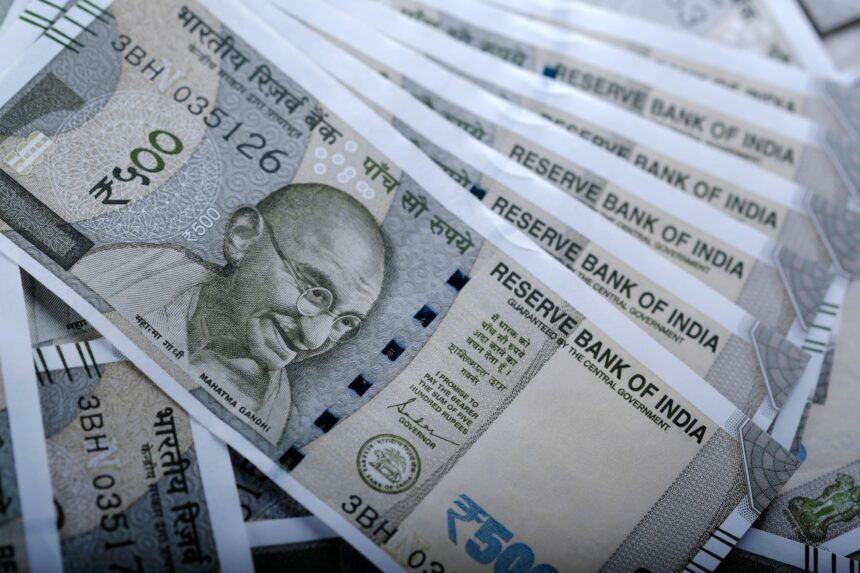
The Indian rupee hit an all time low near ₹90.7 against the US dollar on Monday, triggering renewed intervention by the Reserve Bank of India and sharpening market focus on near term policy signals. Currency traders and economists now expect elevated volatility to persist through year end.
The rupee’s decline reflects a mix of global dollar strength, sustained foreign portfolio outflows and rising uncertainty around US interest rate timing. While the RBI moved quickly to smooth the fall, the broader pressure on emerging market currencies remains intact.
Rupee breach of ₹90.7 shakes currency markets
The Indian rupee crossed the psychologically critical ₹90.7 level in early trade, marking its weakest point on record. The move followed overnight strength in the US dollar index as investors repriced expectations around the Federal Reserve’s rate path. Emerging market currencies across Asia were under pressure, but the rupee underperformed peers.
Dealers reported active dollar selling by state run banks, widely seen as acting on behalf of the RBI. This helped cap intraday losses but failed to reverse sentiment. The market reaction suggests that participants are now testing the central bank’s tolerance range rather than reacting to short term liquidity signals.
Currency desks note that import related dollar demand remains strong, particularly from oil marketing companies and electronics importers. At the same time, exporter hedging activity has slowed as firms wait for clearer direction on whether the rupee will weaken further.
RBI intervention strategy under scrutiny
RBI intervention in the foreign exchange market has been steady rather than aggressive. The central bank has focused on reducing volatility instead of defending a fixed level. This approach aligns with its long stated policy stance but is now facing market stress as the rupee trades at record lows.
India’s foreign exchange reserves remain comfortable by global standards, giving the RBI room to act. However, persistent intervention risks tightening domestic rupee liquidity and complicating monetary management. Analysts believe the RBI will continue to rely on spot market operations combined with forward market tools to manage expectations.
The key signal markets are watching is whether the central bank allows a gradual depreciation path or draws a firmer line around current levels. So far, the response suggests tolerance for a weaker rupee as long as moves remain orderly.
Global drivers intensifying currency pressure
The rupee’s weakness is not occurring in isolation. A stronger dollar environment has emerged as US economic data remains resilient and inflation progress slows. This has pushed back expectations of early rate cuts, keeping US yields elevated.
Foreign portfolio investors have continued to pare exposure to Indian equities and debt, adding to dollar demand. While India’s growth outlook remains relatively strong, global risk appetite has softened amid geopolitical uncertainty and uneven global recovery signals.
Crude oil prices have also stayed firm, widening India’s trade deficit and increasing structural dollar demand. For a net importer like India, sustained energy costs directly translate into currency pressure, especially when capital inflows are uneven.
Market focus shifts to policy cues and data
With the rupee at record lows, attention has shifted to upcoming macroeconomic signals. Inflation readings, trade data and central bank commentary will shape expectations around policy flexibility. Any indication of tighter liquidity or stronger currency defense could change near term positioning.
Bond markets are also reacting cautiously. A weaker rupee raises concerns about imported inflation and limits the space for aggressive rate easing. This has kept government bond yields range bound despite expectations of growth moderation.
Equity markets remain selective. Export oriented sectors such as IT and pharmaceuticals could benefit from a weaker rupee, while companies with high foreign currency liabilities face margin pressure. Portfolio managers are adjusting exposures accordingly rather than making broad directional bets.
Volatility outlook for the rupee ahead
Analysts broadly agree that currency volatility is likely to remain elevated in the near term. The combination of global monetary uncertainty, capital flow sensitivity and trade related dollar demand creates an uneven risk profile for the rupee.
Rather than a sharp one way move, markets expect choppy trading with periodic RBI intervention. The ₹90 level is no longer viewed as a hard floor, but sustained moves beyond current levels would test confidence and invite stronger policy responses.
For businesses and investors, the focus is shifting toward hedging discipline and balance sheet resilience rather than short term currency calls. The rupee’s record low has reset expectations, but the policy framework remains centered on stability rather than defense.
Takeaways
- The rupee hit a record low near ₹90.7 per dollar, driven by global dollar strength and capital outflows
- RBI intervention has aimed to smooth volatility, not defend a fixed exchange rate
- Global factors including US rates and crude oil prices continue to pressure the currency
- Markets are now watching policy signals and data for clues on near term currency direction
FAQs
Why did the Indian rupee fall to a record low?
The rupee weakened due to a stronger US dollar, persistent foreign outflows, high import related dollar demand and global uncertainty around interest rate trajectories.
Is the RBI actively defending the rupee?
The RBI is intervening to manage volatility rather than defend a specific level, using spot and forward market operations to maintain orderly conditions.
Does a weaker rupee hurt the Indian economy?
A weaker rupee raises import costs and inflation risks but can support export competitiveness. The overall impact depends on sector exposure and policy response.
What should investors expect next?
Investors should expect continued currency volatility, selective sector impact in equities and cautious positioning until clearer global and domestic policy cues emerge.