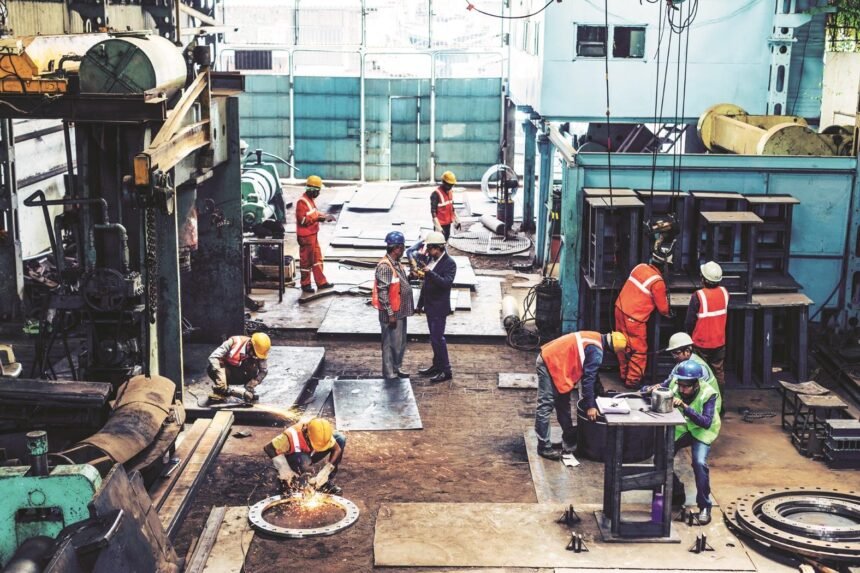
India’s manufacturing landscape is being redefined as the government prepares to revamp the Index of Industrial Production (IIP) by removing closed factories and revising the base year to 2022-23. The reform aims to align the index with the country’s evolving industrial structure and provide a more accurate gauge of growth for investors and policymakers.
The new methodology will increase the weight of fast-growing industries such as electronics, renewable energy, and precision engineering, while reducing representation from outdated sectors. For investors and policymakers alike, the change signals a shift in how India’s industrial strength will be measured and how capital will flow into the next decade.
Why closed factories are being replaced
The IIP currently tracks industrial performance using 2011-12 as its base year. Over time, around 9% of the factories in its data sample have become inactive or changed their core production lines. This has distorted growth measurement, as output from non-operational or repurposed facilities still affects national statistics.
To address this, the Ministry of Statistics and Programme Implementation (MoSPI) plans to replace inactive factories with operational ones that produce similar goods. A factory will be substituted if it records no production or fails to file data for three consecutive months. The new sample design will rely on updated data from the Annual Survey of Industries, ensuring that the revised IIP accurately reflects ongoing production rather than outdated capacity.
Impact on emerging manufacturing sectors
With the shift to a 2022-23 base year, India’s manufacturing weightage will move toward newer, high-growth industries that have gained scale over the past decade. Sectors such as semiconductors, electric vehicles, green energy equipment, robotics, and advanced materials are expected to see higher representation. Traditional sectors like textiles, basic metals, and legacy chemical production may see lower weights due to structural changes and declining global competitiveness.
This update effectively modernizes India’s industrial benchmark, acknowledging that the country’s manufacturing engine is now driven by technology and innovation, not just heavy industry. For instance, electronics manufacturing exports have grown from less than USD 9 billion in 2014 to over USD 27 billion in FY24. The inclusion of such emerging categories will make the IIP a more relevant indicator for both domestic policy and global investors tracking India’s industrial momentum.
Why the IIP overhaul matters for investors
For market participants, a more accurate IIP provides a clearer view of cyclical trends in industrial activity. Equity and fixed-income investors use IIP growth data to forecast sectoral earnings, credit demand, and capacity expansion. An updated index that better represents current industrial patterns will improve forecasting reliability and reduce data distortions.
Moreover, institutional investors—especially those tracking India through macro indicators—will be able to assess industrial performance with greater confidence. A higher weight on sunrise sectors also reinforces India’s appeal as a manufacturing hub aligned with global supply-chain diversification away from China.
Sectors expected to gain from the overhaul include capital goods, consumer durables, renewable energy equipment, and auto components. In contrast, traditional heavy industries might see lower influence on index movements, prompting analysts to recalibrate how industrial growth impacts related stocks and indices.
Policy implications and macroeconomic relevance
From a policy standpoint, the IIP update enhances the quality of high-frequency data used in GDP calculations, monetary policy assessments, and investment planning. The Reserve Bank of India (RBI) uses IIP trends to gauge supply-side pressures and industrial health, while the Finance Ministry relies on it to track manufacturing momentum.
By adopting international statistical norms, India’s IIP revision also aligns its reporting standards with those of major economies. This is part of a broader statistical modernization drive that includes updates to GDP and inflation indices. The move is expected to improve transparency, strengthen policy formulation, and enhance global confidence in India’s data reliability.
The challenge, however, lies in implementation. Ensuring smooth substitution of inactive factories without disrupting time-series continuity requires careful calibration. MoSPI plans to apply an overlap-adjustment method using 12 months of parallel data to maintain consistency between the old and new series.
What to expect next
The rollout of the new IIP is expected in mid-2026, following testing and validation. Policymakers will use this transition period to fine-tune the weighting structure and sector representation. Industry associations are also being consulted to ensure that the index reflects India’s contemporary manufacturing diversity.
Once implemented, the restructured IIP will become a more accurate barometer of the country’s industrial health, serving as a vital tool for investors, analysts, and policymakers navigating India’s next phase of economic growth.
Takeaways
- India is replacing closed factories in the IIP sample and updating the base year to 2022-23 for data accuracy.
- Emerging industries like electronics, EVs, and renewables will gain higher weightage in the revised index.
- The overhaul will improve the reliability of industrial data used by investors and policymakers.
- The updated IIP aligns India with global statistical standards and supports long-term policy precision.
FAQs
Q1: Why is the IIP being revised now?
A1: Because the current base year of 2011-12 no longer reflects India’s industrial structure, with many sample factories inactive or outdated. The new base year 2022-23 better represents current growth sectors.
Q2: Which sectors will gain or lose from the IIP overhaul?
A2: High-growth sectors like electronics, EVs, and renewable energy will gain; older industries such as textiles and basic metals will likely see reduced weightage.
Q3: How will this affect investors and markets?
A3: Investors will have access to more accurate data for forecasting industrial performance and sector earnings. It could also shift focus toward technology-driven manufacturing stocks.
Q4: When will the new IIP series take effect?
A4: The government plans to introduce the updated IIP series around mid-2026, after validation and testing phases are complete.