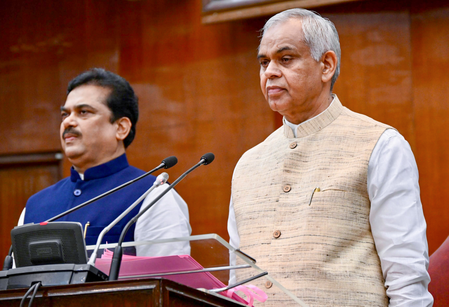
Maharashtra governor touts record FDI inflows, high value MoUs and large scale job pledges, positioning the state as a leading investment destination. The announcements underscore a political economy narrative aimed at reinforcing investor confidence amid competitive inter state capital flows.
Maharashtra governor touts record FDI and major investment commitments at a time when states are competing aggressively to attract domestic and global capital. The emphasis on foreign direct investment, big ticket memorandums of understanding and employment generation reflects a strategic attempt to signal economic strength and policy stability.
While headline numbers create momentum, investors are also assessing execution capacity, sector mix and conversion of MoUs into actual projects.
Record FDI Inflows and Sector Distribution
Foreign direct investment has long been a key metric for evaluating a state’s economic attractiveness. Maharashtra has traditionally ranked among the top recipients of FDI in India due to its industrial base, financial ecosystem and infrastructure depth.
The governor’s reference to record FDI inflows highlights sustained investor interest across sectors such as manufacturing, financial services, technology and renewable energy. Mumbai’s position as India’s financial capital, combined with industrial clusters in Pune and Nashik, strengthens the state’s investment proposition.
However, FDI figures must be contextualised. Announced inflows represent approved commitments, while actual realised investments depend on project execution timelines and regulatory clearances. Investors closely track conversion rates from approval to operational status.
Big Ticket MoUs and Investment Commitments
Big ticket MoUs often form the centrepiece of investment summits and official addresses. These agreements outline proposed capital expenditure in infrastructure, manufacturing, data centres and green energy.
MoUs are important signals of intent, especially when signed with multinational corporations or large domestic conglomerates. They demonstrate engagement between government and private sector players. Yet, market participants differentiate between MoUs and finalised investments.
Execution risks include land acquisition, environmental approvals, financing arrangements and supply chain readiness. For investor calculus, clarity on implementation timelines and policy continuity matters as much as headline commitment values.
Job Pledges and Employment Economics
Large investment announcements frequently come with job creation projections. The governor’s emphasis on employment pledges ties economic growth to social impact, reinforcing political legitimacy.
Employment multipliers vary by sector. Manufacturing and infrastructure projects tend to generate both direct and indirect jobs, while technology and financial services may create high skill but fewer absolute positions.
For investors, job pledges indicate potential expansion of consumption demand within the state. Rising employment can stimulate housing, retail and services sectors, creating secondary growth opportunities.
However, the quality and sustainability of jobs remain key. Investors prefer projects that build long term industrial ecosystems rather than short term construction driven employment spikes.
Political Economy and Competitive Federalism
The intersection of political economy and investor strategy is increasingly visible. States compete to offer policy incentives, streamlined approvals and infrastructure support. Maharashtra’s narrative of record FDI and large MoUs positions it strongly within this competitive federalism framework.
Political stability, regulatory transparency and fiscal discipline influence investor confidence. Any perception of policy reversals or administrative delays can alter capital allocation decisions.
By highlighting record inflows, the state leadership aims to reinforce the perception of governance continuity and pro industry orientation. This messaging is particularly relevant during periods of national economic recalibration or global uncertainty.
Investor Calculus Beyond Announcements
While official announcements shape sentiment, institutional investors evaluate deeper metrics. These include ease of doing business indicators, logistics infrastructure, power availability and dispute resolution mechanisms.
Maharashtra benefits from established industrial corridors, port connectivity and financial services infrastructure. Yet challenges such as urban congestion, land costs and compliance complexity remain.
For long term capital allocation, predictability is critical. Investors seek clarity on tax structures, environmental regulations and labour policies. The ability to execute infrastructure projects on schedule significantly enhances credibility.
Outlook for Investment Momentum
Sustained FDI inflows and successful conversion of MoUs into operational projects could reinforce Maharashtra’s leadership in industrial output and services growth. If large scale projects in manufacturing, renewable energy and technology materialise as planned, multiplier effects may strengthen regional supply chains.
However, global capital flows remain sensitive to interest rate trends, geopolitical developments and currency stability. Even states with strong domestic fundamentals must navigate external volatility.
The coming quarters will test whether the current wave of commitments translates into tangible output expansion and employment growth. Investors will track ground level progress alongside policy signals.
Takeaways
Maharashtra highlights record FDI and major MoUs to strengthen investor confidence
Sector diversity and execution capacity determine long term impact of commitments
Job pledges support consumption growth but depend on project realisation
Investor decisions hinge on policy stability, infrastructure and regulatory clarity
FAQs
Q1: What does record FDI indicate for a state economy?
Record FDI suggests strong investor interest and confidence in the state’s economic environment and growth prospects.
Q2: Are MoUs equivalent to actual investments?
No. MoUs represent intent to invest, while actual capital deployment depends on project approvals, financing and execution.
Q3: Why do job pledges matter to investors?
Job creation can boost local consumption, strengthen supply chains and enhance long term economic sustainability.
Q4: What factors influence investor calculus beyond announcements?
Infrastructure quality, policy consistency, regulatory transparency and ease of doing business are critical for sustained capital flows.