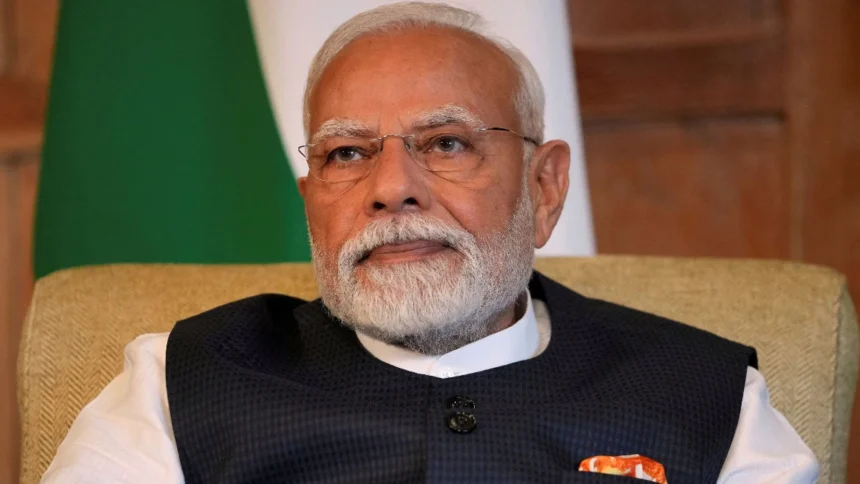
Prime Minister Narendra Modi told global CEOs that India is on track to become the world’s third largest economy, reinforcing the government’s growth narrative. The statement comes as India sustains strong GDP expansion while navigating global slowdown risks and domestic reform challenges.
Prime Minister Narendra Modi’s assertion that India is on track to become the world’s third largest economy places the spotlight on India GDP growth, policy reforms and structural capacity. Currently ranked fifth by nominal GDP after the United States, China, Germany and Japan, India would need to overtake both Germany and Japan to secure the third position. With nominal GDP already above 3.5 trillion dollars and growth rates consistently among the fastest in major economies, the ambition is not symbolic. It is measurable. The policy reality check lies in execution, macro stability and sustained investment momentum.
India GDP Growth and the Size Equation
India has maintained real GDP growth above most large economies in recent years, often in the 6 to 7 percent range. This pace, combined with a large domestic market of over 1.4 billion people, creates compounding economic scale. However, becoming the third largest economy in nominal terms depends not only on real growth but also on currency stability and inflation control.
Germany and Japan have faced slower growth and demographic headwinds. India benefits from a younger workforce and rising consumption. Yet nominal GDP comparisons fluctuate with exchange rate movements. A depreciating rupee can delay the climb even if domestic growth remains strong. The Reserve Bank of India’s inflation targeting framework and foreign exchange management therefore play a central role in sustaining the trajectory.
Structural Reforms Driving Economic Expansion
The policy narrative behind the third largest economy target rests on structural reforms implemented over the past decade. Goods and Services Tax unified indirect taxation and improved formalization. The Insolvency and Bankruptcy Code strengthened credit discipline. Production Linked Incentive schemes aim to expand manufacturing in electronics, pharmaceuticals, textiles and renewable energy.
Digital public infrastructure has transformed service delivery. Unified Payments Interface processes billions of transactions monthly, increasing transparency and financial inclusion. Direct benefit transfers have reduced leakages. These reforms collectively enhance productivity and investor confidence, which are essential for sustained GDP expansion.
However, reforms require depth and continuity. Judicial efficiency, land acquisition processes and labor flexibility still influence investment decisions. The government’s credibility depends on steady improvement in these areas.
Manufacturing Push and Export Ambition
For India to secure the third position globally, manufacturing and exports must accelerate. Services already contribute over half of GDP, led by IT and business services. The next phase demands stronger industrial output and export competitiveness.
The Production Linked Incentive framework seeks to boost domestic value addition and integrate India into global supply chains. Mobile phone manufacturing has already scaled significantly, with India emerging as a major exporter of smartphones. Semiconductor ambitions are taking shape with announced fabrication projects, though execution timelines remain critical.
Export growth also depends on trade agreements and logistics efficiency. Lower logistics costs, faster customs clearance and stable trade policy can enhance competitiveness. Without export expansion, high growth will rely excessively on domestic consumption.
Fiscal Discipline and Public Investment
Public investment has been a key growth driver. The central government has increased capital expenditure on infrastructure such as highways, railways, airports and digital connectivity. Infrastructure spending crowds in private investment and improves long term productivity.
At the same time, fiscal discipline remains essential. India’s fiscal deficit expanded during the pandemic but is on a consolidation path. Sustained borrowing without revenue growth would undermine macro stability. The balance between capital expenditure and fiscal prudence determines investor sentiment.
Tax collections have shown resilience, supported by GST compliance and digital tracking. Strong revenue growth creates space for continued infrastructure push without destabilizing debt dynamics.
Employment, Demographics and Income Growth
Becoming the third largest economy is not solely about aggregate GDP. Per capita income and employment quality matter. India’s demographic dividend provides opportunity but also urgency. Each year millions enter the workforce. Job creation in manufacturing, construction and services must keep pace.
Skilling initiatives and digital literacy programs aim to prepare the workforce for emerging sectors such as electronics manufacturing, renewable energy and advanced services. Income growth expands consumption, which in turn supports domestic demand.
The policy reality check lies in translating macro growth into broad based prosperity. Without sufficient employment generation, headline GDP milestones risk limited social impact.
Takeaways
India is currently the fifth largest economy and needs sustained growth to overtake Germany and Japan.
Structural reforms such as GST, IBC and digital infrastructure underpin the growth narrative.
Manufacturing expansion and export competitiveness are critical to achieving the target.
Fiscal discipline and job creation will determine whether the economic rise is durable.
FAQs
Is India already the third largest economy
No. India is currently the fifth largest by nominal GDP. It must surpass Germany and Japan to reach third position.
How soon can India realistically become third largest
If growth remains strong and exchange rates remain stable, India could move up within the next few years, though timelines depend on global economic conditions.
What sectors will drive the transition
Manufacturing, digital services, infrastructure development and export oriented industries are expected to play key roles.
Does becoming third largest mean higher income for citizens
Not automatically. Per capita income and employment quality determine how economic growth translates into improved living standards.