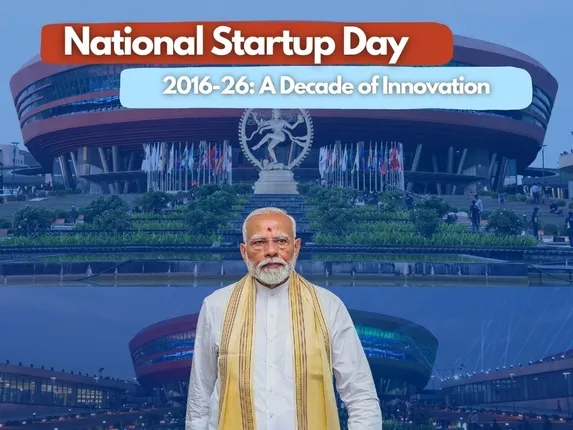
National Startup Day 2026 marked a strategic inflection point for India’s startup ecosystem as Prime Minister Narendra Modi used the decade milestone to outline how innovation policy will evolve beyond scale and valuations toward resilience, global competitiveness, and deep technology leadership.
The event positioned National Startup Day 2026 not as a celebratory checkpoint but as a policy reset moment. With India now home to one of the world’s largest startup bases, the messaging focused on course correction, capital efficiency, and long-term value creation rather than headline unicorn counts.
A decade of Startup India and why 2026 matters
National Startup Day was instituted to commemorate the launch of the Startup India initiative in 2016. Ten years on, the ecosystem has moved from scarcity to scale. India now has hundreds of thousands of registered startups, a mature angel network, and global venture capital participation.
At the 2026 celebration, the emphasis was clear. The early phase was about enabling entry, easing compliance, and unlocking capital. The next phase is about quality, sustainability, and strategic relevance. The Prime Minister’s remarks framed this shift as essential for India’s broader economic ambition rather than just startup success.
This context matters because policy signals at this stage influence capital allocation, founder behaviour, and institutional participation across the ecosystem.
PM Modi’s innovation policy signals to founders and investors
PM Modi’s address framed innovation as a national capability rather than a sectoral activity. He highlighted startups as contributors to manufacturing, defence, climate technology, agriculture, and public infrastructure, not just consumer internet or fintech.
A key signal was the renewed push for deep-tech startups. Artificial intelligence, semiconductors, space technology, biotechnology, and clean energy were positioned as priority areas where startups will receive policy backing and institutional support. This aligns with India’s broader industrial and strategic goals rather than short-term market trends.
For investors, the message was equally direct. The next decade rewards patient capital, technology depth, and global relevance. Quick scale without fundamentals was implicitly discouraged, reflecting lessons from recent funding cycles.
Shifting from valuation focus to value creation
One of the strongest undertones at National Startup Day 2026 was the shift away from valuation-led narratives. The Prime Minister stressed value creation, governance, and ethical entrepreneurship, signalling that policy support will increasingly favour companies building durable businesses.
This reflects a broader reset already underway in the ecosystem. Funding has become more selective, public markets have raised the bar for listings, and founders are under pressure to demonstrate unit economics and profitability paths.
Policy alignment with this reality reduces friction between startups, regulators, and capital markets. It also prepares younger founders for a more disciplined operating environment.
Government role in the next startup growth cycle
The government’s role, as framed at the event, is evolving from enabler to strategic partner. Instead of only simplifying compliance, the focus is on procurement access, research collaboration, and integration with national missions.
Startups were encouraged to work with public sector undertakings, defence establishments, and state governments. This is significant because government procurement remains one of the largest untapped growth channels for Indian startups, especially in enterprise and infrastructure technology.
The emphasis on domestic innovation solving Indian-scale problems also signals continuity with self-reliance goals, while still encouraging global expansion.
Implications for India’s startup ecosystem in 2026 and beyond
For founders, National Startup Day 2026 reinforced the importance of alignment with national priorities and long-term thinking. Consumer-facing plays will continue, but policy momentum is clearly behind startups that build core technology, intellectual property, and export capability.
For accelerators and incubators, the next phase demands stronger technical mentorship and research linkages rather than only pitch readiness. For state governments, the signal is to deepen regional startup ecosystems beyond metro hubs.
The event also underscored the role of youth entrepreneurship, positioning startups as a mainstream career path rather than an elite urban pursuit. This broadening of participation is central to sustaining scale over the next decade.
Why this policy messaging matters right now
The timing of National Startup Day 2026 is important. Global capital conditions remain selective, technology cycles are maturing, and geopolitical shifts are reshaping supply chains. India’s innovation policy needs to respond to these realities, not past successes.
By framing the next phase around depth, discipline, and national relevance, the government is attempting to future-proof the ecosystem. Whether execution matches intent will determine how India’s startup story evolves from volume to value.
Takeaways
- National Startup Day 2026 marked a shift from celebration to strategic reset
- Policy focus is moving toward deep-tech, sustainability, and global competitiveness
- Valuation-led growth is giving way to value creation and governance discipline
- Government aims to act as a strategic partner, not just a facilitator
FAQs
What is National Startup Day and why is it observed?
National Startup Day commemorates the launch of the Startup India initiative and recognises the role of startups in India’s economic development.
What was the key message from PM Modi at National Startup Day 2026?
The focus was on the next phase of innovation policy centred on deep technology, resilience, and long-term value creation.
Which sectors are likely to benefit most from the new innovation focus?
Deep-tech areas such as artificial intelligence, clean energy, space technology, biotechnology, and advanced manufacturing are expected to see increased support.
How does this impact startup funding and growth strategies?
Founders and investors are being nudged toward sustainable growth models, stronger fundamentals, and alignment with national priorities.