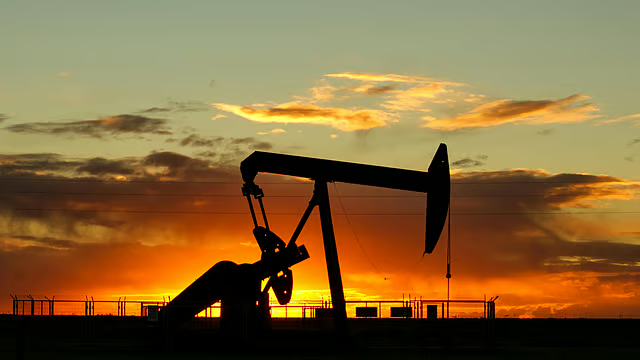
Oil prices jump again as disruption concerns around the Strait of Hormuz intensify, raising global supply fears and triggering volatility across energy markets. The development is pushing governments and investors to reassess risk exposure and energy security strategies.
Oil prices jump again as Hormuz disruption fuels supply fears, reflecting how critical chokepoints influence global energy markets. With a significant portion of the world’s oil passing through this route, even partial disruptions are enough to trigger sharp price reactions and market uncertainty.
Strait of Hormuz Disruption Raises Global Energy Concerns
The Strait of Hormuz is one of the most strategically important oil transit routes in the world. A large share of global crude exports flows through this narrow passage connecting the Persian Gulf to international markets.
Any disruption in this region immediately impacts supply expectations. Recent tensions and operational risks in the area have raised concerns about potential delays or restrictions in oil shipments.
Markets react quickly to such signals because supply disruptions can tighten availability within days. Even without a complete shutdown, increased risk premiums are added to oil prices, pushing them higher.
This explains the latest surge in crude prices, as traders factor in uncertainty and potential supply constraints.
Supply Shock Risks Drive Crude Oil Volatility
Oil markets are highly sensitive to supply side disruptions. When key routes like Hormuz face instability, it creates a perceived supply shock, even if actual production levels remain unchanged.
Producers in the Middle East account for a substantial portion of global oil exports. If shipments are delayed or rerouted, it increases transportation costs and delivery timelines.
Insurance premiums for oil tankers also rise during geopolitical tensions. This adds another layer of cost, which eventually reflects in global oil pricing.
The current situation has introduced significant volatility, with prices reacting sharply to every development related to the region. Traders are closely monitoring geopolitical signals and adjusting positions accordingly.
Impact on Global Economy and Inflation Outlook
Rising oil prices have a direct impact on global inflation. Energy costs influence transportation, manufacturing, and supply chains, making oil a key driver of price stability.
Countries that rely heavily on oil imports, such as India, face additional pressure. Higher import bills can widen trade deficits and weaken currencies, creating broader economic challenges.
For consumers, this often translates into higher fuel prices and increased cost of goods. Businesses also face margin pressure as input costs rise.
Central banks may need to reassess their policy stance if oil driven inflation persists. This could influence interest rates and economic growth projections across regions.
Market Reaction Across Equities and Commodities
The surge in oil prices is not limited to the energy sector. It is influencing broader financial markets, including equities and commodities.
Energy stocks tend to benefit from higher crude prices, as revenues and margins improve. However, sectors such as aviation, logistics, and manufacturing face negative impact due to rising fuel costs.
Stock markets often show mixed reactions in such scenarios. Gains in oil and gas companies are offset by declines in sectors sensitive to input costs.
Commodity markets are also reacting, with related assets such as natural gas and metals experiencing price movements linked to energy trends. Investors are reallocating capital based on risk and opportunity.
Strategic Response from Governments and Industry
Governments are closely monitoring the situation and preparing contingency measures. Strategic petroleum reserves may be used to stabilize supply in case of prolonged disruption.
Some countries are also exploring alternative supply routes and diversifying energy sources. This includes increasing imports from different regions and investing in renewable energy to reduce dependence on oil.
Energy companies are adjusting logistics and supply chains to manage risks. Rerouting shipments and increasing inventory levels are common strategies during such disruptions.
The current situation highlights the importance of energy security and the need for long term diversification.
Outlook Remains Uncertain Amid Geopolitical Risks
The future trajectory of oil prices depends largely on how the situation in the Strait of Hormuz evolves. If tensions escalate, prices could rise further due to tighter supply expectations.
On the other hand, any de escalation or diplomatic resolution may stabilize markets and reduce risk premiums. However, uncertainty is likely to persist in the near term.
Investors and policymakers are expected to remain cautious, closely tracking developments in the region. The situation serves as a reminder of how geopolitical events can quickly reshape global markets.
Takeaways
• Oil prices are rising due to supply fears linked to Hormuz disruption
• The Strait of Hormuz is a critical global oil transit route
• Higher oil prices increase inflation and impact import dependent economies
• Market volatility is expected to continue amid geopolitical uncertainty
FAQs
Why are oil prices rising again?
Oil prices are increasing due to supply concerns related to disruptions in the Strait of Hormuz, a key global oil transit route.
Why is the Strait of Hormuz important?
It handles a large share of global oil shipments, making it critical for maintaining steady energy supply.
How do higher oil prices affect the economy?
They increase inflation, raise transportation costs, and impact business margins and consumer spending.
What could happen next in oil markets?
Prices may remain volatile depending on geopolitical developments and the stability of supply routes.