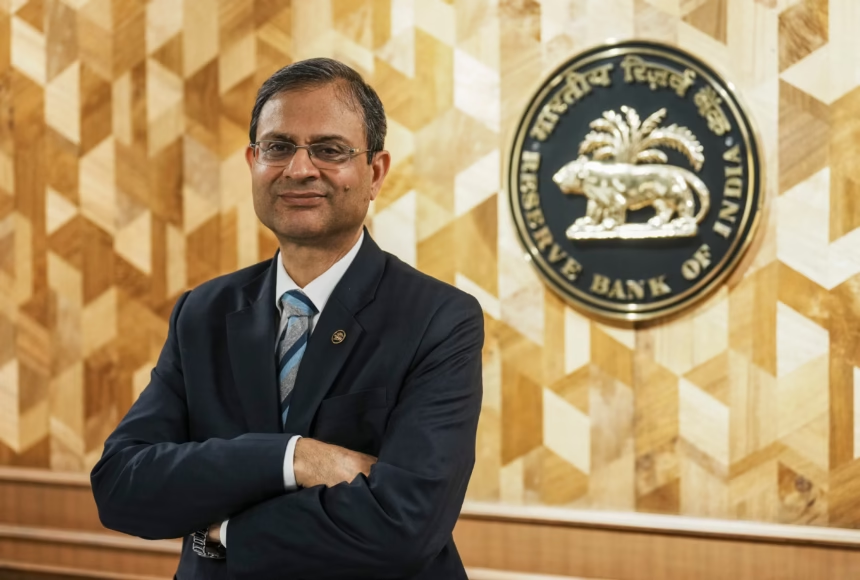
India’s monetary policy outlook turned decisively accommodative after the RBI minutes indicated the possibility of further rate cuts in 2026 amid visible signs of slowing economic growth. The RBI minutes highlight rising concerns around demand softness, easing inflation pressures, and the need to support growth without destabilising financial conditions.
The tone of the minutes suggests a clear shift from inflation control to growth support, marking an important signal for markets, borrowers, and policymakers heading into the next fiscal cycle.
RBI minutes point to growth risks overtaking inflation concerns
The latest RBI minutes show that several members of the Monetary Policy Committee are increasingly focused on downside risks to growth. While inflation has moderated closer to the central bank’s comfort range, domestic demand indicators have softened across consumption and private investment.
Members noted that high real interest rates could begin to weigh more heavily on discretionary spending, small business credit, and capital expenditure if maintained for too long. The RBI minutes reflect an assessment that policy tightness may no longer be proportionate to prevailing macroeconomic conditions.
This shift does not signal an immediate rate cut, but it clearly opens the door for monetary easing if growth indicators continue to weaken in coming quarters.
Inflation trajectory creates room for policy flexibility
A key theme running through the RBI minutes is confidence around inflation management. Food price volatility, which had been a persistent concern earlier, has eased due to improved supply conditions and policy interventions. Core inflation remains stable, giving policymakers additional comfort.
The committee acknowledged that while inflation risks cannot be ignored, the balance of risks is no longer skewed sharply upward. This creates policy space to respond to growth slowdown signals without undermining price stability.
The RBI minutes emphasise that future decisions will remain data dependent, but the tone suggests that inflation is no longer the binding constraint it was in earlier policy cycles.
Slowing growth signals shape the 2026 outlook
Growth moderation featured prominently in the discussion captured in the RBI minutes. Members flagged slower rural demand recovery, uneven urban consumption, and cautious corporate investment sentiment. Export oriented sectors also face uncertainty due to weak global demand and tighter financial conditions in major economies.
Credit growth, while still healthy in headline terms, is showing early signs of moderation in select segments. The RBI minutes note that sustaining growth momentum may require proactive policy support rather than prolonged restraint.
This assessment frames 2026 as a year where monetary policy could play a stabilising role rather than acting as a brake on economic activity.
Implications for borrowers, markets, and banks
The possibility of rate cuts in 2026 carries direct implications across the economy. For borrowers, especially in housing and MSME segments, expectations of lower interest rates could revive credit demand. Banks may see margin pressures ease if borrowing costs fall gradually while asset quality remains stable.
Equity markets typically respond positively to signals of monetary easing, particularly rate sensitive sectors such as real estate, automobiles, and infrastructure. Bond markets are also likely to price in a softer rate trajectory, leading to lower yields if growth data continues to disappoint.
The RBI minutes, however, caution against premature optimism. Any easing cycle would likely be gradual and calibrated rather than aggressive.
How RBI balances credibility with growth support
A critical challenge for the central bank highlighted in the RBI minutes is maintaining policy credibility. After a prolonged period of inflation vigilance, the RBI must ensure that any pivot toward easing does not reignite price pressures or destabilise currency markets.
The committee stressed the importance of clear communication and predictable policy actions. Forward guidance remains cautious, signalling intent without committing to a fixed path.
This approach allows the RBI to retain flexibility while anchoring expectations, a key requirement as global financial conditions remain uncertain.
Broader policy context and fiscal alignment
The RBI minutes also indirectly reflect coordination with fiscal policy. With government spending expected to play a larger role in supporting growth, monetary easing could complement fiscal measures rather than substitute for them.
Lower rates in 2026 would ease borrowing costs for both the government and the private sector, supporting infrastructure spending and crowding in private investment. However, the central bank remains mindful of fiscal discipline and debt sustainability.
This alignment underscores a broader macro strategy aimed at sustaining medium term growth while preserving financial stability.
What to watch going forward
The RBI minutes make it clear that incoming data will drive future decisions. Inflation prints, GDP growth trends, credit flows, and global monetary developments will all influence the policy stance.
Any sharp deterioration in growth indicators could accelerate the shift toward easing, while renewed inflation shocks could delay it. Markets and businesses should therefore view the 2026 rate cut possibility as a conditional signal rather than a guaranteed outcome.
The message from the RBI minutes is clear. The policy stance is evolving, and growth considerations are now firmly back at the centre of monetary decision making.
Takeaways
- RBI minutes indicate growing comfort with inflation and rising concern over slowing growth
- Scope for rate cuts in 2026 has opened, though no immediate action is signalled
- Borrowers and markets may benefit from a gradual easing cycle if growth weakens further
- Policy decisions will remain data driven and cautiously communicated
FAQs
Do the RBI minutes confirm rate cuts in 2026?
No. They indicate the possibility of cuts if growth slows further, but no fixed timeline is committed.
Why is the RBI shifting focus from inflation to growth?
Inflation has moderated while demand and investment signals have softened, requiring a policy rebalancing.
How could rate cuts impact consumers and businesses?
Lower rates would reduce borrowing costs, potentially boosting consumption, housing demand, and business investment.
Will easing be aggressive if it happens?
Unlikely. The RBI has signalled a gradual and calibrated approach to preserve stability.