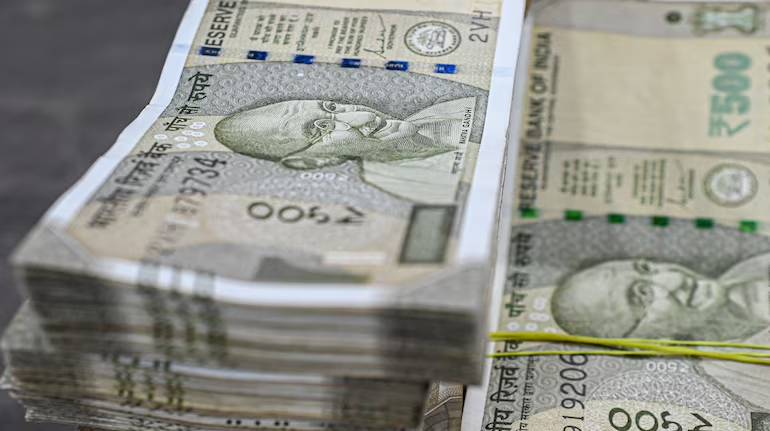
The rupee slide has triggered fresh concern among economists, with warnings that the currency could weaken toward the ₹100 per dollar mark if global pressures persist. Rising oil prices, capital outflows, and a strong dollar are driving the current depreciation trend.
Rupee Slide Raises Alarm Across Financial Markets
The rupee slide has become a key concern for policymakers and market participants as the currency weakens against the US dollar. Recent movements in the foreign exchange market reflect a combination of global and domestic pressures.
A stronger US dollar, driven by elevated interest rates and safe-haven demand, has made emerging market currencies more vulnerable. The Indian rupee is no exception. As investors shift capital toward dollar-denominated assets, currencies like the rupee face downward pressure.
Economists are increasingly discussing the possibility of the rupee approaching ₹100 per dollar. While this is not an immediate base-case scenario, the discussion highlights the level of concern in financial circles.
Key Drivers Behind Rupee Depreciation Trend
Several factors are contributing to the rupee depreciation trend. One of the most significant is the rise in global crude oil prices. India imports a large share of its oil requirements, and higher prices increase demand for dollars to pay for imports.
This widens the current account deficit and puts pressure on the currency. At the same time, global risk aversion is leading to capital outflows from emerging markets, including India.
Another important factor is the interest rate differential between the US and India. When US interest rates remain high, global investors find US assets more attractive, leading to capital movement away from emerging economies.
Domestic factors such as inflation expectations and trade balances also play a role in influencing currency movements.
Impact of ₹100 Per Dollar Scenario on Economy
A potential ₹100 per dollar scenario would have wide-ranging implications for the Indian economy. One of the immediate effects would be higher import costs. Essential imports such as crude oil, electronics, and machinery would become more expensive.
This would contribute to inflation, as higher input costs are passed on to consumers. Fuel prices, in particular, could rise, affecting transportation and logistics costs across sectors.
However, there are also some positive effects. Export-oriented sectors such as IT services, pharmaceuticals, and textiles may benefit from a weaker rupee, as their earnings in dollars translate into higher rupee revenues.
The overall impact depends on the balance between higher import costs and export gains.
RBI Intervention and Currency Management Strategy
The Reserve Bank of India plays a crucial role in managing currency volatility. While the rupee operates under a market-determined exchange rate system, the RBI intervenes when movements become excessive or disruptive.
Intervention typically involves selling foreign exchange reserves to stabilize the currency. India holds substantial forex reserves, which provide a buffer against sharp volatility.
However, continuous intervention is not always sustainable. The RBI must balance currency stability with reserve management and broader monetary policy objectives.
In addition to direct intervention, the central bank may use policy tools such as interest rate adjustments or liquidity measures to influence currency movements.
Global Factors Influencing Rupee Movement
Global economic conditions are a major driver of the rupee’s trajectory. The strength of the US dollar, global interest rate cycles, and geopolitical developments all play a role.
Recent geopolitical tensions, especially in energy-producing regions, have contributed to higher oil prices and increased uncertainty. This has strengthened the dollar and put pressure on emerging market currencies.
Additionally, global investors are becoming more cautious, leading to reduced capital flows into riskier markets. This trend can further weaken currencies like the rupee.
The interplay of these global factors makes currency forecasting complex and subject to rapid changes.
Key Takeaways
- The rupee slide is driven by rising oil prices, capital outflows, and a strong US dollar
- Economists are warning about the possibility of the rupee approaching ₹100 per dollar
- A weaker rupee increases import costs and inflation but may support exports
- RBI intervention and global economic trends will determine the currency’s direction
FAQs
Q1. Why is the rupee weakening against the dollar?
The rupee is weakening due to higher crude oil prices, capital outflows, and a stronger US dollar driven by global economic conditions.
Q2. Is ₹100 per dollar a realistic scenario?
It is not an immediate certainty, but economists consider it a possible scenario if current pressures persist.
Q3. How does a weaker rupee affect consumers?
It can lead to higher prices for imported goods and fuel, contributing to inflation.
Q4. Can the RBI stop the rupee from falling?
The RBI can manage volatility through interventions and policy measures, but it cannot fully control market-driven currency movements.