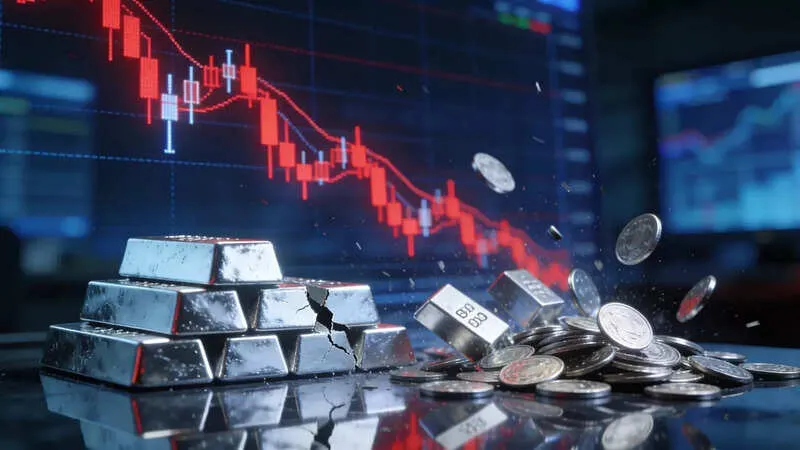
Silver price plunge dominated commodities trading sessions ahead of the New Year as traders booked profits after a strong run up. The sharp pullback reflects a broader reset in macro hedges, with participants reducing exposure amid thin liquidity and shifting risk expectations.
The silver price plunge came despite no sudden deterioration in physical demand. Instead, the move was driven by positioning, year end adjustments, and a recalibration of macro assumptions that had previously supported higher precious metal prices.
Profit taking drives sharp silver price correction
The primary trigger behind the silver price plunge was aggressive profit taking. Silver had rallied strongly in recent weeks, supported by expectations of easing monetary conditions, a softer dollar, and its dual role as both precious and industrial metal.
As the calendar year drew to a close, traders chose to lock in gains rather than carry elevated positions into January. This behavior is common in commodities, where mark to market volatility can impact balance sheets sharply during low liquidity periods.
Once initial selling began, stop losses were triggered, accelerating the decline. Thin volumes amplified the move, creating an outsized price reaction relative to changes in underlying fundamentals.
Macro hedge unwinding weighs on precious metals
Silver often functions as a macro hedge against inflation, currency debasement, and geopolitical uncertainty. Over the past quarter, hedge positions had built up as investors sought protection against global economic risks.
The recent plunge signals a partial unwinding of these hedges. With some macro fears easing and traders reassessing the pace of future policy shifts, the urgency to hold defensive metal exposure has declined temporarily.
Gold prices also softened, though silver’s higher volatility made its correction more pronounced. This divergence highlights silver’s sensitivity to speculative flows compared to gold’s role as a more stable store of value.
Industrial demand expectations add complexity
Unlike gold, silver is heavily linked to industrial demand, including electronics, solar panels, and automotive components. Expectations around industrial activity play a significant role in shaping price trends.
As the year end approaches, some traders have tempered near term industrial demand forecasts, particularly in regions facing slower manufacturing momentum. This reassessment added to the bearish bias, even though long term demand drivers remain intact.
The market is also factoring in inventory levels and supply flows. While no supply shock has emerged, adequate availability has reduced urgency among buyers, allowing prices to correct without immediate resistance.
How commodities traders are repositioning into January
The silver price plunge has prompted traders to rebalance portfolios rather than exit the metal entirely. Many are reducing leverage, shifting from directional bets to options based strategies that limit downside risk.
Some funds are rotating into other commodities where risk reward appears more favorable, while maintaining smaller core silver positions as a hedge. This repositioning reflects caution rather than a structural bearish view.
Physical market participants, including jewelers and industrial buyers, are monitoring price levels closely. Corrections often revive buying interest, especially if prices stabilize near technical support zones.
Currency movements and interest rate outlook influence silver
Currency dynamics play a critical role in precious metals pricing. Recent fluctuations in the US dollar index influenced silver’s trajectory, as a firmer dollar tends to pressure dollar denominated commodities.
Interest rate expectations also matter. Silver tends to benefit from lower real rates, which reduce the opportunity cost of holding non yield assets. Any recalibration of rate cut expectations can therefore impact prices quickly.
Ahead of the New Year, traders are adjusting assumptions around central bank actions, leading to reduced conviction in aggressive metal longs. This uncertainty has contributed to the current consolidation phase.
What the correction means for silver’s medium term outlook
The recent plunge does not necessarily signal a trend reversal. Corrections are a natural part of commodities cycles, especially after sharp rallies. For silver, the key question is whether prices find support as speculative selling fades.
If industrial demand remains resilient and macro risks reemerge, silver could regain momentum. Conversely, sustained strength in the dollar or a slowdown in manufacturing could cap near term upside.
Market participants will watch early January trading for clues. Volume normalization and fresh macro data will help determine whether the move was a temporary reset or the start of a deeper correction.
Broader impact on commodities sentiment
Silver’s decline has influenced broader commodities sentiment, reinforcing caution across metals. Traders are becoming more selective, favoring fundamentals over broad macro narratives.
This shift may reduce volatility in the short term but also limits sharp upside moves until conviction rebuilds. For diversified commodity portfolios, the episode underscores the importance of active risk management around calendar transitions.
As markets enter the New Year, silver’s behavior serves as a reminder that positioning can matter as much as fundamentals in driving price action.
Takeaways
- Silver prices fell sharply due to profit taking after a strong rally
- Macro hedge positions were partially unwound ahead of the New Year
- Thin liquidity amplified the price correction
- Medium term outlook depends on industrial demand and macro signals
FAQs
Why did silver prices fall so sharply before the New Year?
Traders booked profits and reduced leveraged positions during low liquidity year end sessions.
Does the plunge indicate weakening silver demand?
Not necessarily. The move was driven more by positioning than by a collapse in physical demand.
How does silver differ from gold in such corrections?
Silver is more volatile due to its industrial use and higher speculative participation.
What should traders watch next for silver prices?
Dollar movements, interest rate expectations, and early January industrial data will be key.